

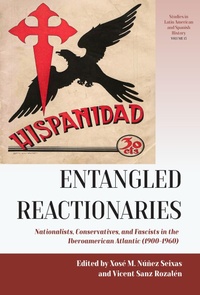
Entangled Reactionaries
Description

Between 1898 and 1939, Spain saw the emergence of political and social identities shaped by the concepts of Hispanidad, Catholicism, race, tradition and the Spanish language. Rooted in 19th-century conservative thought, these ideas evolved through intellectual debate and ideological conflict with liberal and left-wing currents. This book explores how such identities were reshaped during Spain's major political shifts and how they intersected with Latin American discourses. By examining both state-led initiatives and grassroots movements, it offers a dual perspective on the nationalization of the masses and the construction of Spanish and Iberian social and political identities.
More details
Persons
Xosé M. Núñez Seixas obtained his PhD from the EUI Florence and is a professor of modern and contemporary history at the University of Santiago de Compostela. His research interests span the comparative and transnational history of nationalism and territorial identity, the memory of twenty-century dictatorships, and the social and cultural history of war and violence. His latest books are The Spanish Blue Division on the Eastern Front (1941-1945): War, Occupation, Memory (Toronto, 2022); Beyond Folklore? The Franco Regime and Ethnoterritorial Diversity in Spain (London, 2024), and The Eastern Front and European Memory: On Victims and Heroes, 1945-2024 (London, 2025).
Content
Introduction: Entangled Reactionaries across the Atlantic
Xosé M. Núñez Seixas and Vicent Sanz Rozalén
Chapter 1. Intertwined Projects: Hispanicisms and Latinisms in the Spanish and Argentinian Right Wing During the Interwar Period
Maximiliano Fuentes Codera
Chapter 2. Leopoldo Lugones: Reflections on an intellectual, poet, and politician between Europe and Argentina
Fernando J. Devoto
Chapter 3. Italian Fascism's Perceptions of Argentina (1920s-1930s)
Federica Bertagna
Chapter 4. Fascism Beyond European Borders: The Brazilian Integralist Action
Gabriela de Lima Grecco
Chapter 5. Brazilian Fascism and the Three Integralist Leaders: Catholicism, Anti-Semitism, Corporatism
Leandro Pereira Gonçalves and Gabriela Santi Pacheco
Chapter 6. Antisemitism in 1930s Mexico: New Robes for an Old Prejudice
Andrea Acle-Kreysing
Chapter 7. 'The Return to Hierarchical Principles': Chilean Conservative Visions of the 'crisis of social order', 1891-1948
Claudio Llanos and Raúl Burgos
Chapter 8. The Reactionary Discourse of the Spanish 'Generation of 1948'
Sara Prades
Chapter 9. Iberian Substate Nationalisms and Latin America, 1898-1936: Reframing Hispanidad?
Xosé M. Núñez Seixas
Bibliography
Index
