

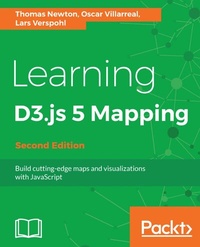
Learning D3.js 5 Mapping
Build cutting-edge maps and visualizations with JavaScript
2nd Edition
Published on 8. July 2025
298 pages
978-1-78728-425-8 (ISBN)
Description

No detailed description available for "Learning D3.js 5 Mapping".
More details
Edition
2nd Revised edition
Language
English
Place of publication
Birmingham
United Kingdom
Target group
Professional and scholarly
US School Grade: College Graduate Student
Edition type
Revised edition
File size
28,31 MB
ISBN-13
978-1-78728-425-8 (9781787284258)
Copyright in bibliographic data and cover images is held by Nielsen Book Services Limited or by the publishers or by their respective licensors: all rights reserved.
Schweitzer Classification
Other editions
Additional editions
Thomas Newton | Oscar Villarreal | Lars Verspohl
Learning D3.js 5 Mapping -
Book
11/2017
2nd Edition
Packt Publishing
€51.10
Shipment within 3-4 weeks
Person
Newton Thomas :
Thomas Newton has over 20 years of experience in software engineering, creating highly scalable and flexible software solutions for clients. During this period, he has developed a broad range of expertise ranging from data visualizations, to large-scale cloud platforms, to continuous delivery and DevOps. When not going in a new technology, he spends time with his beautiful family.Villarreal Oscar :
Oscar Villarreal has been building web applications and visualizations for the past 15 years. He's worked with all kinds of businesses and organizations globally, helping them visualize and interact with data in more meaningful ways. He enjoys spending time with his wife and kid, as well as hanging from the edge of a rock wall when climbing.Verspohl Lars :
Lars Verspohl has been modeling and visualizing data for over 15 years. He works with businesses and organisations from all over the world to turn their often complex data into intelligible interactive visualizations. He also writes and builds stuff at datamake.io. His ideal weekend is spent either at a lake or on a mountain with his kids, although it can be hard to tear them away from the computer games he wrote for them.
Thomas Newton has over 20 years of experience in software engineering, creating highly scalable and flexible software solutions for clients. During this period, he has developed a broad range of expertise ranging from data visualizations, to large-scale cloud platforms, to continuous delivery and DevOps. When not going in a new technology, he spends time with his beautiful family.Villarreal Oscar :
Oscar Villarreal has been building web applications and visualizations for the past 15 years. He's worked with all kinds of businesses and organizations globally, helping them visualize and interact with data in more meaningful ways. He enjoys spending time with his wife and kid, as well as hanging from the edge of a rock wall when climbing.Verspohl Lars :
Lars Verspohl has been modeling and visualizing data for over 15 years. He works with businesses and organisations from all over the world to turn their often complex data into intelligible interactive visualizations. He also writes and builds stuff at datamake.io. His ideal weekend is spent either at a lake or on a mountain with his kids, although it can be hard to tear them away from the computer games he wrote for them.
Content
- Cover
- Title Page
- Copyright
- Credits
- Foreword
- About the Authors
- About the Reviewers
- www.PacktPub.com
- Customer Feedback
- Table of Contents
- Preface
- Chapter 1: Gathering Your Cartography Toolbox
- Quick bootstrap
- Step-by-step bootstrap
- A lightweight web server
- Using the web browser as a development tool
- Installing the sample code
- Working with the developer tools
- Summary
- Chapter 2: Creating Images from Simple Text
- The SVG coordinate system
- Line
- Rectangle
- Circle
- Polygon
- Path
- Experiment
- Paths with curves
- Transform
- Translate
- Scale
- Grouping
- Text
- Summary
- Chapter 3: Producing Graphics from Data - the Foundations of D3
- Creating basic SVG elements
- The enter() function
- The update function
- The exit() function
- Fetch
- Summary
- Chapter 4: Creating a Map
- Foundation - creating your basic map
- Including the dataset
- Experiment 1 - adjusting the bounding box
- Experiment 2 - creating choropleths
- Experiment 3 - adding click events to our visualization
- Experiment 4 - using updates and transitions to enhance our visualization
- Experiment 5 - adding points of interest
- Experiment 6 - adding visualizations as a point of interest
- Summary
- Chapter 5: Click-Click Boom! Applying Interactivity to Your Map
- Events and how they occur
- Experiment 1 - hover events and tooltips
- Experiment 2 - tooltips with visualizations
- Experiment 3 - panning and zooming
- Experiment 4 - orthographic projections
- Experiment 5 - rotating orthographic projections
- Experiment 6 - dragging orthographic projections
- Summary
- Chapter 6: Finding and Working with Geographic Data
- Geodata file types
- What are shapefiles and how do I get them?
- Acquiring shapefiles for a specific country
- GeoJSON
- A quick map in D3 with only GeoJSON
- TopoJSON basics
- TopoJSON command-line tips
- Simplification
- Merging files
- Summary
- Chapter 7: Testing
- Code organization and reusable assets
- Project structure
- Exploring the code directory
- Other administrative files
- Writing testable code
- Keeping methods/functions small
- Preventing side effects
- An example with viz.js
- Unit testing
- Creating resilient visualization code
- Adding a new test case
- Summary
- Chapter 8: Drawing with Canvas and D3
- Introducing Canvas
- Drawing with Canvas
- The three drawing steps of every Canvas visual
- Drawing various shapes with Canvas
- Animating the Canvas
- Animating the Canvas way
- Getting a general overview
- Preparing the rain data
- Updating each drop
- Drawing frame by frame
- Canvas and D3
- Getting an overview of our experiment
- The data
- Updating each drop
- Binding the data
- Drawing the data
- Running the app
- Summary
- Chapter 9: Mapping with Canvas and D3
- Choosing Canvas or SVG
- Reasons to choose SVG
- Reasons to choose Canvas
- Visualizing flight paths with Canvas and D3
- The data
- Building the flight path map in SVG
- Measuring the performance
- Building the flight path map in Canvas
- Setting up the map
- Drawing the map and listening for user input
- Preparing and drawing with Canvas
- Drawing the background scene
- Defining the planes
- Calculating the plane's positions
- Animating the plane
- Measuring the performance
- Optimizing performance
- Continuing with measuring performance
- Summary
- Chapter 10: Adding Interactivity to Your Canvas Map
- Why Canvas interaction is different
- Drawing the world on a Canvas
- Setting up
- Drawing the world
- Making the world move
- Setting up the behavior
- Handling zoom and rotation
- Finding the Canvas object under the mouse - Picking
- Picking, the theory
- Creating all things hidden
- Drawing the hidden Canvas
- Picking the values
- Storing more data and using a lookup array
- Highlighting the country on mouse over
- Visualizing data per country and adding a tooltip
- Adding new data to our old globe
- Coloring the globe
- Adding a tooltip
- The HTML
- Building the static parts of the tooltip
- Showing and hiding the tooltip
- Summary
- Chapter 11: Shaping Maps with Data - Hexbin Maps
- Reviewing map visualization techniques
- Choropleth maps
- Cartograms
- Dot density maps
- Value and use of the hexagon
- Making a hexbin map
- Reviewing the hexbin algorithm
- Setting it up
- Drawing the map
- Drawing a point grid for our hexagons
- Keeping only the points within the map
- Making the hex tile
- Retrieving the hexagon center points
- Drawing the hex tiles
- Joining data points to the layout points
- Dressing our data for the final act
- Turning our visual into an interactive app
- Adding additional information on hover and click
- Changing the hexagon size
- Changing the color scale interpolator
- Browsing different datasets
- Encoding data as hexagon size
- Summary
- Chapter 12: Publishing Your Visualization with GitHub Pages
- What we will publish
- Understanding the type of content you can publish
- Hosting your code on GitHub
- Making sense of some key terms and concepts
- Tracking historic changes of your files
- Collaborating on a project
- Working on project branches
- Setting up a GitHub account
- Creating a repository
- Editing a file on GitHub
- Uploading files to the repository
- Publishing your project on GitHub Pages
- Preparing the files for publishing
- Keeping your paths absolute
- Changing the main HTML filename to index.html
- Publishing your project
- Summary
- Index
