

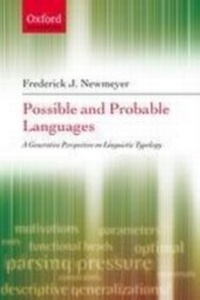
Possible and Probable Languages
A Generative Perspective on Linguistic Typology
1st Edition
Published on 13. October 2005
289 pages
978-0-19-153440-9 (ISBN)
Description

In this important and pioneering book Frederick Newmeyer takes on the question of language variety. He considers why some language types are impossible and why some grammatical features are more common than others. The task of trying to explain typological variation among languages has been mainly undertaken by functionally-oriented linguists. Generative grammarians entering the field of typology in the 1980s put forward the idea that cross-linguistic differences could be explained by linguistic parameters within Universal Grammar, whose operation might vary from language to language. Unfortunately, this way of looking at variation turned out to be much less successful than had been hoped for. Professor Newmeyer's alternative to parameters combines leading ideas from functionalist and formalist approaches which in the past have been considered incompatible. He throws fresh light on language typology and variation, and provides new insights into the principles of Universal Grammar. The book is written in a clear, readable style and will be readily understood by anyone with a couple of years' study of linguistics. It will interest a wide range of scholars and students of language, including typologists, historical linguists, and theorists of every shade.
More details
Other editions
Additional editions
Frederick J. Newmeyer
Possible and Probable Languages
A Generative Perspective on Linguistic Typology
Book
10/2005
Oxford University Press
€97.70
Shipment within 15-20 days
Frederick J. Newmeyer
Possible and Probable Languages
A Generative Perspective on Linguistic Typology
Book
10/2005
Oxford University Press
€79.40
Shipment within 15-20 days
Content
- Intro
- Contents
- Preface
- 1 On the Possible and the Probable in Language
- 1.1 Introduction
- 1.2 Possible human languages
- 1.2.1 Formalists and functionalists on the notion 'possible human language'
- 1.2.2 The problem of knowing what is possible
- 1.2.3 Teaching 'impossible' grammars
- 1.2.4 The problem of explaining what is possible
- 1.3 Probable and improbable human languages
- 1.4 Two methodological approaches to capturing typological generalizations
- 1.5 Conclusion
- 2 Parameterized Principles
- 2.1 Introduction
- 2.2 Early generative syntactic typology
- 2.2.1 Syntactic typology and markedness theory
- 2.2.2 Deep structure and typological consistency
- 2.2.3 UG principles and the solution of typological problems
- 2.3 The Government-Binding program for capturing parametric variation
- 2.3.1 Luigi Rizzi and the parameterization of Subjacency
- 2.3.2 The Government-Binding program and typology
- 2.3.3 Some examples of GB parameters
- 2.3.4 Predicting the clustering of typological properties
- 2.3.5 The typological implications of the core versus periphery distinction
- 2.3.6 Markedness relations within core grammar and typological inconsistency
- 2.3.7 Mark Baker's Parameter Hierarchy
- 2.3.8 Constraints on possible parameters
- 2.4 Parameters and typology in the Minimalist Program
- 2.4.1 Minimalist mechanisms and typology
- 2.4.2 Kayne's antisymmetric program and typology
- 2.4.3 Microparameters
- 2.4.4 Summary
- 2.5 Parameters, typology, and language acquisition
- 2.6 Parameters, typology, and language change
- 2.7 Conclusion
- 3 Parameters, Performance, and the Explanation of Typological Generalizations
- 3.1 Introduction
- 3.2 Against a parametric approach to grammar
- 3.2.1 The 'standard story' on the superiority of the parametric approach
- 3.2.2 The deficiencies of parameter-setting models
- 3.3 The irrelevance of typology for grammatical theory
- 3.3.1 Typologically and linguistically significant generalizations
- 3.3.2 Robust typological generalizations do not fall out from UG principles
- 3.3.3 Typological generalizations are not reliably D-structure generalizations
- 3.3.4 Simpler grammars are not necessarily more common grammars: The case of preposition-stranding
- 3.3.5 Typological generalizations and 'knowledge of language'
- 3.4 Hawkins's processing-based explanation of cross-linguistic variation
- 3.4.1 Grammar as a conventionalization of performance preferences
- 3.4.2 Efficiency and complexity in grammar
- 3.5 Conclusion
- 4 In Defense of the Saussurean View of Grammar
- 4.1 Introduction
- 4.2 Usage-based models of grammar
- 4.3 The appeal of usage-based models
- 4.4 Functional explanation is fully compatible with formal generative grammar
- 4.5 Connectionism and usage-based models of grammar
- 4.6 Full grammatical structure is cognitively represented
- 4.6.1 A typology-based argument for full argument structure
- 4.6.2 Matthew Dryer on the question of canonical word order
- 4.6.3 Get again
- 4.6.4 Ellipsis and full argument structure
- 4.6.5 Evidence against usage-based models from child speech
- 4.6.6 Evidence against usage-based models from little-used sentences and from introspective judgments
- 4.7 The mental grammar is only one of many systems that drive usage
- 4.8 Grammars are not tailor-made to serve language users' 'needs'
- 4.9 Pressure to reduce ambiguity is not an important factor in language
- 4.9.1 The reflexive-person generalization
- 4.9.2 Differential object marking
- 4.9.3 Subject-object ordering
- 4.9.4 Acceptable ambiguity in Modern Irish
- 4.9.5 Summary
- 4.10 Some arguments against stochastic grammars
- 4.11 Grammars are not fragile, fluid, and temporary
- 4.12 The evolutionary origins of grammar lie in conceptual structure, not in communication
- 4.12.1 The mainstream position on the evolution of language
- 4.12.2 A three-stage process in language evolution
- 4.13 Conclusion
- 5 The Locus of Functional Explanation
- 5.1 Introduction
- 5.2 Two views of the form-function interface
- 5.3 Some problems in deciding between atomistic and holistic functionalism
- 5.3.1 On the content of the claim that grammatical processes are linked to functional motivations
- 5.3.2 Atomistic functionalism and psycholinguistic experimentation
- 5.4 Language change as a testing ground for atomistic and holistic functionalism
- 5.4.1 Atomistic functionalism at the synchronic and diachronic level
- 5.4.2 Retention
- 5.4.3 Propagation
- 5.4.4 Innovation
- 5.5 Some further difficulties with atomistic functionalism
- 5.5.1 The overgeneralization of functionally motivated principles
- 5.5.2 Dysfunctional consequences of functionally motivated principles
- 5.5.3 The problem posed by competing motivations
- 5.6 More on Optimality Theory, functional explanation, and typology
- 5.6.1 Optimality-theoretic syntax
- 5.6.2 Standard OT sheds no light on typology
- 5.6.3 Functionally based Optimality Theory
- 5.6.4 The failure of functionally based Optimality Theory
- 5.6.5 Summary
- 5.7 Conclusion
- Afterword
- References
- Index
- A
- B
- C
- D
- E
- F
- G
- H
- I
- J
- K
- L
- M
- N
- O
- P
- Q
- R
- S
- T
- U
- V
- W
- X
- Y
- Z
