

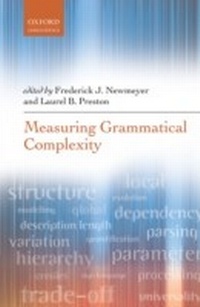
Measuring Grammatical Complexity
1st Edition
Published on 30. October 2014
384 pages
978-0-19-150844-8 (ISBN)
Description

This book examines the question of whether languages can differ in grammatical complexity and, if so, how relative complexity differences might be measured. The volume differs from others devoted to the question of complexity in language in that the authors all approach the problem from the point of view of formal grammatical theory, psycholinguistics, or neurolinguistics. Chapters investigate a number of key issues in grammatical complexity, taking phonological, morphological, syntactic, and semantic considerations into account. These include what is often called the 'trade-off problem', namely whether complexity in one grammatical component is necessarily balanced by simplicity in another; and the question of interpretive complexity, that is, whether and how one might measure the difficulty for the hearer in assigning meaning to an utterance and how such complexity might be factored in to an overall complexity assessment.
Measuring Grammatical Complexity brings together a number of distinguished scholars in the field, and will be of interest to linguists of all theoretical stripes from advanced undergraduate level upwards, particularly those working in the areas of morphosyntax, psycholinguistics, neurolinguistics, and cognitive linguistics.
More details
Other editions
Additional editions
Frederick J. Newmeyer | Laurel B. Preston
Measuring Grammatical Complexity
Book
10/2014
Oxford University Press
€157.85
Shipment within 15-20 days

Frederick J. Newmeyer | Laurel B. Preston
Measuring Grammatical Complexity
Software
10/2014
Oxford University Press, USA
€117.66
Article exhausted; check different version
Persons
Frederick J. Newmeyer specializes in syntax and the history of linguistics and has as his current research program the attempt to synthesize the results of formal and functional linguistics. He was Secretary-Treasurer of the Linguistic Society of America (LSA) from 1989 to 1994 and its President in 2002. He has been elected Fellow of the LSA and the American Association for the Advancement of Science. In 2011 he received a Mellon Foundation Fellowship for Emeritus Faculty.
Laurel B. Preston is a graduate student in the Department of Linguistics at the University of Washington, Seattle. Her research interests include temporal semantics, with particular attention to the temporal interpretation of nouns, and adult second language acquisition. Her current work investigates poverty-of-the-stimulus problems in second language acquisition.
Content
- 1: Frederick J. Newmeyer and Laurel B. Preston: Introduction
- 2: John A. Hawkins: Major Contributions from Formal Linguistics to the Complexity Debate
- 3: David Gil: Sign languages, Creoles, and the Development of Predication
- 4: Ray Jackendoff and Eva Wittenberg: What You Can Say Without Syntax: A hierarchy of grammatical complexity
- 5: Ljiljana Progovac: Degrees of Complexity in Syntax: A view from evolution
- 6: Theresa Biberauer, Ian Roberts, Michelle Sheehan, and Anders Holmberg: Complexity in comparative Syntax: The view from modern parametric theory
- 7: Andreas Trotzke and Jan-Wouter Zwart: The Complexity of Narrow Syntax: Minimalism, representational economy, and simplest merge
- 8: Peter W. Culicover: Constructions, Complexity, and Word Order Variation
- 9: Kaius Sinnemäki: Complexity Trade-offs: A case study
- 10: Daniel Ross: The Importance of Exhaustive Description in Measuring Linguistic Complexity: The case of English try and pseudocoordination
- 11: Steven Moran and Damián Blasi: Cross-linguistic Comparison of Complexity Measures in Phonological Systems
- 12: Lisa Matthewson: The Measurement of Semantic Complexity: How to get by if your language lacks generalized quantifiers
- 13: Cristiano Chesi and ANdrea Moro: Computational Complexity in the Brain
- 14: Lise Menn and Cecily Jill Duffield: Looking for a 'Gold Standard' to Measure language Complexity: What psycholinguistics and neurolinguistics can (and cannot) offer to formal linguistics
- References
- Index
