

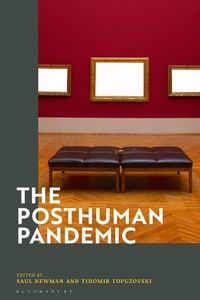
The Posthuman Pandemic
1st Edition
Published on 30. December 2021
264 pages
978-1-350-23907-4 (ISBN)
Description

With the COVID-19 crisis forcing us to reflect in a dramatic way on the limits of the human and the implications of the Anthropocene Age, this timely volume addresses these concerns through an exploration of post-humanism as represented in philosophy, politics and aesthetics.
Global pandemics bring into sharp focus the bankruptcy of the neoliberal economic paradigm, the future of the arts sector in society, and our dependence upon political forces outside our control. In response to the recent state of emergency, The Posthuman Pandemic highlights the urgent need to rethink our anthropocentrism and develop new political models, aesthetic practices and ways of living.
Central to these discussions is the idea of post-humanism, a philosophy that can help us grapple with the crisis, as it takes seriously the unstable ecosystems on which we depend and the precarious nature of our long-cherished notions of agency and sovereignty. Bringing together international philosophers, political theorists and media and art theorists, all of whom engage with the posthuman, this volume explores a range of vital subjects, from the inequality revealed by COVID-19 survival rates to museums' role in spreading human-centric understandings of a world struck by human fragility.
Facing up to the realities that the coronavirus outbreak has uncovered, The Posthuman Pandemic combines both breadth and depth of analysis to take on the posthuman challenges confronting us today.
Global pandemics bring into sharp focus the bankruptcy of the neoliberal economic paradigm, the future of the arts sector in society, and our dependence upon political forces outside our control. In response to the recent state of emergency, The Posthuman Pandemic highlights the urgent need to rethink our anthropocentrism and develop new political models, aesthetic practices and ways of living.
Central to these discussions is the idea of post-humanism, a philosophy that can help us grapple with the crisis, as it takes seriously the unstable ecosystems on which we depend and the precarious nature of our long-cherished notions of agency and sovereignty. Bringing together international philosophers, political theorists and media and art theorists, all of whom engage with the posthuman, this volume explores a range of vital subjects, from the inequality revealed by COVID-19 survival rates to museums' role in spreading human-centric understandings of a world struck by human fragility.
Facing up to the realities that the coronavirus outbreak has uncovered, The Posthuman Pandemic combines both breadth and depth of analysis to take on the posthuman challenges confronting us today.
More details
Edition
1. Auflage
Language
English
Place of publication
London
United Kingdom
Publishing group
Bloomsbury Publishing PLC
Target group
Professional and scholarly
Illustrations
10 bw illus
ISBN-13
978-1-350-23907-4 (9781350239074)
Copyright in bibliographic data and cover images is held by Nielsen Book Services Limited or by the publishers or by their respective licensors: all rights reserved.
Schweitzer Classification
Other editions
Additional editions
Saul Newman | Tihomir Topuzovski
The Posthuman Pandemic
Book
07/2023
Bloomsbury Academic
€55.89
Shipment within 15-20 days
Saul Newman | Tihomir Topuzovski
The Posthuman Pandemic
Book
12/2021
Bloomsbury Academic
€133.70
Shipment within 15-20 days
Persons
Saul Newman is Professor of Political Theory at Goldsmiths, University of London, UK. His latest titles include Postanarchism (2016) and Political Theology: A Critical Introduction, (2019).
Tihomir Topuzovski is Interdisciplinary Programme Director at The Museum of Contemporary Art in Skopje, North Macedonia, and is editor-in-chief of the journal The Large Glass.
Tihomir Topuzovski is Interdisciplinary Programme Director at The Museum of Contemporary Art in Skopje, North Macedonia, and is editor-in-chief of the journal The Large Glass.
Content
Introduction, Saul Newman (Goldsmiths University of London, UK) and Tihomir Topuzovski (Museum of Contemporary Arts, Skopje, Macedonia)
Part I: Philosophy
1. The (post)human and the (post)pandemic: rediscovering our selves, Christine Daigle (Brock University, Canada)
2. "Life is obviously not easy to define": Viral Politics and Dynamic Patterning in Susanne K. Langer's Philosophies of Art and Life, Iris van der Tuin (Utrecht University, the Netherlands)
3. Dead, Alive: Deconstruction, Biopolitics and Life Death, Stefan Herbrechter (Heidelberg University, Germany)
Part II: Politics
4. Contagious Politics: Posthuman anarchism, Saul Newman (Goldsmiths University of London, UK)
5. Spectatorial Splitting and Transcultural Seeing in the Age of Pandemics, Josephine Berry (Goldsmiths University of London, UK)
6. Posthuman Vectors and the Production of a Common Flesh, Amanda Boetzkes (University of Guelph, Canada); and Anna McWebb (McGill University, Canada)
7. While You Were at Home, Confined... Control and Technology After the City, Rick Dolphijn (Utrecht University, the Netherlands)
Part II: Art
8. Is Human to Posthuman as Earth is to Post-Earth? Notes on Terraforming and (Trans)Forming, Amanda du Preez (University of Pretoria, South Africa)
9. Quarantine in Waiting: Plant Clocks and the Asynchronies of Viral Time,
Ada Smailbegovic(Brown University, USA)
10. Thinking and/over/in the pandemic: From contact points towards contact zones potentially reconciling us with the ultramicroscopic sublayers of life, Martin Grünfeld (University of Copenhagen, Denmark)
11. Viral agencies and curating worldly life differently in museum spaces, Fiona Cameron (Western Sydney University, Australia)
Index
Part I: Philosophy
1. The (post)human and the (post)pandemic: rediscovering our selves, Christine Daigle (Brock University, Canada)
2. "Life is obviously not easy to define": Viral Politics and Dynamic Patterning in Susanne K. Langer's Philosophies of Art and Life, Iris van der Tuin (Utrecht University, the Netherlands)
3. Dead, Alive: Deconstruction, Biopolitics and Life Death, Stefan Herbrechter (Heidelberg University, Germany)
Part II: Politics
4. Contagious Politics: Posthuman anarchism, Saul Newman (Goldsmiths University of London, UK)
5. Spectatorial Splitting and Transcultural Seeing in the Age of Pandemics, Josephine Berry (Goldsmiths University of London, UK)
6. Posthuman Vectors and the Production of a Common Flesh, Amanda Boetzkes (University of Guelph, Canada); and Anna McWebb (McGill University, Canada)
7. While You Were at Home, Confined... Control and Technology After the City, Rick Dolphijn (Utrecht University, the Netherlands)
Part II: Art
8. Is Human to Posthuman as Earth is to Post-Earth? Notes on Terraforming and (Trans)Forming, Amanda du Preez (University of Pretoria, South Africa)
9. Quarantine in Waiting: Plant Clocks and the Asynchronies of Viral Time,
Ada Smailbegovic(Brown University, USA)
10. Thinking and/over/in the pandemic: From contact points towards contact zones potentially reconciling us with the ultramicroscopic sublayers of life, Martin Grünfeld (University of Copenhagen, Denmark)
11. Viral agencies and curating worldly life differently in museum spaces, Fiona Cameron (Western Sydney University, Australia)
Index
