

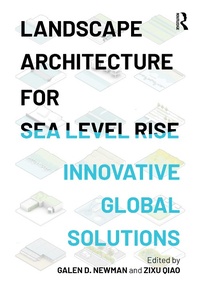
Landscape Architecture for Sea Level Rise
Innovative Global Solutions
1st Edition
Published on 17. May 2022
332 pages
978-1-000-55559-2 (ISBN)
Description

This book assesses and illustrates innovative and practical world-wide measures for combating sea level rise from the profession of landscape architecture. The work explores how the appropriate mixture of integrated, multi-scalar flood protection mechanisms can reduce risks associated with flood events including sea level rise.
Because sea level rise is a global issue, illustrative case studies performed from the United States, Korea, Australia, New Zealand, Thailand, Japan, China, and the Netherlands identify the structural (engineered), non-structural (nature-based), and hybrid mechanisms (mixed) used to combat sea level rise and increase flood resilience. The alternative flood risk reduction mechanisms are extracted and analyzed from each case study to develop and explain a set of design-based typologies to combat sea level rise which can then be applied to help proctor new and existing communities.
It is important for those located within the current or future floodplain considering sea level rise and those responsible for land use, developmental, and population-related activities within these areas to strategically implement a series of integrated constructed and green infrastructure-based flood risk reduction mechanisms to adequately protect threatened areas. As a result, this book is beneficial to both academics and practitioners related to multiple design professions such as urban designers, urban planners, architects, real estate developers, and landscape architects.
Because sea level rise is a global issue, illustrative case studies performed from the United States, Korea, Australia, New Zealand, Thailand, Japan, China, and the Netherlands identify the structural (engineered), non-structural (nature-based), and hybrid mechanisms (mixed) used to combat sea level rise and increase flood resilience. The alternative flood risk reduction mechanisms are extracted and analyzed from each case study to develop and explain a set of design-based typologies to combat sea level rise which can then be applied to help proctor new and existing communities.
It is important for those located within the current or future floodplain considering sea level rise and those responsible for land use, developmental, and population-related activities within these areas to strategically implement a series of integrated constructed and green infrastructure-based flood risk reduction mechanisms to adequately protect threatened areas. As a result, this book is beneficial to both academics and practitioners related to multiple design professions such as urban designers, urban planners, architects, real estate developers, and landscape architects.
Reviews / Votes
World Architecture Festival Architecture Book of the Year (2024)"This is an important study of an urgent crisis currently facing many parts of the world, intended to protect communities, their land, and buildings against global sea level rises. It contains ideas and practical solutions from expert contributors around the world. It can be seen as an important state-of-the-art manual for landscape architects, engineers, architects, developers, and politicians. It more than fits the bill by being a full-on technical guide."
Book of the Year Award Committee
"In terms of the global implications of sea-level rise, the future is now. This book acknowledges the urgency of addressing the impacts of sea-level rise in coastal and other at-risk communities by focusing on solutions that address hard and soft engineering and design in a global context."
- Dr. Jennifer Horney, Professor, Founding Director of the Epidemiology Program, Core Faculty of the Disaster Research Center, University of Delaware
"This important book offers practical and evidence-driven design solutions for coastal communities threatened by sea level rise. Through illustrative case studies from around the world the authors offer a range of innovative structural and nature-based solutions that are critical to building community resilience. A must read for anyone interested in how resilience can be advanced through landscape architecture, urban design, and land use planning."
- Dr. Phil Berke, Director, Center for Resilient Communities and Environment, University of North Carolina-Chapel Hill
"It is rare in the field of flood risk reduction to find international comparisons. Design for Sea Level Rise provides that and more. This book includes integrated analyses of eighteen flood cases from around the world. Impressively illustrated and presented, this piece of work will surely become the benchmark for landscape architects interested in addressing the increasing threat of flooding from sea level rise."
- Dr. Samuel Brody, Director, Center for Texas Beaches and Shores, Professor, Department of Marine and Coastal Environmental Science, Texas A&M University at Galveston
"With its range of well-illustrated case studies from around the world, Design for Sea Level Rise: Global Innovative Solutions seems likely to become an essential resource for designers and planners interested in this central sustainability challenge."
- Dr. Stephen M. Wheeler, Professor, Department of Human Ecology, U.C. Davis
"Sea level rise is much perceived as a worldwide problem not related to people's lives. In this insightful book, Newman and Qiao present a collection of global case studies to combat sea level rise. The design-based typologies and illustrated mechanisms provide valuable knowledge and resources for mitigating rising seas."
- Charlene M. LeBleu, FCELA, FASLA, AICP, Professor, Landscape Architecture, Auburn University
More details
Edition
1. Auflage
Language
English
Place of publication
London
United Kingdom
Publishing group
Taylor & Francis Ltd
Target group
Professional and scholarly
Illustrations
18 Tables, color; 181 Halftones, color; 181 Illustrations, color
ISBN-13
978-1-000-55559-2 (9781000555592)
Copyright in bibliographic data and cover images is held by Nielsen Book Services Limited or by the publishers or by their respective licensors: all rights reserved.
Schweitzer Classification
Other editions
Additional editions
Book
05/2022
1st Edition
Routledge
€215.77
Shipment within 10-20 days
Book
05/2022
1st Edition
Routledge
€45.00
Shipment within 10-20 days
Persons
Dr. Galen D. Newman is Associate Professor and Interim Department Head in the Department of Landscape Architecture and Urban Planning at Texas A&M University. He also serves as the Director of the Center for Housing and Urban Development. Dr. Newman's research overlaps the fields of community resilience, land use science, urban analytics, landscape performance and advanced visualization. He has published over 70 peer reviewed articles in high-quality journals and has received over 31 million dollars in interdisciplinary funded research projects.
Zixu Qiao has a Master of Landscape Architecture from Texas A&M University. She is a professional landscape architect, guest speaker at University of Guelph, and the founder of Land.Space Architecture. Her work includes research, design, and planning on a variety of site planning and landscape architecture projects in the US and China. Her design is committed to improving cities' economic and environmental sustainability, resilience, and quality of life. She founded Land.Space Architecture in 2019, an online educational platform committed to improving young professionals' visualization skills in landscape architecture.
Zixu Qiao has a Master of Landscape Architecture from Texas A&M University. She is a professional landscape architect, guest speaker at University of Guelph, and the founder of Land.Space Architecture. Her work includes research, design, and planning on a variety of site planning and landscape architecture projects in the US and China. Her design is committed to improving cities' economic and environmental sustainability, resilience, and quality of life. She founded Land.Space Architecture in 2019, an online educational platform committed to improving young professionals' visualization skills in landscape architecture.
Content
Section 1: Landscape Architecture and Sea Level Rise
1. Sea Level Rise as a Design and Planning Issue
2. Global Strategies for Flood and Sea Level Rise Mitigation
Section 2: Global Design for Sea Level Rise
Structural Heavy Design
3. Jefferson Parish, New Orleans Region, Louisiana
4. Tampa, Florida
Non-structural Heavy Design
5. Busan, Korea
6. Moakley Park, Boston, Massachusetts.
7. Philadelphia, Pennsylvania
8. Fisherman's Bend, Victoria, Australia
9. Island Bay, Greater Wellington Region of Aotearoa-New Zealand
10. Wilmington, Delaware
Hybrid Heavy Design
11. Franks Tract Futures, Sacramento: San Joaquin Delta, California
12. Samut Sakhon, Bangkok Metropolitan Region, Thailand
13. Port Saint Joe, Florida
14. Miyagi Prefecture, Sendai, Japan
Balanced Design
15. Fleming Park, Baltimore, MD
16. Sanya Dong'an Wetland Park, Hainan, China
17. Houston-Galveston Metropolitan Statistical Area, League City, TX
Scenario-based Design
18. Amsterdam and Western Scheldt Regions, the Netherlands
19. Miami, Florida
20. Christchurch, Canterbury Region, Aotearoa New Zealand
Section 3: Innovative Solutions for Sea Level Rise
21. Structural Mechanisms
22. Non-structural Mechanisms
23. Hybrid Mechanisms
24. The Urban Periculum: A Landscape at Risk from Sea Level Rise
1. Sea Level Rise as a Design and Planning Issue
2. Global Strategies for Flood and Sea Level Rise Mitigation
Section 2: Global Design for Sea Level Rise
Structural Heavy Design
3. Jefferson Parish, New Orleans Region, Louisiana
4. Tampa, Florida
Non-structural Heavy Design
5. Busan, Korea
6. Moakley Park, Boston, Massachusetts.
7. Philadelphia, Pennsylvania
8. Fisherman's Bend, Victoria, Australia
9. Island Bay, Greater Wellington Region of Aotearoa-New Zealand
10. Wilmington, Delaware
Hybrid Heavy Design
11. Franks Tract Futures, Sacramento: San Joaquin Delta, California
12. Samut Sakhon, Bangkok Metropolitan Region, Thailand
13. Port Saint Joe, Florida
14. Miyagi Prefecture, Sendai, Japan
Balanced Design
15. Fleming Park, Baltimore, MD
16. Sanya Dong'an Wetland Park, Hainan, China
17. Houston-Galveston Metropolitan Statistical Area, League City, TX
Scenario-based Design
18. Amsterdam and Western Scheldt Regions, the Netherlands
19. Miami, Florida
20. Christchurch, Canterbury Region, Aotearoa New Zealand
Section 3: Innovative Solutions for Sea Level Rise
21. Structural Mechanisms
22. Non-structural Mechanisms
23. Hybrid Mechanisms
24. The Urban Periculum: A Landscape at Risk from Sea Level Rise
