

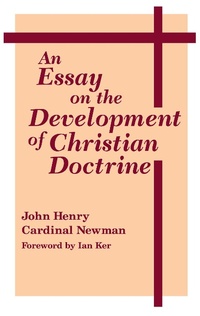
An Essay on the Development of Christian Doctrine
Published on 2. March 1994
480 pages
978-0-268-15809-5 (ISBN)
Description

An Essay on the Development of Christian Doctrine, reprinted from the 1878 edition, "is rightly regarded as one of the most seminal theological works ever to be written," states Ian Ker in his foreword to this sixth edition. "It remains," Ker continues, "the classic text for the theology of the development of doctrine, a branch of theology which has become especially important in the ecumenical era."
John Henry Cardinal Newman begins the Essay by defining how true developments in doctrine occur. He then delivers a sweeping consideration of the growth of doctrine in the Catholic Church from the time of the Apostles to his own era. He demonstrates that the basic "rule" under which Christianity proceeded through the centuries is to be found in the principle of development, and he emphasizes that throughout the entire life of the Church this principle has been in effect and safeguards the faith from any corruption.
John Henry Cardinal Newman begins the Essay by defining how true developments in doctrine occur. He then delivers a sweeping consideration of the growth of doctrine in the Catholic Church from the time of the Apostles to his own era. He demonstrates that the basic "rule" under which Christianity proceeded through the centuries is to be found in the principle of development, and he emphasizes that throughout the entire life of the Church this principle has been in effect and safeguards the faith from any corruption.
Reviews / Votes
"It is a great boon to Newman scholars and to the general public to have available the revised, 1878 edition of Newman's essay on development. . . . As an added benefit, it contains a superb foreword by Father Ian Ker which places the essay within the context of Newman's own theological work as well as that of the theological understandings of development which preceded and followed the essay. [It] is also the profoundly personal stand of one of the finest theological minds of the nineteenth century. . . . This book belongs in every theological library, and is accessible to most educated readers. It is especially rewarding for those who find the study of history a liberating theological exercise." -The Catholic World"All Newman scholars would agree that 'Newman anticipates the main fndings of the Second Vatcan Council.' He is ofen called 'the invisible father of the Second Vatcan Council', because so many of his views on the nature of the Church and its relaton to the world then received formal and collegiate ratificaton. Ian Ker comes to the same conclusion, as he writes: 'When studying theology, I came to appreciate the ways in which he antcipated so many of the central themes of the Ecumenical Council (Vatcan II) which he predicted and which opened a new era in Christan history. My reading and re-reading of his writngs over the years has only deepened my conviction that John Henry Newman is to be numbered among the Doctors of the Church.'" -Theological Quarterly
"I believe that we, the Church, do not turn to (Newman) often enough in our navigation of the doctrinal challenges we face today, and that what he offers is an excellent guide pointing the way through the turbulent waters." -Daily Theology Podcast
More details
Series
Language
English
Place of publication
Notre Dame IN
United States
Target group
Professional and scholarly
Product notice
Reflowable
ISBN-13
978-0-268-15809-5 (9780268158095)
Copyright in bibliographic data and cover images is held by Nielsen Book Services Limited or by the publishers or by their respective licensors: all rights reserved.
Schweitzer Classification
Other editions
Additional editions
John Henry Cardinal Newman
An Essay on the Development of Christian Doctrine
Book
11/2024
University of Notre Dame Press
€172.40
Shipment within 10-20 days
John Henry Cardinal Newman
An Essay on the Development of Christian Doctrine
Book
03/1994
6th Edition
University of Notre Dame Press
€44.40
Shipment within 10-20 days
Persons
Ian Ker is a member of the theology faculty at Oxford University. His many works include The Catholic Revival in English Literature, 1845-1961 (University of Notre Dame Press, 2003).
Content
- Cover
- Title Page
- AN ESSAY ON THE DEVELOPMENT OF CHRISTIAN DOCTRINE
- Copyright
- Dedication
- PREFACE TO THE EDITION OF 1878
- ADVERTISEMENT TO THE FIRST EDITION
- Contents
- FOREWORD
- PART I: DOCTRINAL DEVELOPMENTS VIEWED IN THEMSELVES
- INTRODUCTION
- CHAPTER I: ON THE DEVELOPMENT OF IDEAS
- SECTION I: ON THE PROCESS OF DEVELOPMENT IN IDEAS
- SECTION II: ON THE KINDS OF DEVELOPMENT IN IDEAS
- CHAPTER II: TH E ANTECEDENT ARGUMENT IN BEHALF OF DEVELOPMENTS IN CHRlSTIAN DOCTRINE
- SECTION I: DEVELOPMENTS OF D0CTRINE TO BE EXPECTED
- SECTION II: AN INFALLIBLE DEVELOPING AUTHORITY TO BE EXPECTED
- SECTION III: THE EXISTING DEVELOPMENTS OF DOCTRINE THE PROBABLE FULFILMENT OF THAT EXPECTATION
- CHAPTER III: ON THE HISTORICAL ARGUMENT IN BEHALF OF THE EXISTING DEVELOPMENTS
- SECTION I: METHOD OF PROOF
- SECTION II: STATE OF THE EVIDENCE
- CHAPTER IV: INSTANCES IN ILLUSTRATION
- SECTION I: INSTANCES CURSORILY NOTICED
- SECTION II: OUR LORD'S INCARNATION AND THE DIGNITY OF HIS BLESSED MOTHER AND OF ALL SAINTS
- SECTION III: THE PAPAL SUPREMACY.
- PART II: DOCTRINAL DEVELOPMENTS VIEWED RELATIVELY TO DOCTRINAL CORRUPTIONS
- CHAPTER V: GENUINE DEVELOPMENTS CONTRASTED WITH CORRUPTIONS
- SECTION I: FIRST NOTE OF A GENUINE DEVELOPMENT. PRESERVATION OF TYPE
- SECTION II: SECOND NOTE. CONTINUITY OF PRINCIPLES
- SECTION III: THIRD NOTE, POWER OF ASSIMILATION
- SECTION IV: FOURTH NOTE. LOGICAL SEQUENCE
- SECTION V: FIFTH NOTE. ANTICIPATION OF ITS FUTURE
- SECTION VI: SIXTH NOTE. CONSERVATIVE ACTION UPON ITS PAST
- SECTION VII: SEVENTH NOTE. CHRONIC VIGOUR
- CHAPTER VI: APPLICATION OF THE SEVEN NOTES TO THE EXISTING DEVELOPMENTS OF CHRISTIAN DOCTRINE
- SECTION I: THE CHURCH OF THE FIRST CENTURIES
- SECTION II: THE CHU RCH OF THE FOURTH CENTURY
- SECTION III: THE CHURCH OF THE FIFTH AND SIXTH CENTURIES
- CHAPTER VII: APPLICATION OF THE SECOND NOTE OF A TRUE DEVELOPMENT
- 1. The Principles of Christianity
- 2. Supremacy of Faith
- 3. Theology
- 4. Scripture and its Mystical Interpretation
- 5. Dogma
- 6. Additional Remarks
- CHAPTER VIII: APPLICATION OF THE THIRD NOTE OF A TRUE DEVELOPMENT
- 1. The Assimilating Power of Dogmatic Truth
- 2. The Assimilating Power of Sacramental Grace
- CHAPTER IX: APPLICATION OF THE FOURTH NOTE OF A TRUE DEVELOPMENT
- 1. Pardons
- 2. Penances
- 3. Satisfactions
- 4. Purgatory
- 5. Meritorious Works
- 6. The Monastic Rule
- CHAPTER X: APPLICATION OF THE FIFTH NOTE OF A TRUE DEVELOPMENT
- 1. Resurrection and Relics
- 2. The Virgin Life
- 3. Cultus of Saints and Angels
- 4. Office of the Blessed Virgin
- CHAPTER XI: APPLICATION OF THE SIXTH NOTE OF A TRUE DEVELOPMENT
- SECTION I: VARIOUS INSTANCES
- SECTION II: DEVOTION TO THE BLESSED VIRGIN
- CHAPTER XII: APPLICATION OF THE SEVENTH NOTE OF A TRUE DEVELOPMENT
