

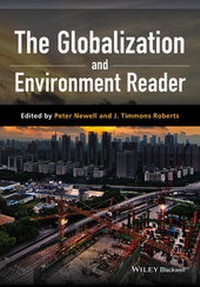
The Globalization and Environment Reader
Description

Reviews / Votes
"Globalization won't just 'go away' but it just can't 'go on', either. To become literate enough to confront the environmental contradictions that follow from this disturbing reality means understanding all sides of a thorny discussion. Newell and Roberts provide an incredible resource to do just that." Paul Robbins, Director, Nelson Institute for Environmental Studies "The perfect primer to get the reader up to speed and then speeding ahead. An essential guide for scholars and policy-makers looking to confront the challenge of making our increasingly global world a green one." Kevin P. Gallagher, Boston University "This collection, expertly put together by the editors, provides an unrivalled introduction to the debate on how economic globalization is implicated in the global environmental crisis, and what we can do about it. It contains classic texts and recent publications that shed a critical light on this vitally important topic." Robert Falkner, London School of Economics and Political Science "This valuable and well-chosen selection of the most important texts covers the rich variety of viewpoints, insights, debates, arguments, and outlooks on how globalization affects and/or enhances environmental quality." Arthur P.J. Mol, Wageningen University, The Netherlands "The Globalization and Environment Reader offers a wealth of perspectives on the limits and possibilities of securing an increasingly uncertain future. This book showcases a strong line-up of scholars bringing global and green lenses to some of the most critical questions of our time." Philip McMichael, Cornell UniversityMore details
Other editions
Additional editions
Persons
Peter Newell is Professor of International Relations at the University of Sussex and former Director of the Centre for Global Political Economy. He is associate editor of the journal Global Environmental Politics, and sits on the editorial board of Global Environmental Change and the Journal of Environment and Development. He is the author and co-author of eight books (including Globalization and the Environment), more than 40 journal articles, and 40 book chapters on topics relating to globalization and the environment.
J. Timmons Roberts is Ittleson Professor of Environmental Studies and Sociology at Brown University, where he was Director of the Center for Environmental Studies. A Non-Resident Senior Fellow at the Brookings Institution in Washington, Roberts has written 11 books and over 70 articles on climate change and global environmental politics. He was recently appointed to the Board on Environmental Change and Society of the National Academy of Sciences.
Content
Editors' Introduction: The Globalization and Environment Debate 1
J. Timmons Roberts and Peter Newell
Part I Going Global 21
Introduction 23
1 The Anthropocene: Are Humans Now Overwhelming the Great Forces of Nature? (2007) 27
Will Steffen, Paul J. Crutzen, and John R. McNeill
2 Address at the Closing Ceremony of the Eighth and Final Meeting of the World Commission on Environment and Development and the Tokyo Declaration (1987) 43
Gro Harlem Brundtland
3 Foxes in Charge of the Chickens (1993) 51
Nicholas Hildyard
4 Can the Environment Survive the Global Economy? (1997) 63
Edward Goldsmith
5 Ecological Modernization and the Global Economy (2002) 77
Arthur P. J. Mol
6 Environment and Globalization: Five Propositions (2010) 94
Adil Najam, David Runnalls, and Mark Halle
Part II the Nature of Globalization - Cases and Trends in Globalization 109
Introduction 111
7 The Value of the World's Ecosystem Services and Natural Capital (1997) 117
Robert Costanza, Ralph d'Arge, Rudolf de Groot, Stephen Farber, Monica Grasso, Bruce Hannon, Karin Limburg, Shahid Naeem, Robert V. O'Neill, Jose Paruelo, Robert G. Raskin, Marjan Van den Belt, and Paul Sutton
8 Sustainability and Markets: On the Neoclassical Model of Environmental Economics (1997) 134
Michael Jacobs
9 Crafting the Next Generation of Market-Based Environmental Tools (1997) 148
Jeremy B. Hockenstein, Robert N. Stavins, and Bradley W. Whitehead
10 Climate Fraud and Carbon Colonialism: The New Trade in Greenhouse Gases (2004) 162
Heidi Bachram
11 The Business of Sustainable Development (1992) 177
Stephen Schmidheney
12 The "Commons" versus the "Commodity": Alter-globalization, Anti-privatization and the Human Right to Water in the Global South (2007) 187
Karen Bakker
Part III Explaining the Relationship Between Globalization and the Environment 211
Introduction 213
13 Peril or Prosperity? Mapping Worldviews of Global Environmental Change (2011) 219
Jennifer Clapp and Peter Dauvergne
14 Introduction to World Development Report, 2003: Sustainable Development in a Dynamic Global Economy (2003) 233
World Bank
15 The Political Ecology of Globalization (2012) 247
Peter Newell
16 Institutions for the Earth: Promoting International Environmental Protection (1992) 262
Marc A. Levy, Peter M. Haas, and Robert O. Keohane
Part IV Governing Globalization and the Environment 279
Introduction 281
17 Trading Up and Governing Across: Transnational Governance and Environmental Protection (1997) 285
David Vogel
18 The WTO and the Undermining of Global Environmental Governance (2000) 294
Ken Conca
19 Private Environmental Governance and International Relations: Exploring the Links (2003) 299
Robert Falkner
20 Managing Multinationals: The Governance of Investment for the Environment (2001) 309
Peter Newell
21 Reforming Global Environmental Governance: The Case for a United Nations Environment Organisation (UNEO) (2012) 323
Frank Biermann
Part V Can Globalization be Greened? 333
Introduction 335
22 Whose Common Future: Reclaiming the Commons (1994) 341
The Ecologist
23 Resisting 'Globalisation-from-above' Through 'Globalisation-from-below' (1997) 362
Richard Falk
24 Picking the Wrong Fight: Why Attacks on the World Trade Organization Pose the Real Threat to National Environmental and Public Health Protection (2005) 371
Alasdair R. Young
25 What Every Environmentalist Needs to Know About Capitalism (2010) 379
Fred Magdoff and John Bellamy Foster
26 Pathways of Human Development and Carbon Emissions Embodied in Trade (2012) 396
Julia K. Steinberger, J. Timmons Roberts, Glen P. Peters, and Giovanni Baiocchi
27 Introduction to Towards a Green Economy: Pathways to Sustainable Development and Poverty Eradication (2012) 406
United Nations Environment Programme (UNEP)
28 Critique of the Green Economy: Toward Social and Environmental Equity (2012) 422
Barbara Unmüßig, Wolfgang Sachs, and Thomas Fatheuer
Index 439
Editors' Introduction: The Globalization and Environment Debate
J. Timmons Roberts and Peter Newell
Introduction
Just before the massive People's Climate March in 2014, author and activist Naomi Klein released a book which argued that we as a global society face a choice: either unregulated capitalism, or a livable Earth. The book, This Changes Everything: Capitalism vs. the Climate (Klein, 2014), cited climate scientists who believe we are on a collision course and so must drastically and immediately change the direction of our development path. Klein put it in stark terms: "What the climate needs to avoid collapse is a contraction in humanity's use of resources; what our economic model demands to avoid collapse is unfettered expansion. Only one of these sets of rules can be changed, and it's not the laws of nature" (21).
Klein argued that the time for half-measures is past, having been lost in the 1990s and 2000s when the process of globalization was deepening and intensifying. "Gentle tweaks to the status quo stopped being a climate option when we supersized the American Dream in the 1990s, and then proceeded to take it global" (22). She argued that the profound changes that need to be made could build a more sustainable and fairer society, such as "radically cutting our fossil fuel emissions and beginning the shift to zero-carbon sources of energy . with a full-blown transition underway within the decade" (18). But, she concluded, "we are not stopping the fire," because doing those things would "fundamentally conflict with deregulated capitalism . [and] are extremely threatening to an elite minority." She continued that it was "our great collective misfortune that the scientific community made its decisive diagnosis of the climate threat at the precise moment . that marked the dawning of what came to be called 'globalization.'"
Klein recounts the three policy pillars of the "market fundamentalism" of globalization that "systematically sabotaged our collective response to climate change .privatization of the public sphere, deregulation of the corporate sector, and lower corporate taxation, paid for with cuts to public spending" (19). She describes how globalization made it impossible for the United Nations negotiations on climate to succeed, and quotes a Canadian college student who spoke at the 2011 United Nations climate talks in South Africa: "You have been negotiating all my life" (11). This was not an exaggeration: as we'll describe below, those talks began in the early 1990s in the build up to the 1992 UN Framework Convention on Climate Change. For Klein the overwhelming issue of climate change requires that we acknowledge its magnitude and horror, and think creatively about how we can reorganize society in a new and positive way. "Because of our lost decades, it is time to turn this around now. Is it possible? Absolutely. Is it possible without challenging the fundamental logic of deregulated capitalism? Not a chance."
The question of whether the globalization of the world's economy is compatible with the requirement for humans to live sustainably on planet Earth is one of the most pressing we face. Despite nearly a half-century of environmental diplomacy, institution building and a bewildering array of environmental policy tools from regulation to environmental markets and voluntary measures, the health of the global environment continues to deteriorate at an alarming rate (Newell, 2012). While some environmental problems are being more successfully dealt with, others continue to get worse, such as the total consumption of Earth's resources and soaring levels of gases in the atmosphere that are believed to be destabilizing the atmosphere in which our civilization developed and upon which it depends for our collective survival. While the global economy has increased in size by 22-fold since 1900, our use of construction minerals has increased 34-fold, ores 27-fold, and fossil fuels (coal, oil and gas) have seen a 12-fold increase (Krausmann et al., 2009). We use 3.6 times as much crops, residues, and wood as we did back then. Sadly, it is the same with the gases that are causing climate change (Boden et al., 2010). We are not bending the often exponential curves in these trends the way we need to. Radical change is needed.
Amid accumulating evidence that humanity has already passed and threatens to cross yet more planetary limits (Rockström et al., 2009), debate is intensifying about how to respond. For some the answer is to try to harness the vast and growing power of business, since their decisions have so much impact and they hold so much leverage in political circles. Articulating a claim often repeated in debates about globalization and the environment, Maurice Strong put it succinctly in 1992: "The environment is not going to be saved by environmentalists. Environmentalists do not hold the levers of economic power" (Bruno and Karliner, 2002: 22). Many people have faith in the ability of markets to solve society's problems to properly price nature. They believe that if the costs of environmental harm could be "internalized" (or priced) into economic decision-making so that nature is valued in such a way that ecological limits become a feature of business-as-usual decision-making, then a sustainable economy would develop. Others believe that a globalizing capitalist world economy has been the driver and cause of the current predicament, and that the whole system needs to be reformed for environmental problems to be adequately addressed. Placing further power in the hands of market actors to "solve" the environmental crisis would be, as Nicolas Hildyard suggests in this volume, equivalent to putting the "foxes in charge of the chickens." For critics, therefore, we need to revisit our commitment to a globalizing, export-driven model of economic growth, not re-arrange the chairs on a sinking ship.
As we'll see throughout this volume, the debate about globalization and the environment is intimately connected to the debate about economic development's environmental impact. We need to understand the nature of development - how it takes place, who is influencing its direction, who benefits and who tends to be left behind. Over the past few decades, humanity has seen huge increases in economic development, bringing important overall improvements in indicators of health, education, and physical wellbeing (e.g. Norberg, 2007). The most recent phases of international development have also taken place while international trade has swung rapidly upward, part of what observers have called the unstoppable trend of "globalization" (e.g. Roberts, Hite, and Chorev, 2015). However, this pace of development and globalization has led to immense environmental degradation, and for over four decades many scientists have been arguing that the scale of the degradation threatens humanity. Yet most of the debate on development has for years ignored the environmental impacts that potentially undermine the entire model being held up as an ideal for poor nations to emulate: boundless economic growth and industrialization (Sutcliffe, 2000).
Along with economic globalization has come the globalization of environmental damage. The crux of the problem is that while economic development and globalization threaten the environment, many scholars and politicians argue that development is the key to achieving decent human wellbeing and in solving these same environmental problems (e.g. World Bank, 1992; Grossman and Kreuger, 1995; Selden and Song, 1995). As Mexican President Carlos Salinas was reported to have said on US television, Mexico needed first to pollute itself in order to meet its basic needs, and then environmental concerns could come later. The core issue is how to reconcile the two goals of economy and ecology. As we will see in this book, much research and policy is based on the premise that they can be brought together, but this might be wishful thinking.
To complicate things further, efforts to reconcile economy and ecology have taken place in a context of deepening and dramatic inequalities across the world and within countries. The third "leg" of the tripod of sustainability then is equity: how to harmonize development and environmental sustainability against a background of unequal development and international injustice. Forty years of negotiations, high-level reports, and "grand bargains" (which we review briefly below and which are discussed by a number of this volume's readings) leave us still grasping for solutions that will bring economy, ecology, and equity into alignment. This is not simply in any direction: economic growth in no way guarantees that equity and ecology will be addressed. Some types of environmental protection measures can create economic stagnation and even leave some parts of society behind. This has generated calls for a "just transition" to a green economy, for example, protecting vulnerable groups in the context of radical re-orderings of production and technology. This means ensuring that resource inequalities and workplace exploitation are not exacerbated by changing the technology but leaving poor working conditions in place and environmental injustices untouched. Examples include poorer immigrant women and child laborers assembling solar photovoltaic panels, or the dispossession of communities of their land to make way for wind...
