

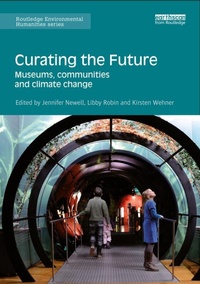
Curating the Future
Museums, Communities and Climate Change
1st Edition
Published on 12. August 2016
322 pages
978-1-317-21795-4 (ISBN)
Description

Curating the Future: Museums, Communities and Climate Change explores the way museums tackle the broad global issue of climate change. It explores the power of real objects and collections to stir hearts and minds, to engage communities affected by change.
Museums work through exhibitions, events, and specific collection projects to reach different communities in different ways. The book emphasises the moral responsibilities of museums to address climate change, not just by communicating science but also by enabling people already affected by changes to find their own ways of living with global warming.
There are museums of natural history, of art and of social history. The focus of this book is the museum communities, like those in the Pacific, who have to find new ways to express their culture in a new place. The book considers how collections in museums might help future generations stay in touch with their culture, even where they have left their place. It asks what should the people of the present be collecting for museums in a climate-changed future? The book is rich with practical museum experience and detailed projects, as well as critical and philosophical analyses about where a museum can intervene to speak to this great conundrum of our times. Curating the Future is essential reading for all those working in museums and grappling with how to talk about climate change. It also has academic applications in courses of museology and museum studies, cultural studies, heritage studies, digital humanities, design, anthropology, and environmental humanities.
Museums work through exhibitions, events, and specific collection projects to reach different communities in different ways. The book emphasises the moral responsibilities of museums to address climate change, not just by communicating science but also by enabling people already affected by changes to find their own ways of living with global warming.
There are museums of natural history, of art and of social history. The focus of this book is the museum communities, like those in the Pacific, who have to find new ways to express their culture in a new place. The book considers how collections in museums might help future generations stay in touch with their culture, even where they have left their place. It asks what should the people of the present be collecting for museums in a climate-changed future? The book is rich with practical museum experience and detailed projects, as well as critical and philosophical analyses about where a museum can intervene to speak to this great conundrum of our times. Curating the Future is essential reading for all those working in museums and grappling with how to talk about climate change. It also has academic applications in courses of museology and museum studies, cultural studies, heritage studies, digital humanities, design, anthropology, and environmental humanities.
Reviews / Votes
I applaud the contributors to this book for their courage, conviction and actions in confronting the reality of climate change. In so doing, this book chronicles a new standard of mindfulness in museum practice, grounded in a commitment to the durability and well-being of individuals, communities and the planet.Robert R. Janes, Editor-in-Chief Emeritus, Museum Management and Curatorship
This book documents and advocates for the significance of material storytelling as a resource for addressing the most significant challenges of the Anthropocene - how to acknowledge and manage the impact of climate change on our planet and its people. I cannot imagine a stronger argument for the importance of museums.
Professor Andrea Witcomb, Alfred Deakin Institute for Citizenship and Globalisation, Deakin University, Australia
Curating the Future is far more than a book about how to exhibit the vitally important, if sometimes contentious, topic of climate change. Instead, it sheds new light by bringing together a myriad of examples and perspectives that show how museums and their relationships with collections, Indigenous peoples, and others are being transformed as they find ways to reflect upon and mobilise in relation to the environmental changes that threaten our collective future.
Professor Sharon Macdonald, Alexander von Humboldt Professor of Social Anthropology and Director of the Centre for Anthropological Research on Museums and Heritage (CARMaH), Humboldt-Universitaet zu Berlin, Germany
This collection is a provocative, exciting and pioneering contribution to museum studies scholarship, the environmental humanities and beyond. It offers fundamental, first principles thinking about how museums and communities through their collections and exhibition activities might engage global climate change. It is beautifully written, rich with practical case studies and new theoretical insights - a must read for heritage and museum professionals and scholars.
Dr Fiona Cameron, Senior Research Fellow, Institute for Culture and Society, Western Sydney University, Australia
This innovative collection celebrates the reanimated life of objects in many contemporary museums and argues that museums are great places for promoting conversations and actions on the pressing realities of climate change. Through a creative congregation of scholarly analyses, cameo essays, poems and pictures, it reflects on community collaborations, visitor experiences and curatorial practices in mounting exhibitions and performances. It will excite readers' hearts as well as their minds.
Professor Margaret Jolly, Professor and ARC Laureate Fellow 2010-2015, Australian National University, Australia
I strongly recommend this volume to any scholar interested in climate change and other environmental issues, but more broadly it is relevant to anyone seeking to engage the public about complex and challenging topics. I agree wholeheartedly that museums are often "safe places" (4) to start these conversations.
Torben Rick, Museum Anthropology Review
More details
Series
Edition
1. Auflage
Language
English
Place of publication
London
United Kingdom
Publishing group
Taylor & Francis Ltd
Target group
College/higher education
Professional and scholarly
Product notice
Reflowable
Illustrations
50 s/w Abbildungen, 60 farbige Abbildungen, 50 s/w Photographien bzw. Rasterbilder, 1 s/w Tabelle, 60 Farbfotos bzw. farbige Rasterbilder
1 Tables, black and white; 60 Halftones, color; 50 Halftones, black and white; 60 Illustrations, color; 50 Illustrations, black and white
ISBN-13
978-1-317-21795-4 (9781317217954)
Copyright in bibliographic data and cover images is held by Nielsen Book Services Limited or by the publishers or by their respective licensors: all rights reserved.
Schweitzer Classification
Other editions
Additional editions
Jennifer Newell | Libby Robin | Kirsten Wehner
Curating the Future
Museums, Communities and Climate Change
Book
08/2016
1st Edition
Routledge
€230.27
Shipment within 10-20 days
Jennifer Newell | Libby Robin | Kirsten Wehner
Curating the Future
Museums, Communities and Climate Change
Book
08/2016
1st Edition
Routledge
€59.00
Shipment within 10-20 days
Persons
Jennifer Newell is the curator of Pacific Ethnography at the American Museum of Natural History, New York, USA. She teaches Museum Anthropology at Columbia University, USA, and convenes the Museums and Climate Change Network. She has partnerships with museums in the Pacific, including in Samoa and Fiji, and is a former curator at the British Museum.
Libby Robin works across the university and museum sectors in Australia, Sweden and Germany. She is Professor of Environment and Society at the Australian National University, research affiliate at the National Museum of Australia, affiliated professor at the Royal Institute of Technology, Stockholm, Sweden, and Board Member, Rachel Carson Center, LMU, Munich, Germany.
Kirsten Wehner is Head Curator of the People and the Environment program at the National Museum of Australia. She is a member of the Humanities for the Environment Australia-Pacific Observatory and a professional associate of the Centre for Creative and Cultural Research at the University of Canberra, Australia.
Libby Robin works across the university and museum sectors in Australia, Sweden and Germany. She is Professor of Environment and Society at the Australian National University, research affiliate at the National Museum of Australia, affiliated professor at the Royal Institute of Technology, Stockholm, Sweden, and Board Member, Rachel Carson Center, LMU, Munich, Germany.
Kirsten Wehner is Head Curator of the People and the Environment program at the National Museum of Australia. She is a member of the Humanities for the Environment Australia-Pacific Observatory and a professional associate of the Centre for Creative and Cultural Research at the University of Canberra, Australia.
Content
Foreword 1. Curating Connections in a Climate Changed World 2. Poem: "Tell Them" Part 1: Welcoming New Voices: Opening museums 3. Rob Nixon, The Anthropocene and Social Justice 4. Cameo: Museums Connecting 5. Talking Around Objects: Stories for a Climate Changed world 6. Object in view: Jaki-ed mat, Marshall Islands 7. The Pacific in New York: Managing Objects and Cultural Heritage Partnerships in Times of Global Change 8. Cameo: Connie Hart's Basket 9. Peoples who Still Live: The Role of Museums in addressing Climate Change in the Pacific 10. Object in view: Taking a Bite Out of Lost Knowledge: Sharks' Teeth, Extinction, and the Value of Preemptive Collections Part 2: Reuniting Nature and Culture 11. Towards an Ecological Museology: Responding to the animal-objects of the Australian Institute of Anatomy collection 12. Object in view: Harry Clarke's high wheeler bicycle 13. Food and Water Exhibitions: Lenses on Climate Change 14. Object in view: The Stump-Jump Plough: Reframing a National Icon 15. Telling Torres Strait History through Turtle 16. Four Seasons in One Day: Weather, Culture and the Museum 17. Object in view: Nelson the Newfoundland's Dog Collar 18. The Last Snail: Loss, hope and care for the future 19. Object in view: Hiding in plain sight: Lessons from the Olinguito Part 3: Focusing on the Future 20. The Reef in Time: The prophecy of Charlie Veron's living collections 21. Food Stories for the Future 22. Shaping Garden Collections for Future Climates 23. Object in view: A Past Future for the Cucumber 24. The Art of the Anthropocene 25. Object in view: The Canary Project: Photographs and Fossils Part 4: Representing Change and Uncertainty 26. Cameo: The Vulnerable Volvo 27. Museum Awakenings: Responses to Environmental Change at the Swedish Museum of Natural History, 1965-2005 28. Rising Seas: Facts, Fictions and Aquaria 29. Object in view: The Model of Flooded New York 30. When the Ice Breaks: The Arctic in the Media 31. Displaying the Anthropocene in and beyond Museums 32. Poem: Dear Matafele Peinem
