

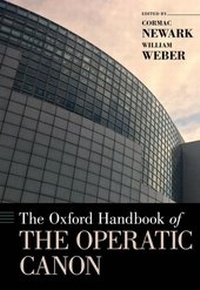
Oxford Handbook of the Operatic Canon
1st Edition
Published on 18. September 2020
456 pages
978-0-19-022421-9 (ISBN)
Description

Opera has always been a vital and complex mixture of commercial and aesthetic concerns, of bourgeois politics and elite privilege. In its long heyday in the eighteenth and nineteenth centuries, it came to occupy a special place not only among the arts but in urban planning, too this is, perhaps surprisingly, often still the case. The Oxford Handbook of the Operatic Canon examines how opera has become the concrete edifice it was never meant to be, by tracing its evolution from a market entirely driven by novelty to one of the most canonic art forms still in existence. Throughout the book, a lively assembly of musicologists, historians, and industry professionals tackle key questions of opera's past, present, and future. Why did its canon evolve so differently from that of concert music? Why do its top ten titles, all more than a century old, now account for nearly a quarter of all performances worldwide? Why is this system of production becoming still more top-heavy, even while the repertory seemingly expands, notably to include early music?Topics range from the seventeenth century to the present day, from Russia to England and continental Europe to the Americas. To reflect the contested nature of many of them, each is addressed in paired chapters. These complement each other in different ways: by treating the same geographical location in different periods, by providing different national or regional perspectives on the same period, or by thinking through similar conceptual issues in contrasting or changing contexts. Posing its questions in fresh, provocative terms, The Oxford Handbook of the Operatic Canon challenges scholarly assumptions in music and cultural history, and reinvigorates the dialogue with an industry that is, despite everything, still growing.
More details
Other editions
Additional editions
Cormac Newark | William Weber
The Oxford Handbook of the Operatic Canon
Book
11/2020
Oxford University Press Inc
€207.50
Shipment within 15-20 days
Content
- Cover
- The Oxford Handbook of The Operatic Canon
- Copyright
- Contents
- List of Contributors
- Acknowledgments
- About the companion website
- Note to the reader
- General introduction: Idiosyncrasies of the operatic canon
- Terminology
- Different historical and geographical conceptions of the operatic canon
- Performing canons versus critical canons
- Novelty versus familiarity
- Quantitative measures of canonic status
- Notes
- Part I: History, Geography
- Introduction to Chapters 1 and 2: Foundations: France and Italy in the eighteenth century
- Chapter 1: The practical and symbolic functions of pre-Rameau opera at the Paris Opéra before Gluck
- Lully and his "imitators": Canonization and early attacks on it
- From mild disaffection to open disrespect
- A new life for old opera
- The elusive image of old opera
- Notes
- Chapter 2: Italian opera and the concept of "canon" in the late eighteenth century
- Literati and a literary canon for Italian opera
- Literati on music and musicians: Classicism versus fashion
- Canon(s) in the operatic market, 1751-1760
- Canon(s) of the operatic market, 1781-1790
- Toward a renegotiation of the operatic star-system: The composer's new starring role
- Notes
- Chapters 1 and 2: Further reading
- Introduction to chapters 3 and 4: From royal authority to public taste in Berlin, 1740-1815
- Chapter 3: The repertory of the Italian Court Opera in Berlin, 1740-1786
- Early history of Berlin opera
- Periods in the emergence of the Berlin canon, 1740-1786
- The conditions that created the Italian Court Opera, 1740-1756
- The revival of old operas, 1763-1786
- The new era at the Opernhaus and the Nationaltheater, 1786-1796
- Conclusion
- Notes
- Chapter 4: Catching up and getting ahead: The opera house as temple of art in Berlin c. 1800
- Facing the past
- Renewing the canon
- Canonic infrastructures
- Notes
- Chapters 3 and 4: Further reading
- Introduction to chapters 5 and 6: Operatic practices at the London Opera: Pasticcio to repertory to canon?
- Chapter 5: From recycled performances to repertory: The King's Theatre in London, 1705-1820
- Notes
- Chapter 6: Repertory opera and canonic sensibility:The London Opera, 1820-1860
- Toward repertory opera
- Toward a canonic sensibility
- Notes
- Chapters 5 and 6: Further reading
- Introduction to chapters 7 and 8: From capital-city opera house to provincial theaters in France
- Chapter 7: The evolution of French opera repertories in provincial theaters: Three epochs, 1770-1900
- Choice of methodological focus: Premieres or repertories?
- The system of producing works
- 1770-1830: The triumph of opéra comique
- From Napoleon's decrees to the period 1830-1860
- After 1864: Continuity and expansion of repertory
- Conclusion
- Notes
- Chapter 8: The mingling of opera genres: Canonic opera at the Théâtre des Arts in Rouen, 1882-1897
- The constraints of the theatrical system
- The origins of the Rouen repertory
- Attention to local traditions
- Notes
- Chapters 7 and 8: Further reading
- Introduction to chapters 9 and 10: The Italian opera world and its canons
- Chapter 9: Theaters, markets, and canonic implications in the Italian opera system, 1820-1880
- Novelty in demand
- The changing trajectories of supply
- New media, new music-publishing practices
- Preludes to a canon?
- Notes
- Chapter 10: Operatic canons and repertories in Italy c. 1900
- Repertories and publishers and the five "canonic columns"
- Sonzogno's contribution
- Milan and La Scala as center of the duel
- Notes
- Chapters 9 and 10: Further reading
- Introduction to chapters 11 and 12: Opera in the western hemisphere, 1811-1910: New York, Buenos Aires, and Montevideo
- Chapter 11: International opera in nineteenth-century New York: Core repertories and canonic values
- The early years, arrangements, and tours
- New houses, new operas
- The Metropolitan Opera and its competitors
- Canon and core repertory
- Notes
- Chapter 12: Canons of real and imagined opera: Buenos Aires and Montevideo, 1810-1860
- Rossini in Buenos Aires
- Bellini in Montevideo
- Feast after famine
- Notes
- Chapters 11 and 12: Further reading
- Introduction to chapters 13 and 14: Tensions Between the National and the Cosmopolitan: Canons in England and Russia
- Chapter 13: The Survival of English Opera in Nineteenth-Century Concert Life
- English opera in concert programs
- Ideological division in critical commentary on English opera
- Contrasting critical points of view
- A sturdy, changing tradition
- Notes
- Chapter 14: National and international canons of opera in Tsarist Russia
- The Imperial Theaters and the critics
- The status of foreign repertories
- Canonizing a national composer
- The national canon and the international repertory
- Notes
- Chapters 13 and 14: Further reading
- Part II: Other views, other Canons
- Introduction to chapters 15 and 16: Singers and the operatic canon
- Chapter 15: Setting the standard: Singers, theater practices, and the operatic canon in nineteenth-century France
- Defining the répertoire
- Débuts, rentrées, and benefit concerts
- Taking the canon on tour
- Reviving the "classics"
- From creators to interpreters
- Notes
- Chapter 16: Redefining the standard: Pauline Viardot and Gluck's Orphée
- Pauline Viardot as Orphée
- Hearing and seeing Viardot as Orphée
- Total recall
- To canonize a singer
- Notes
- Chapters 15 and 16: Further reading
- Introduction to chapters 17 and 18: Uses of the operatic canon
- Chapter 17: Canons of the Risorgimento then and now
- Overlapping canons
- Il canone del Risorgimento
- The canon as participation
- Notes
- Chapter 18: "Blow the opera houses into the air: "Wagner, Boulez, and Modernist canons
- Notes
- Chapters 17 and 18: Further reading
- Introduction to chapters 19 and 20: Rewriting the operatic canon
- Chapter 19: Phantoms at the Opéra: Meyerbeer and de-canonization
- Matters of life and death
- Afterlife
- Numerical work
- Counting canons
- Notes
- Chapter 20: The uses and disadvantages of opera history: Unhistorical thinking in fin-de-siècle Paris
- "Untimely" music: Gluck (and) the eternal
- D'Indy's distortions
- Notes
- Chapters 19 and 20: Further reading
- Introduction to chapters 21 and 22: Contiguous genres: Operetta and American musicals
- Chapter 21: Viennese operetta canon formation and the journey to prestige
- Operetta in Vienna
- Wilhelm Karczag and the canonization of Strauss's legacy
- "Negative eternity"
- The critical canon
- Notes
- Chapter 22: Canons of theAmerican musical
- A core canon
- A plurality of canons
- Notes
- Chapters 21 and 22: Further reading
- Introduction to chapters 23 and 24: Twentieth-century reproduction technology and the operatic canon
- Chapter 23: Sound recording and the operatic canon: Three "drops of the needle"
- Notes
- Chapter 24: Opera on film and the canon
- Beginnings
- Developments on the small screen
- Opera film as cinema
- Audio versus video
- The age of the HD broadcast
- Notes
- Chapters 23 and 24: Further reading
- Introduction to chapters 25 and 26: Views of the operatic canon from the industry
- Chapter 25: Critical reflections on the operatic canon
- Popular modern pieces
- Early music revivals
- (Long-)nineteenth-century revivals
- Europe versus the United States
- Technological developments
- Chapter 26: Inside and outside the operatic canon, on stage and in the boardroom
- Chapters 25 and 26: Further listening and viewing
- Bibliography
- Index
