

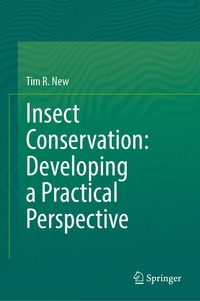
Insect Conservation: Developing a Practical Perspective
Description

The variety of theoretical themes and practical components contributing to modern insect conservation continues to diversify, together with realisation that insects affect many aspects of human wellbeing. Some such topics develop rapidly to become integral features of insect management or recovery plans; others become dismissed as irrelevant or tangential to major conservation effort, even if they are fundamentally important for basic biological understanding. This book includes commentaries on a varied array of topics previously covered in short Editorials in the Journal of Insect Conservation , and which are revisited here to assess, expand and update their wider relevance, and to demonstrate progress in appreciation of insect significance and needs. Some topics have remained highly relevant, even when poorly understood, but the complexity of influences on insect life are appreciated most effectively by including many such considerations in conservation, and understanding their roles in both communication and conservation management. Australian examples throughout the book demonstrate the practical difficulties of conserving a diverse, poorly documented and inadequately resourced insect fauna with a rather short history of conservation concern. The fauna is also one for which conservation interest is growing and for which designs of conservation management plans and designation of priorities are urgently needed as wider strategies also develop.
The seven major chapters deal with published Editorials, each reprinted and followed by updated commentary and references, collectively addressing relevance and importance of developments over the intervening decade or so. An introductory chapter aids perspective through a brief account of the fundamentals of insect conservation, and the final chapter helps to integrate the text to provide outlooks based on increased understanding of insect life. The book is intended for students and environmental managers, as well as a more general readership seeking information on how insect conservation 'works' and how to address a number of contemporary issues.
More details
Other editions
Additional editions
Person
Prof. Tim R. New is an entomologist with wide interests in insect ecology, conservation and systematics, and has published extensively in those areas, with more than 50 books and numerous research papers and reviews. He is a past Editor-in-Chief of Journal of Insect Conservation, and is recognised widely for his promotion of insect conservation in Australia and elsewhere.
Content
Chapter 1. Introducing Insect Conservation.- Chapter 2. Some Fundamentals.- Chapter 3. Public Support and Understanding.- Chapter 4. Alien Species: Contrasting Implications.- Chapter 5. Essentials or Distractions?.- Chapter 6. Regulation, Understanding and Policy.- Chapter 7. Gaining Experience and Community Support.- Chapter 8. Ways Forward?.- Chapter 9. Integration: A Positive Future for Insects?.
