

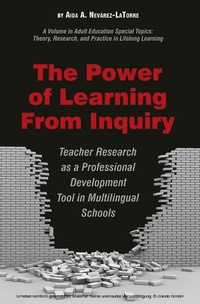
The Power of Learning from Inquiry
Teacher Research as a Professional Development Tool in Multilingual Schools
1st Edition
Published on 1. February 2010
197 pages
978-1-60752-298-0 (ISBN)
Description

The power of teacher inquiry is revealed when educators examine their practices with the purpose of making necessary changes to improve the learning opportunities of their multilingual students, and working conditions in schools. Dr. Nevárez-La Torre, proposes a model for conducting classroom inquiry that teachers may follow to pursue important questions about their practice and multilingual students' learning process.
There are eight chapters in this book divided into three sections. The first section introduces the idea for the book a model for using teacher inquiry as a tool for professional development. The second section includes the analyses of the trajectory followed by three teachers into using teacher inquiry to grow as professionals in ESL and bilingual classrooms. The third section of the book situates professional development using teacher inquiry within a broader theoretical framework and examines some key implications of this work for the education of in-service and pre-service teachers.
All prices
More details
Other editions
Additional editions
Aida A. Nevarez-LaTorre
The Power of Learning from Inquiry
Teacher Research as a Professional Development Tool in Multilingual Schools
Book
02/2010
Information Age Publishing
€62.50
Article not available at the moment
Content
- Intro
- The Power of Learning From Inquiry
- Teacher Research as a Professional Development Tool in Multilingual Schools
- A volume in Adult Education Special Topics: Theory, Research, and Practice in Lifelong Learning
- Series Editor: Kathleen P. King, Fordham University
- CONTENTS
- Section I: Introduction to Learning from Inquiry as Professional Development
- 1. Introduction: My Pathway Into Teacher Inquiry 3
- 2. Investigating Classroom Practice and Learning From It: A Teacher Inquiry Model (TI Model) 21
- Section II: Teacher Inquiry in Action
- 3. Rethinking ESL: An ESL Teacher Works With a Transient Child 47
- 4. Learning Among Educators 67
- 5. A Bilingual Reading Specialist Path to Challenging the Curriculum 81
- 6. The Magic Words "Research Shows": A Bilingual Teacher Learns From Her Students' Parents 97
- section iii: Understanding Teacher Inquiry: Its Power and Its Future
- 7. Understanding Teacher Inquiry 119
- 8. Looking Ahead: Teacher-Centered Professional Development and Transformation 137
- Section IV: Appendix
- Information Age Publishing, Inc.
- Charlotte, North Carolina www.infoagepub.com
- Adult Education Special Topics: Theory, Research, and Practice in Lifelong Learning
- This book is dedicated
- to my parents Aida Luz and Alfonso
- and to my grandmother Aurelia. You educated me in the Faith and that has made all the difference.
- Este libro es dedicado
- a mis padres Aida Luz y Alfonso
- y a mi abuela Aurelia. Ustedes me educaron en la Fe y eso ha hecho toda la diferencia.
- The Power of Learning From Inquiry
- by
- Aida A. Nevárez-LaTorre
- Fordham University
- acknowledgments
- preface
- The Forum
- Professional Development as a Journey
- Developing Powerful Teachers of Inquiry
- Postlude
- Introduction
- My Pathway Into Teacher Inquiry
- The Onset of My Participation in Teacher Inquiry
- Purpose of the Book
- Main Concepts Explored in Book
- Context of the Forum
- Gathering Information about the Forum's Work
- Some DELIMITATIONS of this Work
- Importance of Book
- Overview of Chapters
- A Personal Invitation to the Journey
- CHAPTER 1
- section i
- Introduction to learning from inquiry as professional development
- Investigating Classroom Practice and Learning from It
- A Teacher Inquiry Model (TI Model)
- The Inception of the Bilingual Teacher Research Forum
- The Role of the Facilitator of the Forum
- Description of the Professional Development Model
- Learning about Inquiry in the Collective
- Facing Some Challenges
- Evolution of the Forum's Work
- CHAPTER 2
- Figure 2. 1. Teacher inquiry model for professional development.
- Rethinking ESL
- An ESL Teacher Works With a Transient Child
- Becoming a Teacher Researcher
- An ESL Teacher's Inquiry
- Inquiry Process
- Dora's Professional Growth
- CHAPTER 3
- Table 3.1. Instructional Strategies Used by Dora
- 1. Write in the comfort language.
- 2. Audiotape stories read in class.
- 3. ELL dictates a paraphrase of story.
- 4. Do pre-writing activities (i.e., talking, drawing, creating a word wall/ personal word list for writing).
- 5. Use visual aids like picture dictionaries, sentence frames, and word lists of high frequency words.
- 6. Write with a partner (buddy writer).
- 7. Make comparisons between sounds in L1 and L2 highlighting similarities.
- 8. Scaffold through the use of think alouds and giving clues of words.
- 9. Use word play.
- 10. Keep language use simple without lowering academic expectations.
- 11. Use oracy to support literacy and vice versa.
- 12. Model language use.
- 13. Do demonstrations and use gestures and body language.
- section ii
- teacher inquiry in action
- Learning among Educators
- Promoting Collaboration among Teachers
- Mainstream Teacher Perceptions and Attitudes towards ELLs
- Working with Ms. Long
- Working with Ms. Smith
- Analysis of Dora's Collaborative Efforts
- CHAPTER 4
- A Bilingual Reading Specialist's Path to Challenging the Curriculum
- Literacy Views Challenged by Forum Members
- Literacy in the all-English Regular Classroom
- Literacy in Natalia's Classroom
- Inquiry on Teaching Literacy through Writing
- Natalia's Professional Growth
- CHAPTER 5
- The Magic Words "Research Shows"
- A Bilingual Teacher Learns From Her Students' Parents
- Participation in the Forum
- Inquiry Project
- Mercedes Learns from Inquiry
- Transformation: Putting Learning into Action
- CHAPTER 6
- section iii
- understanding teacher inquiry: its power and its future
- Understanding Teacher Inquiry
- A Sociocultural Lens
- Teacher Inquiry
- Teacher Inquiry as Professional Development
- Teacher Inquiry about Issues on Second Language Learning
- A Dearth of Teacher Inquiry
- 1. inaccessibility (complex material not written with teachers in mind)
- 2. lack of local relevance (when the knowledge produced by research is not specific, contextualized, experiential, observable, and testable, teachers will be less inclined to accept its relevance to their work)
- 3. lack of narrative (in statistical studies where classroom events are represented as series of numbers, teachers will struggle to see its relevance to their work)
- 4. lack of ownership (lack of participation in the design, implementation, and dissemination of the research might decrease teachers' interests in what researchers have to say)
- 5. lack of credibility (the teachers might question practice recommendations made by researchers who do not understand their classroom demands)
- 6. pressure (heavy workloads at school might limit the time teachers have to read or do research)
- 7. implied inadequacy (the suggestion that teachers engage in research, may imply that there is a problem classroom or school and thus it may question their competency as practitioners)
- 8. self-image (teachers' perceptions that their knowledge of classrooms is not valuable or of interest to other professionals)
- 9. lack of recognition (when teacher research is denied from publication because it does not meet a journal's criteria for acceptability, like validity, objectivity, and methodological rigor, it is discouraging to practitioner researchers)
- and
- 10. lack of technical knowledge (many practitioners lack training in research design, data analysis, or writing for publication). (p. 18)
- Complexities in Conducting Teacher Research in Multilingual Schools
- CHAPTER 7
- Looking Ahead
- Teacher-Centered Professional Development and Transformation
- The Journey Thus Far
- New Realms for Research
- Creating the Future: Learning from Teacher-Researchers
- Epilogue
- CHAPTER 8
- SECTION IV
- Appendix
- Bibliography of sources on teacher inquiry
- Books
- I. Learning About Teacher Inquiry
- II. Examples of Inquiries Conducted by Practitioners
- Journals and Websites
- 1. TESOL Quarterly-the Journal of the TESOL Professional Association
- 2. TESOL's Language Teacher Research Series:
- 3. Networks: An OnLine Journal for Teacher Research-
- 4. The Ontario Action Researcher
- 5. Action Research International
- 6. Teachers of English to Speakers of Other Languages (TESOL)-
- 7. Teacher Research-
- 8. Teachers Network: Our Teacher Research-
- 9. Educating as Inquiry-A Teacher Action Research Site
- 10. Fairfax County Public Schools: Teacher Researcher Network
- References
- About the Author
- Index

