

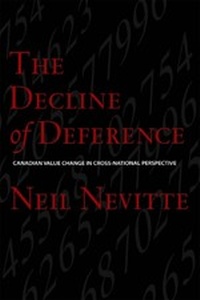
The Decline of Deference
Canadian Value Change in Cross National Perspective
1st Edition
Published on 1. August 1996
352 pages
978-1-4426-0251-9 (ISBN)
Description

Since the 1980s Canadians have experienced turmoil on an unprecedented scale and on a variety of fronts. Constitutional battles pitted citizen against citizen and publics against leaders. Vigorous new interest groups challenged governments to respond to new issues like the environment, gay rights, and equality for women. In the face of expanding trade relations Canadians mobilized to respond to economic uncertainty, and family relations were exposed to new stresses. What explains the turmoil?
In this extraordinarily wide-ranging book, Neil Nevitte demonstrates that the changing patterns of Canadian values are connected. Changing attitudes to authority in the family are connected to changing attitudes to the work-place and to politics and they all point to one theme-the decline of deference. Canada's turmoil is not unique, nor is it a result of the "Americanization" of Canadian values. Canada, he argues, is but one stage on which the rhythms of post-industrial value change are played out.
In this extraordinarily wide-ranging book, Neil Nevitte demonstrates that the changing patterns of Canadian values are connected. Changing attitudes to authority in the family are connected to changing attitudes to the work-place and to politics and they all point to one theme-the decline of deference. Canada's turmoil is not unique, nor is it a result of the "Americanization" of Canadian values. Canada, he argues, is but one stage on which the rhythms of post-industrial value change are played out.
Reviews / Votes
Presents an unexpected profile of Canadians: remarkably egalitarian in family life, increasingly difficult to govern politically and to manage in the workplace. Cosmopolitan and sophisticated, yes. But tolerant? Not really.- The Globe and Mail
More details
Language
English
Place of publication
Toronto
Canada
Target group
College/higher education
Professional and scholarly
Edition type
Digital original
File size
18,57 MB
ISBN-13
978-1-4426-0251-9 (9781442602519)
Copyright in bibliographic data and cover images is held by Nielsen Book Services Limited or by the publishers or by their respective licensors: all rights reserved.
Schweitzer Classification
Other editions
Additional editions
Book
08/1996
Broadview Press Ltd
€49.50
Article exhausted; check different version
Person
Neil Nevitte is Professor of Political Science and cross-appointed as Professor at the School of Public Policy and Governance and the School of Global Affairs at the University of Toronto.
Content
Part I: Setting the Stage
Chapter One: A Decade of Turmoil
Interpreting Turmoil
Canada as One Stage
Three Perspectives on Canadian Value Change:
1. Canada as an Advanced Industrial State
2. Canada as a North American State
3. Canada as an Immigrant Society
Chapter Two: Setting the Stage
Structural Shifts in Context
From Structural Change to Value Change
Public Priorities and Orientations Towards Authority
Conclusions
Part II: Political Value Change
Chapter Three: A Changing Political Culture
Interest in Politics
Confidence in Governmental Institutions
Confidence in Non-Governemtnal Institutions
The Rise of Cosmopolitanism
Conclusions
Chapter Four: Changing Patterns of Political Participation
The Rise of Protest Behaviour
New Movements
The Case of Environmentalism
Civil Permissiveness
Orientations Towards Change
Challenging Public Authority
Conclusions
Part III: Economic Value Change
Chapter Five: Changing Economic Cultures
Support for the Free Market
Why do People Live in Need
When Jobs are Scarce
Free Markets and Free Trade: The Case of NAFTA
Conclusions
Chapter Six: A Changing Work Culture
The Work Ethic and Pride in Work
Why do People Work?
Elaborating Canadian-U.S. Comparisons
Workplace Participation
Conclusions
Part IV: Primary Relations
Chapter Seven: Moral Outlooks
Shifting Religious Orientations
Moral Permissiveness
Tolerance
Situation Tolerance
Conclusions
Chapter Eight: Family Values, Stability and Change
The Family and Marriage
Women and Men, Family and Work
Parents and Children
Connecting Authority Orientations: The Family, Work, and the Polity
Conclusions
Part V: Conclusions
Chapter Nine: Patterns of Change
Canada as an Advanced Industrial State: Perspective 1
Canada as a North American State: Perspective 2
Canada as an Immigrant Society: Perspective 3
Revisiting Authority Orientations
Authority Orientations and the Status Quo
Appendix: World Values Survey
Index
Chapter One: A Decade of Turmoil
Interpreting Turmoil
Canada as One Stage
Three Perspectives on Canadian Value Change:
1. Canada as an Advanced Industrial State
2. Canada as a North American State
3. Canada as an Immigrant Society
Chapter Two: Setting the Stage
Structural Shifts in Context
From Structural Change to Value Change
Public Priorities and Orientations Towards Authority
Conclusions
Part II: Political Value Change
Chapter Three: A Changing Political Culture
Interest in Politics
Confidence in Governmental Institutions
Confidence in Non-Governemtnal Institutions
The Rise of Cosmopolitanism
Conclusions
Chapter Four: Changing Patterns of Political Participation
The Rise of Protest Behaviour
New Movements
The Case of Environmentalism
Civil Permissiveness
Orientations Towards Change
Challenging Public Authority
Conclusions
Part III: Economic Value Change
Chapter Five: Changing Economic Cultures
Support for the Free Market
Why do People Live in Need
When Jobs are Scarce
Free Markets and Free Trade: The Case of NAFTA
Conclusions
Chapter Six: A Changing Work Culture
The Work Ethic and Pride in Work
Why do People Work?
Elaborating Canadian-U.S. Comparisons
Workplace Participation
Conclusions
Part IV: Primary Relations
Chapter Seven: Moral Outlooks
Shifting Religious Orientations
Moral Permissiveness
Tolerance
Situation Tolerance
Conclusions
Chapter Eight: Family Values, Stability and Change
The Family and Marriage
Women and Men, Family and Work
Parents and Children
Connecting Authority Orientations: The Family, Work, and the Polity
Conclusions
Part V: Conclusions
Chapter Nine: Patterns of Change
Canada as an Advanced Industrial State: Perspective 1
Canada as a North American State: Perspective 2
Canada as an Immigrant Society: Perspective 3
Revisiting Authority Orientations
Authority Orientations and the Status Quo
Appendix: World Values Survey
Index
