

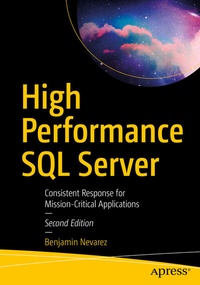
High Performance SQL Server
Description

This book shows you how to configure SQL Server and design your databases to support a given instance and workload. You will learn advanced configuration options, in-memory technologies, storage and disk configuration, and more, all aimed toward enabling your desired application performance and throughput.
Configuration doesn't stop with implementation. Workloads change over time, and other impediments can arise to thwart desired performance.
High Performance SQL Server
covers monitoring and troubleshooting to aid you in detecting and fixing production performance problems and minimizing application outages. You will learn about a variety of tools, ranging from the traditional wait analysis methodology to the query store or indexing, and you will learn how improving performance is an iterative process.
This book is an excellent complement to query performance tuning books and provides the other half of what you need to know by focusing on configuring the instances on which mission-critical queries are executed.
What You Will Learn
-
Understand SQL Server's database engine and how it processes queries
- Configure instances in support of high-throughput applications
- Provide consistent response times to varying user numbers and query volumes
- Design databases for high-throughput applications with focus on performance
- Record performance baselines and monitor SQL Server instances against them
- Troubleshot and fix performance problems
Who This Book Is For
SQL Server database administrators, developers, and data architects. The book is also of use to system administrators who are managing and are responsible for the physical servers on which SQL Server instances are run.
More details
Other editions
Additional editions
Previous edition

Person
Benjamin Nevarez is a database professional based in Los Angeles, California who specializes in SQL Server query tuning and optimization. He is the author of four books: SQL Server 2017 on Linux , High Performance SQL Server , SQL Server 2014 Query Tuning & Optimization , and Inside the SQL Server Query Optimizer , and he has co-authored other books, including SQL Server 2012 Internals . Benjamin has been a speaker at many SQL Server conferences and events around the world, including the PASS Summit, SQL Server Connections and SQLBits. His blog can be found at benjaminnevarez.com and he can be reached on twitter at @BenjaminNevarez and on Facebook.
Content
Part I. SQL Server Internals.- 1. How SQL Server Works.- 2. SQL Server on Linux.- Part II. Design and Configuration.- 3. SQL Server Configuration.- 4. tempdb Troubleshooting and Configuration.- Part III. Monitoring.- 5. Analyzing Wait Statistics.- 6. The Query Store.- Part IV. Performance Tuning and Troubleshooting.- 7. SQL Server In-Memory Technologies.- 8. Performance Troubleshooting.- 9. Indexing.- 10. Intelligent Query Processing.- 11. SQL Server Storage.
