

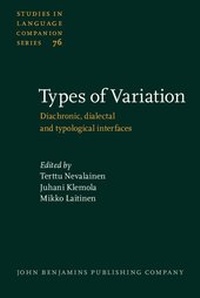
Types of Variation
Diachronic, dialectal and typological interfaces
1st Edition
Published on 1. June 2006
VIII, 378 pages
978-90-272-9359-6 (ISBN)
Description

This volume interfaces three fields of linguistics rarely discussed in the same context. Its underlying theme is linguistic variation, and the ways in which historical linguists and dialectologists may learn from insights offered by typology, and vice versa. The aim of the contributions is to raise the awareness of these linguistic subdisciplines of each other and to encourage their cross-fertilization to their mutual benefit. If linguistic typology is to unify the study of all types of linguistic variation, this variation, both diatopic and diachronic, will enrich typological research itself. With the aim of capturing the relevant dimensions of variation, the studies in this volume make use of new methodologies, including electronic corpora and databases, which enable cross- and intralinguistic comparisons dialectally and across time. Based on original research and unified by an innovative theme, the volume will be of interest to both students and teachers of linguistics and Germanic languages.
More details
Other editions
Additional editions
Terttu Nevalainen | Juhani Klemola | Mikko Laitinen
Types of Variation
Diachronic, dialectal and typological interfaces
Book
06/2006
John Benjamins Publishing Co
€127.20
Shipment within 10-15 days
Persons
Content
- Types of Variation
- Editorial page
- Title page
- LCC data
- Dedication
- Contents
- I. Typology and grammaticalization
- 'Triangulation' of diachrony, dialectology and typology
- 1. Introduction
- 2. Scope of the volume
- 2.1 Languages and language varieties
- 2.2 Materials, methods and approaches
- 3. Interfaces
- 3.1 Approaching the issue: typology and grammaticalization
- 3.2 Diachrony and typology
- 3.3 Dialectology and typology
- 3.4 Dialectology, typology and diachrony
- 4. Towards a dynamic paradigm
- Notes
- References
- Bi-directional vs. uni-directional asymmetries in the encoding of semantic distinctions in free and bound person forms
- 1. Introduction
- 2. Semantic distinctions in free and bound forms
- 2.1 Person
- 2.2 Number
- 2.3 Inclusivity and the first person complex
- 2.4 Gender
- 2.5 Summary
- 3. Free vs. bound pronoun languages and the head vs. dependent marking typology
- 4. Semantic distinctions in person forms and head vs. dependent marking
- 4.1 Hypothesis 1
- 4.2 Hypothesis 2
- 5. Bi-directional asymmetries in semantic distinctions and grammaticalization
- 6. Concluding remarks
- Abbreviations
- Notes
- References
- II. Diachrony and typology
- Historical morphology from a typological point of view
- 1. Introduction
- 2. Morphological typology
- 3. Typological parameters
- 4. Conclusion
- Notes
- References
- Typology and comparative linguistics
- Notes
- References
- Primary adjectives in English and German
- 1. Introduction
- 2. Outlining the analysis
- 2.1 General questions
- 2.2 The dimensions of comparison
- 3. The group of primary adjectives in English and German
- 3.1 Part one: Present-Day English compared to Modern German
- 3.2 Part two: Old/Middle English and Old/Middle High German
- 3.3 Part three: Germanic
- 3.4 Common Germanic Stems
- 4. Prototypical adjectives and primariness
- 5. Common primary adjectives in all Germanic languages
- 6. Conclusions
- Notes
- References
- The concessive connective albeit
- 1. Introduction
- 1.1 Data
- 1.2 Terminology
- 2. Characteristics of concessive connectives and concessive clauses
- 2.1 General characteristics
- 2.2 Sources of concessive connectives
- 2.3 Concessivity and functional levels
- 3. Diachronic developments of albeit
- 3.1 Albeit as a composite phrase
- 3.2 Albeit as an atomic connective
- 4. Albeit in PDE
- 4.1 Syntactic distribution
- 4.2 Semantic issues
- 4.3 Internet comments
- 5. Conclusion
- Notes
- References
- Possessives and determiners in Old English
- Introduction
- 1. Det Poss and Poss Det
- 2. The Det Poss construction
- 3. The Poss Det construction
- 4. Prehistory of the Det Poss construction
- 5. The demise of Poss Det in ME
- 6. Conclusion
- Appendix: Corpora examined
- Notes
- References
- Analytic of the samyn or synthetic its?
- 1. Introduction
- 1.1 Personal vs possessive pronouns - problems with terminology
- 1.2 A brief history of personal pronouns in English/Scots
- 1.3 The collapse of grammatical gender and the pronominal use
- 2. Older Scots means to render neuter possession
- 2.1 The remnants of his used for neuter possession
- 2.2 Analytic constructions in neuter possessive contexts in Older Scots vs synthetic its
- 3. Data analysis
- 3.1 The material
- 3.2 The procedure
- 3.3 Registers and thematic groups
- 3.4 Chronological distribution
- 4. Conclusions
- Appendix
- Notes
- References
- Expressing human indefiniteness in English
- 1. Introduction
- 2. Typology of indefinite expressions
- 2.1 Indefiniteness specified
- 2.2 From the concept of indefiniteness to indefiniteness in pronouns
- 3. Singular and plural variation in English
- 4. Diachronic typology and markedness of the variants
- 5. Indefinite expressions and pronominal number in diachrony
- 6. Material and criteria for inclusion
- 7. Number variation following common gender one and NPs
- 7.1 Third person pronouns with one
- 7.2 Third person forms with NPs of common gender
- 7.3 Discussion of the results of one and NPs
- 8. Cataphoric personal reference
- 8.1 Third person and demonstrative variants in cataphora
- 8.2 Discussion of cataphoric reference
- 9. Conclusions
- Appendix
- Notes
- References
- III. Dialectology and typology
- Dialect and typology
- 1. Line of argument: What is a dialect essentially?
- 2. Dialect and typology: the concepts and how they are embedded
- 3. L-change and L-learning as Darwinian processes of selection: concepts
- 4. Oral dialect and the typological parameter: Parsing in the hearing domain - the structural rise of discourse prominence
- 5. Conclusion
- Notes
- References
- Somerset relativizers revisited
- Note
- References
- Resilient or yielding?
- 1. 'Begorrah, Ned or maybe g'day?'
- 2. The sources and the questions
- 2.1 The sources
- 2.2 The questions
- 3. Unbound reflexive pronouns
- 4. The perfective aspect
- 4.1 After perfects (AFP)
- 4.2 The medial object perfect (MOP)
- 5. The expression of habitual aspect
- 5. Conclusion
- References
- Appendix
- IV. Dialectology, typology and diachrony
- Negative indefinites
- 1. Introduction
- 2. Dialectology
- 3. The diachrony of iemand niet 'someone not'
- 4. The typology of iemand (.) niet 'someone not'
- 5. Conclusion
- Notes
- References
- The relatives who and what in northern East Anglia
- 1. Introduction
- 2. Local history of the personal subject relatives
- 2.1 Corpus of Early English Correspondence (CEEC)
- 2.2 Hickling corpus
- 2.3 The Francis Corpus
- 2.4 Forby, Wright and SED on What
- 2.5 Theoretical discussion
- 3. SED Norfolk. subdialects in the Francis Corpus
- 3.1 First sorting
- 3.2 Syntactic typology of the two (rural) subdialects
- Conclusion
- Notes
- References
- Vernacular universals?
- 1. Introduction
- 2. Previous research
- 2.1 Typology and markedness
- 2.2 Was/were variation in Present-day English dialects
- 2.3 Earlier regional variation
- 3. Material and method
- 4. Results
- 4.1 Regional distribution
- 4.2 Vernacular patterns
- 4.3 Multivariate analysis
- 5. Discussion
- 5.1 Subject-type generalizations
- 5.2 Comparison with Finnish
- 6. Conclusion
- Notes
- References
- Index of languages
- Index of authors
- Index of subjects
- The series Studies in Language Companion Series
