

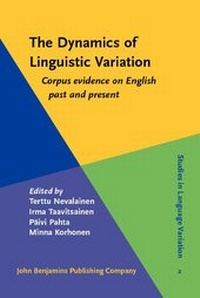
The Dynamics of Linguistic Variation
Corpus evidence on English past and present
1st Edition
Published on 3. December 2008
VIII, 339 pages
978-90-272-9038-0 (ISBN)
Description

Variability is characteristic of any living language. This volume approaches the 'life cycle' of linguistic variability in English using data sources that range from electronic corpora to the internet. In the spirit of the 1968 Weinreich, Labov and Herzog classic, the fifteen contributions divide into three sections, each highlighting different stages in the dynamics of English across time and space. They show, first, how increase in variability can be initiated by processes that give rise to new patterns of discourse, which can ultimately crystallize into new grammatical elements. The next phase is the spread of linguistic features and patterns of discourse, both new and well established, through the social and regional varieties of English. The final phase in this ebb and flow of linguistic variability consists of processes promoting some variable features over others across registers and regional and social varieties, thus resulting in reduced variation and increased linguistic homogeneity.
More details
Other editions
Additional editions
Terttu Nevalainen | Irma Taavitsainen | Paeivi Pahta
The Dynamics of Linguistic Variation
Corpus evidence on English past and present
Book
12/2008
John Benjamins Publishing Co
€111.30
Shipment within 10-15 days
Persons
Content
- The Dynamics of Linguistic Variation
- Editorial page
- Title page
- LCC data
- Table of contents
- List of contributors
- Exploring the dynamics of linguistic variation through public and private corpora
- Part I. Creating discourse
- Part I. Introduction
- "And so now...": The grammaticalisation and (inter)subjectification of now
- 1. Introduction
- 2. Previous research & synchronic functions
- 3. Historical evolution
- 4. Historical collocations
- 5. Conclusions
- References
- Electronic resources
- Self-repetition in spoken English discourse
- 1. Introduction
- 2. Definition and material
- 3. Intentional and unintentional repetition
- 4. Frequency and distribution
- 5. Functions
- 6. Turn handling
- 7. Conclusion
- References
- Modal adverbs in interaction - obviously and definitely in adolescent speech
- Pressing -ing into service: I don't want you coming around here any more
- 1. Introduction
- 2. Background
- 3. Frequency of occurrence
- 4. Approach
- 5. Analysis
- 6. Conclusion
- Corpora
- References
- Part II. Moving across varieties
- Part II. Introduction
- Conversations from the speech community: Exploring language variation in synchronic dialect corpora
- 1. Introduction
- 2. Data collection
- 3. Analytic method
- 4. Linguistic analyses
- 5. Discussion
- References
- The English modals and semi-modals: regional and stylistic variation
- 1. Introduction
- 2. Possibility
- 3. Necessity
- 4. Prediction
- 5. Conclusion
- References
- Patterns of negation: The relationship between NO and NOT in regional varieties of English
- 1. Introduction: The origins of NO and NOT
- 2. Previous research
- 3. Source materials
- 4. Overview of frequencies of NO, NOT and N'T
- 5. Linguistic factors in the use of NO
- 6. Relative frequency of NO in registers of writing
- 7. Conclusion
- Corpora used and referred to
- References
- Angloversals? Concord and interrogatives in contact varieties of English
- 1. Introduction
- 2. Database
- 3. Subject-verb concord
- 4. Interrogatives
- 5. Conclusions
- References
- South Pacific Englishes - Unity and diversity in the usage of the present perfect
- 1. Introduction
- 2. The compilation of SPEed
- 3. Aspect markers in the substrate languages
- 4. The case-study: The usage of the present perfect
- 5. Conclusion
- References
- Information from the internet
- Appendix
- Part II. Moving across varieties
- Part III. Introduction
- Feature loss in 19th century Irish English
- 1. Introduction
- 2. Features lost since the 18th century
- 3. Specifically Irish features
- 4. English dialect / archaic features
- 5. Likely transfer features from Irish
- 6. Conclusion
- References
- The written wor(l)ds of men and women in early white Australia
- The progressive and phrasal verbs: Evidence of colloquialization in nineteenth-century English?
- 1. Introduction
- 2. Material and data
- 3. Results
- 4. Discussion and conclusion
- References
- Probabilistic determinants of genitive variation in spoken and written English A multivariate compar
- 1. Introduction
- 2. Data
- 3. The linguistic variable
- 4. Overall distribution of genitives
- 5. Conditioning factors in genitive choice
- 6. Results
- 7. Summary and conclusion
- References
- Her daughter's being taken into care or her daughter being taken? Genitive and common-case marking
- 1. Introduction
- 2. Background
- 3. Material and method
- 4. Results
- 5. Summary and suggestions for further research
- References
- Index
- The Studies in Language Variation Series
