

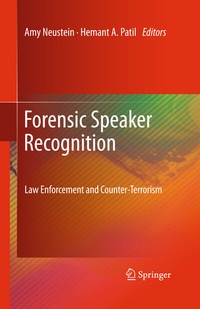
Forensic Speaker Recognition
Description

Forensic Speaker Recognition is a useful book for forensic speech scientists, speech signal processing experts, speech system developers, criminal prosecutors and counter-terrorism intelligence officers and agents.
More details
Other editions
Additional editions
Content
I. FORENSIC CASE WORK.- 1. Historical and Procedural Overview of Forensic Speaker Recognition As a Science.- 2. Automatic Speaker Recognition for Forensic Case Assessment and Interpretation.- 3. Aural/Acoustic Versus Automatic Methods in Forensic Phonetic Case Work.- 4. Speaker Profiling:The Study of Acoustic Characteristics Based on Phonetic Features of Hindi Dialects for Forensic Speaker Identification.- II. SPEECH SIGNAL DEGRADATION: MANAGING PROBLEMATIC CONDITIONS AFFECTING PROBATIVE SPEECH SAMPLES.- 5. Speech under Stress and Lombard Effect: Impact and Solutions for Forensic Speaker Recognition .- 6. Speaker Identification over Narrow band VoIP Networks.- 7. Noise Robust Speaker Identification: Using Nonlinear Modeling Techniques.- 8. Robust Speaker Recognition in Noisy Environments: Using Dynamics of Speaker-Specific Prosody.- 9. Characterization of Noise Associated with Forensic Speech Samples.- 10. Speech Processing for Robust Speaker Recognition: Analysis and Advancements for Whispered Speech.- III.METHODS AND STRATEGIES: ANALYZING FEATURES OF SPEAKER RECOGNITION TO OPTIMIZE VOICE VERIFICATION SYSTEM PERFORMANCE IN LEGAL SETTINGS.- 11. Effects of Phonological Content and Transmission Channels on Forensic Speaker Recognition.- 12. Aerodynamic and Acoustic Theory of Voice Production.- 13. Prosodic Features for Speaker Recognition.- 14. Speaker Identification Using Intermediate Matching Kernal-based Support Vector Machines.- IV. APPLICATIONS TO LAW ENFORCEMENT AND COUNTER-TERRORISM.- 15. Speaker Spotting: Automatic Telephony Surveillance for Homeland Security. 16. Helping the Forensic Research Institute of the French Gendarmerie to Identify a Suspect in the Presence of Voice Disguise or Voice Forgery. 17. Applying Lessons Learned from Commercial Voice Biometric Deployments to Forensic Investigations.- 18. Designing Better Speaker Verification Systems: Bridging the Gap between Creators and Implementers ofInvestigatory Voice Biometric Technologies
