

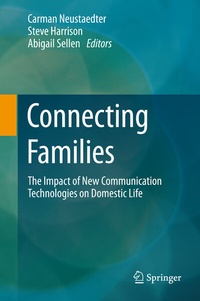
Connecting Families
Description

New technologies are radically changing the way that families connect with one another: we can text our teenagers from work, eat dinner with far-away parents via video link, and instantly upload and share photos after a family day out. Whether we are bridging time or distance, and whether we are enhancing our closest relationships or strengthening the bonds of extended family, as computer technologies alter the communication landscape, they in turn are changing the way we conduct and experience family life.
This state of the art volume explores the impact of new communication systems on how families interact - how they share their lives and routines, engage in social touch, and negotiate being together or being apart - by considering a range of different family relationships that shape the nature of communication. Composed of three sections, the first looks at what is often the core of a 'family', the couple, to understand the impact of technology on couple relationships, communication, and feelings of closeness. The second section studies immediate families that have expanded beyond just the individual or couple to include children. Here, the emphasis is on connection for communication, coordination, and play. The third section moves beyond the immediate family to explore connections between extended, distributed family members. This includes connections between adult children and their parents, grandparents and grandchildren, and adult siblings. Here family members have grown older, moved away from 'home', and forged new families.
Researchers, designers and developers of new communication technologies will find this volume invaluable. Connecting Families: The Impact of New Communication Technologies on Domestic Life brings together the most up-to-date studies to help in understanding how new communication technologies shape - and are shaped by - family life, and offers inspiration and guidance for design by makingclear what families need and value from technological systems.
Reviews / Votes
Norita Ahmad , American University of Sharjah, Sharjah, United Arab Emirates
Excerpts from full review posted Apr 2 2013 to Computing Reviews [Review #: CR141100]
This collection offers a diverse overview of research about technologies for connecting families. It suggests ways technology can be used to keep families together, regardless of composition. The handful of different technologies presented are sometimes intricate and complex, and sometimes rather simple. Some are aimed at specific family configurations, such as a long-distance relationship between a son in college and his mother at home, or grandparents and their grandchildren.
.the authors do provide some very useful technologies to connect families. This book is for readers who want to explore ways to contact and keep in touch with their loved ones when they are away.
More details
Other editions
Additional editions
Content
Connecting Families: An Introduction.- Section 1: Couples .- Designing for Collocated Couples.- Shared Living, Experiences, and Intimacy over Video Chat in Long Distance Relationships.- Section 2: Immediate Families and Children .- Intra-Family Messaging with Family Circles.- Enriching Virtual Visitation in Divorced Families.- Kids & Video: Playing with Friends at a Distance.- Section 3: The Extended, Distributed Family .- Connecting Families Across Time Zones.- Inter-Family Messaging with Domestic Media Spaces.- Reading, Laughing, and Connecting with Young Children.- Connecting Grandparents and Grandchildren.- Index.
