

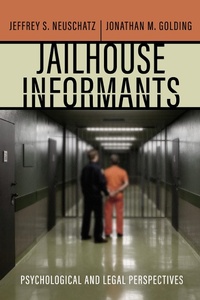
Jailhouse Informants
Psychological and Legal Perspectives
Published on 8. March 2022
277 pages
978-1-4798-0335-4 (ISBN)
Description

Offers a new understanding of jailhouse informants and the role they play in wrongful convictions
Jailhouse informants-witnesses who testify in a criminal trial, often in exchange for some incentive-are particularly persuasive to jurors. A jailhouse informant usually claims to have heard the defendant confess to a crime while they were incarcerated together. Research shows that such testimony increases the likelihood of a guilty verdict. But it is also a leading contributor to wrongful convictions. Informants, after all, are generally criminals who are offering testimony in return for some key motivator, such as a reduced sentence.
This book offers a broad overview of the history and legal and psychological issues surrounding the testimony of jailhouse informants. It provides groundbreaking psychological research to address how they are used, the number of convictions that have ultimately been overturned on other evidence, how such informants are perceived in the courtroom, and by what means jurors might be informed about the risks of this type of testimony. The volume provides a much-needed examination of legal remedies to the impact of jailhouse informants and suggests best practices in dealing with jailhouse informant testimony in court.
There is a critical need to understand the influence of jailhouse informants and how their testimony can best be handled in court in the interests of justice. Jailhouse Informants is the first work of its kind that rises to the challenge of answering these difficult questions.
Jailhouse informants-witnesses who testify in a criminal trial, often in exchange for some incentive-are particularly persuasive to jurors. A jailhouse informant usually claims to have heard the defendant confess to a crime while they were incarcerated together. Research shows that such testimony increases the likelihood of a guilty verdict. But it is also a leading contributor to wrongful convictions. Informants, after all, are generally criminals who are offering testimony in return for some key motivator, such as a reduced sentence.
This book offers a broad overview of the history and legal and psychological issues surrounding the testimony of jailhouse informants. It provides groundbreaking psychological research to address how they are used, the number of convictions that have ultimately been overturned on other evidence, how such informants are perceived in the courtroom, and by what means jurors might be informed about the risks of this type of testimony. The volume provides a much-needed examination of legal remedies to the impact of jailhouse informants and suggests best practices in dealing with jailhouse informant testimony in court.
There is a critical need to understand the influence of jailhouse informants and how their testimony can best be handled in court in the interests of justice. Jailhouse Informants is the first work of its kind that rises to the challenge of answering these difficult questions.
Reviews / Votes
"A unique and important contribution to the field of forensic psychology." - Brian Cutler, editor of Expert Testimony on the Psychology of Eyewitness Identification "Wonderfully written and fills in many gaps in the literature with regard to cooperating witnesses. A must read for those interested in forensic psychology and in the enduring work of creating a more effective justice system." - Deah Quinlivan, Florida Southern College "Neuschatz and Golding offer a broad overview of the history and legal and psychological issuessurrounding the testimony of jailhouse informants in the United States.
" (Law and Social Inquiry) "Incentivizing jailhouse information is one of several themes in the book as the authors draw together research on deception, confessions, testimony, witnesses, and jurors...In the context of recent public pressure to examine and combat racial injustice in the criminal justice system, this book is a valuable contribution to forensic psychology." (Choice) "Neuschatz and Golding do an outstanding job explaining the issues, the existing research and legislation shortfall, and the psychological theories that drive jailhouse informants, criminal justice practitioners, and jurors. This text is truly a must-read and is written so that anyone can easily absorb and immediately use the information provided by the authors to improve the way jailhouse informants are used." - Journal of Police and Criminal Psychology (Journal of Police and Criminal Psychology)
More details
Series
Language
English
Place of publication
New York
United States
Target group
Professional and scholarly
ISBN-13
978-1-4798-0335-4 (9781479803354)
Copyright in bibliographic data and cover images is held by Nielsen Book Services Limited or by the publishers or by their respective licensors: all rights reserved.
Schweitzer Classification
Other editions
Additional editions
Book
03/2022
New York University Press
€34.50
Shipment within 10-20 days
Persons
Jeffrey S. Neuschatz (Author)
Jeffrey S. Neuschatz is Distinguished Professor in the Department of Psychology at The University of Alabama in Huntsville.
Jonathan M. Golding (Author)
Jonathan M. Golding is Professor in the Department of Psychology at the University of Kentucky.
Jeffrey S. Neuschatz is Distinguished Professor in the Department of Psychology at The University of Alabama in Huntsville.
Jonathan M. Golding (Author)
Jonathan M. Golding is Professor in the Department of Psychology at the University of Kentucky.
