

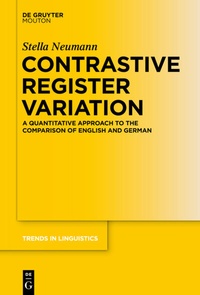
Contrastive Register Variation
A Quantitative Approach to the Comparison of English and German
1st Edition
Published on 12. December 2013
XX, 361 pages
978-3-11-023859-4 (ISBN)
Description

The book provides the first comparison of usage preferences across registers in the language pair English-German. Due to the innovative quantitative approach and broad coverage, the volume is an excellent resource for scholars working in contrastive linguistics and translation studies as well as for corpus linguists.
More details
Series
Language
English
Place of publication
Berlin/Boston
Germany
Publishing group
de Gruyter Mouton
Target group
Professional and scholarly
US School Grade: College Graduate Student
Illustrations
60 s/w Tabellen
60 b/w tbl.
File size
3,11 MB
ISBN-13
978-3-11-023859-4 (9783110238594)
DOI
http://www.degruyter.com/isbn/9783110238594
Schweitzer Classification
Other editions
Additional editions
Stella Neumann
Contrastive Register Variation
A Quantitative Approach to the Comparison of English and German
Book
12/2013
1st Edition
De Gruyter Mouton
€189.95
Shipment within 7-9 days
Person
Stella Neumann, RWTH Aachen University, Germany.
Content
- Intro
- Acknowledgements
- List of tables and figures
- List of abbreviations
- Chapter 1. Introduction
- 1 The concept of variation in linguistics
- 2 Goal of the study
- 3 Methodology for the investigation of variation
- 4 Organisation of the study
- Part 1: Theoretical foundations
- Chapter 2. State of the art
- 1 Texts: a view on text linguistics
- 2 Register: situating texts in the language system
- 3 Variation: comparing linguistic systems
- 3.1 Contrastive linguistics -
- 3.2 Lexico-grammatical variation across languages -
- 3.3 Register variation across languages -
- 4 Translation: influences from language mediation
- 4.1 Register analysis in translation studies -
- 4.2 Translation properties -
- 5 Envoi
- Chapter 3. On empirical methods in linguistics
- 1 Conceptual and methodological links between linguistics and social sciences
- 2 Empirical methods
- 2.1 Qualitative and quantitative approaches
- 2.2 From abstract concepts to observable features
- 3 Quality criteria for empirical research
- 4 Limits of cross-linguistic empirical research
- 5 Summary
- Chapter 4. Indicators of register classification
- 1 Field of discourse
- 1.1 Experiential domain
- 1.2 Goal orientation
- 2 Tenor of discourse
- 2.1 Agentive roles
- 2.2 Social role relationship
- 2.3 Social distance
- 2.4 Appraisal
- 3 Mode of discourse
- 3.1 Language role
- 3.2 Channel
- 3.3 Medium
- 4 Summary
- Part 2: Empirical analysis
- Chapter 5. Research design
- 1 The corpus
- 1.1 Design
- 1.2 Enrichment
- 2 Exploiting the corpus
- 2.1 Query tools
- 2.2 Statistics
- 3 Corpus contrasts
- 3.1 Overview of the contrasts
- 3.2 Relative register values
- 4 Hypotheses
- 4.1 Language-internal variation in originals
- 4.2 Cross-linguistic variation in originals
- 4.3 Variation between originals and translations
- 5 Summary
- Chapter 6. English intralingual register variation
- 1 Field of discourse
- 1.1 Experiential domain
- 1.2 Goal orientation
- 2 Tenor of discourse
- 2.1 Social role relationship
- 2.2 Social distance
- 3 Mode of discourse
- 3.1 Language role
- 3.2 Medium
- 4 Summary
- Chapter 7. German intralingual register variation
- 1 Field of discourse
- 1.1 Experiential domain
- 1.2 Goal orientation
- 2 Tenor of discourse
- 2.1 Social role relationship
- 2.2 Social distance
- 3 Mode of discourse
- 3.1 Language role
- 3.2 Medium
- 4 Summary
- Chapter 8. Cross-linguistic register comparison
- 1 Field of discourse
- 1.1 Experiential domain
- 1.2 Goal orientation
- 2 Tenor of discourse
- 2.1 Social role relationship
- 2.2 Social distance
- 3 Mode of discourse
- 3.1 Language role
- 3.2 Medium
- 4 Summary
- Chapter 9. Variation between originals and translations
- 1 Field of discourse
- 1.1 Experiential domain
- 1.2 Goal orientation
- 2 Tenor of discourse
- 2.1 Social role relationship
- 2.2 Social distance
- 3 Mode of discourse
- 3.1 Language role
- 3.2 Medium
- 4 Summary
- Chapter 10. Insights on register variation
- 1 Variation in the CroCo registers
- 1.1 Variation in the English registers
- 1.2 Variation in the German registers
- 1.3 Cross-linguistic variation
- 1.4 Variation between the originals and translations
- 2 The hypotheses revisited
- 3 Towards a model of register variation
- Chapter 11. Conclusions
- 1 Summary of the results
- 2 Evaluation of the methodology
- 3 Outlook
- References
- Appendix: Linguistic features in alphabetic order
- Index
