

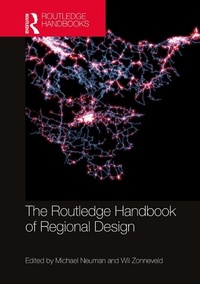
The Routledge Handbook of Regional Design
1st Edition
Published on 14. April 2021
484 pages
978-1-000-36654-9 (ISBN)
Description

The Routledge Handbook of Regional Design explores contemporary research, policy, and practice that highlight critical aspects of strategy-making, planning, and designing for contemporary regions-including city regions, bioregions, delta regions, and their hybrids.
As accelerating urbanization and globalization combine with other forces such as the demand for increasing returns on investment capital, migration, and innovation, they yield cities that are expanding over ever-larger territories. Moreover, these polycentric city regions themselves are agglomerating with one another to create new territorial mega-regions. The processes that beget these novel regional forms produce numerous and significant effects, positive and negative, that call for new modes of design and management so that the urban places and the lives and well-being of their inhabitants and businesses thrive sustainably into the future.
With international case studies from leading scholars and practitioners, this book is an important resource not just for students, researchers, and practitioners of urban planning, but also policy makers, developers, architects, engineers, and anyone interested in the broader issues of urbanism.
As accelerating urbanization and globalization combine with other forces such as the demand for increasing returns on investment capital, migration, and innovation, they yield cities that are expanding over ever-larger territories. Moreover, these polycentric city regions themselves are agglomerating with one another to create new territorial mega-regions. The processes that beget these novel regional forms produce numerous and significant effects, positive and negative, that call for new modes of design and management so that the urban places and the lives and well-being of their inhabitants and businesses thrive sustainably into the future.
With international case studies from leading scholars and practitioners, this book is an important resource not just for students, researchers, and practitioners of urban planning, but also policy makers, developers, architects, engineers, and anyone interested in the broader issues of urbanism.
Reviews / Votes
"This book brings together a diversity of chapters dealing with theoretical advances and practical innovations in the newly emerging field of regional design. These chapters cover an exceptionally broad international and thematic range of questions. As the editors and contributors argue, existing political administrations, from the local to the national, are ill-equipped to deal with the mounting problems of institutional and spatial design in the exploding city-regions, mega-regions and bio-regions of the contemporary world. The book offers many penetrating insights into these problems and offers much new thinking about critical issues of governance. It is destined to be widely read by academics, practitioners and students."-Allen J. Scott, Distinguished Research Professor, University of California, Los Angeles
"At a time when societies all over the world face major challenges, planning and planners are urged to move beyond the local level. This timely and well-balanced book combines reflections on the foundation of regional design with carefully selected case studies and considerations for education and governance by leading thinkers and practitioners from around the globe."
-Louis Albrechts, Emeritus Professor of Planning, KULeuven "This book brings together a diversity of chapters dealing with theoretical advances and practical innovations in the newly emerging field of regional design. These chapters cover an exceptionally broad international and thematic range of questions. As the editors and contributors argue, existing political administrations, from the local to the national, are ill-equipped to deal with the mounting problems of institutional and spatial design in the exploding city-regions, mega-regions and bio-regions of the contemporary world. The book offers many penetrating insights into these problems and offers much new thinking about critical issues of governance. It is destined to be widely read by academics, practitioners and students."
Allen J. Scott, Distinguished Research Professor, University of California, Los Angeles
"At a time when societies all over the world face major challenges, planning and planners are urged to move beyond the local level. This timely and well-balanced book combines reflections on the foundation of regional design with carefully selected case studies and considerations for education and governance by leading thinkers and practitioners from around the globe."
Louis Albrechts, Emeritus Professor of Planning, KULeuven
"Michael Neuman and Wil Zonneveld's Routledge Handbook of Regional Design provides a timely response to set the intellectual agenda for regional planning. This handbook is long overdue ... very interesting and informative. The coverage of cases across different countries and continents does provide a rich source of reference and showcases the contemporary landscape of regional design. "
Cecilia Wong, University of Manchester
"If you are interested in all things regional, spatial, planning, and governance then this is a book for you... the Handbook excels ... important ... distinctive contribution"
John Harrison, Loughborough University:
"Expands traditional understandings of 'design' in new directions fascinating chapters, providing concise [case study] histories."
Stephen Wheeler, University of California at Davis
"Offers a wealth of well-documented case histories [plus] an inspiring diversity of special topics on how to understand certain qualities of the region and its governance [that] informs today's integral policy-making."
Terry van Dijk, University of Groningen
"Michael Neuman's seminal 2000 article [Chapter 1] initiated a surge of interest in what he has called regional design... a sweeping view... Neuman and Zonnefeld deserve praise for their latest entry in this long history."
Michael Teitz, University of California at Berkeley
More details
Edition
1. Auflage
Language
English
Place of publication
London
United Kingdom
Publishing group
Taylor & Francis Ltd
Target group
College/higher education
Professional and scholarly
Illustrations
33 Tables, black and white; 14 Line drawings, black and white; 107 Halftones, black and white; 121 Illustrations, black and white
ISBN-13
978-1-000-36654-9 (9781000366549)
Copyright in bibliographic data and cover images is held by Nielsen Book Services Limited or by the publishers or by their respective licensors: all rights reserved.
Schweitzer Classification
Other editions
Additional editions
Michael Neuman | Wil Zonneveld
The Routledge Handbook of Regional Design
Book
08/2024
1st Edition
Routledge
€69.80
Shipment within 15-20 days
Michael Neuman | Wil Zonneveld
The Routledge Handbook of Regional Design
Book
04/2021
1st Edition
Routledge
€266.16
Shipment within 15-20 days
Michael Neuman | Wil Zonneveld
The Routledge Handbook of Regional Design
Book
04/2021
Routledge
Unfortunately, price unknown
Available (delivery time upon request)
Persons
Michael Neuman is Professor of Sustainable Urbanism at the University of Westminster and Principal of the Michael Neuman Consultancy. He is the multi-award-winning author of numerous books, articles, chapters, reports, and plans that have been translated into ten languages. His research and practice span urbanism, planning, design, engineering, sustainability, infrastructure, and governance. He has advised mayors in Europe, the United States, and Australia, the Regional Plan Association of New York, the Barcelona Metropolitan Plan, and other governments and private clients around the world.
Wil Zonneveld is Full Professor of Urban and Regional Planning in the Department of Urbanism, Faculty of Architecture and the Built Environment, TU Delft. The subject of his 1991 PhD thesis was the conceptualization of space and territory in Dutch regional and national planning. This subject has been addressed many times since then, extending analyses to include transnational and European levels of scale, with a strong emphasis on visualization and connections with governance capacity.
Wil Zonneveld is Full Professor of Urban and Regional Planning in the Department of Urbanism, Faculty of Architecture and the Built Environment, TU Delft. The subject of his 1991 PhD thesis was the conceptualization of space and territory in Dutch regional and national planning. This subject has been addressed many times since then, extending analyses to include transnational and European levels of scale, with a strong emphasis on visualization and connections with governance capacity.
Content
Part I: Intellectual Underpinnings and Practices
Introduction: The Resurgence of Regional Design
Chapter 1. The Emergence of Regional Design: Recovering a Great Landscape Architecture and Planning Tradition
Chapter 2. European History and Traditions: Revisiting the European Spatial Development Perspective
Chapter 3. The Ecological Underpinnings of Regional Design
Chapter 4. Contemporary Regional Design Theory
Part II: City Region Case Studies
Chapter 5. Urban Policies and Strategies for Balanced Regional Development in Korea
Chapter 6. Japan's Linear Megalopolis: Shinkansen High-speed Rail as the Spine of a 60-year Mega-region Evolution
Chapter 7. Germany's 'European Metropolitan Regions'
Chapter 8. Can Megalopolis Continue To Thrive? A Profile of the US Northeast Megaregion and Its Prospects
Chapter 9. The Texas Urban Triangle Megaregion
Chapter 10. Designing the New York Metropolitan Region
Chapter 11. The Santiago de Chile Metropolitan System: Transformative Tensions and Contradictions Shaping Spatial Planning
Chapter 12. Nairobi
Chapter 13. Design and Governance for the Barcelona City Region
Chapter 14. Regional Planning and Regional Design in Greater Paris
Chapter 15. Sydney: Evolution Towards a Tri-city Metropolitan Region and Beyond
Chapter 16. Who Designed Los Angeles? Nature, Profit, Policy, People
Part III: Hydraulic, Ecological, and Bioregional Design Case Studies
Chapter 17. The Dutch Deltametropolis
Chapter 18. The Regional Design of Green Infrastructure in the Pearl River Delta
Chapter 19. Regional Design Stepping into the Sea
Chapter 20. Bioregional Design: The Design Science of the Future
Part IV: Education, Management, and Governance
Chapter 21. Interdisciplinary Pedagogies for Regional Development Challenges: The Re-coupling of Planning, Design and the Social Sciences
Chapter 22. Imagining the Region
Chapter 23. Mapping for Regions
Chapter 24. The Complex Ecology of the City-Region
Chapter 25. The Futures of Regional Design
Introduction: The Resurgence of Regional Design
Chapter 1. The Emergence of Regional Design: Recovering a Great Landscape Architecture and Planning Tradition
Chapter 2. European History and Traditions: Revisiting the European Spatial Development Perspective
Chapter 3. The Ecological Underpinnings of Regional Design
Chapter 4. Contemporary Regional Design Theory
Part II: City Region Case Studies
Chapter 5. Urban Policies and Strategies for Balanced Regional Development in Korea
Chapter 6. Japan's Linear Megalopolis: Shinkansen High-speed Rail as the Spine of a 60-year Mega-region Evolution
Chapter 7. Germany's 'European Metropolitan Regions'
Chapter 8. Can Megalopolis Continue To Thrive? A Profile of the US Northeast Megaregion and Its Prospects
Chapter 9. The Texas Urban Triangle Megaregion
Chapter 10. Designing the New York Metropolitan Region
Chapter 11. The Santiago de Chile Metropolitan System: Transformative Tensions and Contradictions Shaping Spatial Planning
Chapter 12. Nairobi
Chapter 13. Design and Governance for the Barcelona City Region
Chapter 14. Regional Planning and Regional Design in Greater Paris
Chapter 15. Sydney: Evolution Towards a Tri-city Metropolitan Region and Beyond
Chapter 16. Who Designed Los Angeles? Nature, Profit, Policy, People
Part III: Hydraulic, Ecological, and Bioregional Design Case Studies
Chapter 17. The Dutch Deltametropolis
Chapter 18. The Regional Design of Green Infrastructure in the Pearl River Delta
Chapter 19. Regional Design Stepping into the Sea
Chapter 20. Bioregional Design: The Design Science of the Future
Part IV: Education, Management, and Governance
Chapter 21. Interdisciplinary Pedagogies for Regional Development Challenges: The Re-coupling of Planning, Design and the Social Sciences
Chapter 22. Imagining the Region
Chapter 23. Mapping for Regions
Chapter 24. The Complex Ecology of the City-Region
Chapter 25. The Futures of Regional Design
