

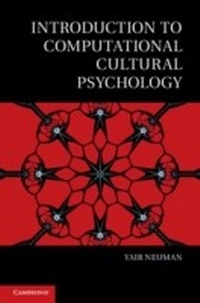
Introduction to Computational Cultural Psychology
1st Edition
Published on 31. January 2014
978-1-107-72285-9 (ISBN)
Description

Human psychology is deeply rooted in the culture in which people live. Introduction to Computational Cultural Psychology introduces a revolutionary approach for studying cultural psychology. Drawing on novel computational tools and in-depth case studies, Professor Yair Neuman offers thought-provoking answers to questions such as: how are thought and language deeply related? How can computers help us to understand different cultures? How can computers assist military intelligence in identifying vengeful intentions? And how is our concept of 'love' rooted in our basic embodied experience? Written by a leading interdisciplinary researcher this book is a 'tour-de-force' which will be of interest to a variety of researchers, students and practitioners in psychology as well as an interdisciplinary audience with an interest in the intricate web weaved between the human psyche and its cultural context.
Reviews / Votes
'The cognitive sciences have been motivated and guided by the premise that human mentality can be modeled in computational ways through algorithms and other computer formats. The underlying assumption has always been that cognition can be studied as a universal state of the brain independently of its location in space and time. This book challenges this assumption by showing, brilliantly, how cognition is an intricate product of the interaction of the brain, the body, and the situation. Neuman's revision of the algorithmic principle in semiotic terms is truly masterful, showing how computation can serve the modeling process, not dominate it. This work is required reading for all cognitive scientists. It illuminates the core of the modeling problem and shows which path the cognitive sciences must follow in the future in a world that has extended the brain and its capacities in the computational realm of the global village.' Marcel Danesi, University of Toronto and Editor of Semiotica 'Introduction to Computational Cultural Psychology advances the field beyond the thinking of other merely applied paradigm of computational thinking of social science, which could only mediate at best between tools of computational science and its target application the social domain, which is inherently complex. Neuman's brilliant and innovative thinking moves the reader towards a new and comprehensive paradigm on computational cultural psychology - one that allows the field and readers to think and understand computational cultural psychology as a meaning-making system. In doing so, and by the many situational and rich cultural examples, he seduces the reader towards a focus of on the semiotically mediated nature of meaning and system-like thinking of such complex phenomenon of thought in the human mind. This is brilliant and well-articulated must-read for scholars and readers of all level on culture linguistics and computational studies.' Newton Howard, Massachusetts Institute of TechnologyMore details
Series
Language
English
Place of publication
Cambridge
United Kingdom
Target group
Professional and scholarly
College/higher education
Illustrations
10 Tables, black and white; 17 Line drawings, black and white
File size
3,86 MB
ISBN-13
978-1-107-72285-9 (9781107722859)
Copyright in bibliographic data and cover images is held by Nielsen Book Services Limited or by the publishers or by their respective licensors: all rights reserved.
Schweitzer Classification
Other editions
Additional editions
Book
02/2014
Cambridge University Press
€43.10
Shipment within 15-20 days
Book
02/2014
Cambridge University Press
€101.70
Shipment within 15-20 days
Person
Yair Neuman is a professor in the Department of Education at Ben-Gurion University of the Negev in Israel. Professor Neuman was the chief algorithm developer at IARPA Metaphor Project, where novel algorithms have been developed for the identification of metaphorical language. His work has been published extensively in leading journals for various disciplines including psychology, psychoanalysis, theoretical biology, mathematical modelling, semiotics and information sciences. His last book Reviving the Living: Meaning Making in Living Systems was published in 2008.
Content
1. What is computational cultural psychology?; 2. The digital psychologist: information technology and cultural psychology; 3. Why don't primates have God? Language and the abstraction of thought; 4. Lost in translation: how to use automatic translation machines for understanding 'otherness'; 5. Spies and metaphors: automatic identification of metaphors for strategic intelligence; 6. Scent of a woman: the mediation of smell and automatic analysis of extended senses; 7. Dolly Parton's love lexicon: detection of motifs in cultural texts; 8. The relational matrix of the I; 9. Identifying themes: from the Wingfield family to Harry and Sally; 10. Eating and dining: studying the dynamics of dinner; 11. Getting even: the cultural psychology of revenge and what computers can do about it; Epilogue. On generals and mail coach drivers.
