

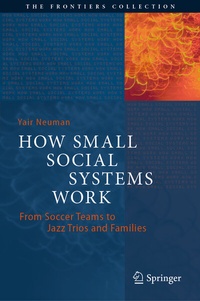
How Small Social Systems Work
Description

Most of us are intuitively familiar with small social systems, such as families and soccer teams. Surprisingly, though, most of us are unaware of how complex these systems are or of the fact that they have a unique character distinguishing them from both populations and individuals. The current manuscript, which emerged from high-level scientific publications on the subject, aims to bridge this gap in our understanding of small social systems. The book aims to explain, illustrate, and model the unique and fascinating nature of small (social) systems by relying on deep scientific foundations and by using examples from sport, movies, music, and the martial arts. To support its friendly exposition of challenging scientific ideas, the book also discusses entertaining questions such as (1) why inviting your mother-in-law to dinner might be a challenging event, for reasons you have never considered; (2) why soccer teams should be messy in order to win; (3) why Nazis are deeply wrong in their understanding of the importance of entropy; and (4) why "panda fighters" failed in the UFC (Ultimate Fighting Championship).
"How Small Systems Work is a welcome book, which sheds light on a branch of mathematics overlooked by scholars: how networks store information. Focusing on small systems, the book asks fundamental questions, providing the tools (and the examples) for answering them -with fun. Neuman analyses, with plenty of humor, the dynamics of a family of cats, the pleasure of listening to jazz, and the science behind football championships, while uncovering hidden gems in the history of cinema"
Dr. Mario Alemi, author of "The Amazing Journey of Reason: from DNA to Artificial Intelligence"
More details
Other editions
Additional editions

Person
Professor Yair Neuman (b. 1968) is the author of numerous papers and eight academic books published by leading publishers. He has been a visiting professor at various universities, such as Oxford, Toronto and MIT, and holds a full professorship at the Department of Cognitive and Brain Sciences, Ben-Gurion University of the Negev, Israel. His most recent book, dealing with mathematics and literature, appeared in a new book series published in collaboration with the Fields Institute for Research in Mathematical Sciences.
