

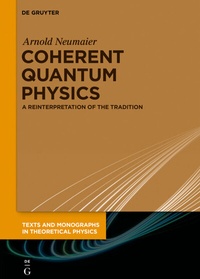
Coherent Quantum Physics
Description

This book introduces mathematicians, physicists, and philosophers to a new, coherent approach to theory and interpretation of quantum physics, in which classical and quantum thinking live peacefully side by side and jointly fertilize the intuition. The formal, mathematical core of quantum physics is cleanly separated from the interpretation issues. The book demonstrates that the universe can be rationally and objectively understood from the smallest to the largest levels of modeling. The thermal interpretation featured in this book succeeds without any change in the theory. It involves one radical step, the reinterpretation of an assumption that was virtually never questioned before - the traditional eigenvalue link between theory and observation is replaced by a q-expectation link: Objective properties are given by q-expectations of products of quantum fields and what is computable from these. Averaging over macroscopic spacetime regions produces macroscopic quantities with negligible uncertainty, and leads to classical physics.
- Reflects the actual practice of quantum physics.
- Models the quantum-classical interface through coherent spaces.
- Interprets both quantum mechanics and quantum field theory.
- Eliminates probability and measurement from the foundations.
- Proposes a novel solution of the measurement problem.
More details
Other editions
Additional editions
Person
Content
- Intro
- Preface
- Foreword
- Contents
- 1. Introduction
- Part I: Mathematical concepts for quantum physics
- 2. Basic quantum physics
- 3. Uncertainty, statistics, probability
- 4. Euclidean spaces
- 5. Coherent spaces
- 6. Coherent quantum physics
- 7. Quantum field theory and quantum statistical mechanics
- Part II: The interpretation of quantum physics
- 8. Requirements for good foundations
- 9. The thermal interpretation of quantum physics
- 10. Measurement
- 11. Measurement devices
- 12. Particles
- 13. Some quantum experiments
- Part III: Appendix: Critique of the tradition
- 14. A critique of Born's rule
- 15. Pure states and mixed states
- 16. Traditional interpretations
- Bibliography
- Authors
- Index
