

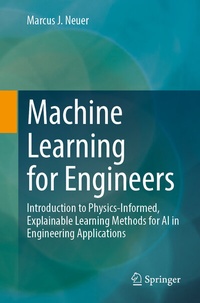
Machine Learning for Engineers
Description

Machine learning and artificial intelligence are ubiquitous terms for improving technical processes. However, practical implementation in real-world problems is often difficult and complex.
This textbook explains learning methods based on analytical concepts in conjunction with complete programming examples in Python, always referring to real technical application scenarios. It demonstrates the use of physics-informed learning strategies, the incorporation of uncertainty into modeling, and the development of explainable, trustworthy artificial intelligence with the help of specialized databases.
Therefore, this textbook is aimed at students of engineering, natural science, medicine, and business administration as well as practitioners from industry (especially data scientists), developers of expert databases, and software developers.
More details
Other editions
Additional editions
Person
Dr. Marcus J. Neuer has developed machine learning and explainable artificial intelligence for usable, profitable applications in various research and industry projects. He leads the research and development department at innoRIID GmbH and teaches at RWTH Aachen as well as the University of Applied Sciences for Business, FHDW. His algorithms are successfully used today in various products, including in the fields of nuclear safety and the process industry.
Content
1 Introduction to Working with Data.- 2 Data as a Stochastic Process.- 3 Exploratory Analysis (Data Cleaning, Histograms, Principal Component Analysis, Mathematical Transformations).- 4 Fundamentals of Supervised and Unsupervised Learning Methods.- 5 Physics-Informed Learning Methods (Optimization Methods for Data Preprocessing, Integration of Transformatively-Enriched Data, Integration of Mathematical Models).- 6 Stochastic Learning Methods (Mixture-Density Networks, Credal Networks).- 7 Semantic Databases.- 8 Explainable, Trustworthy Artificial Intelligence.
