

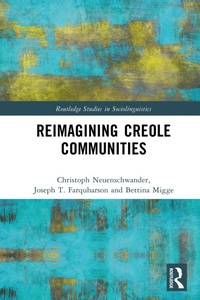
Reimagining Creole Communities
1st Edition
Published on 28. April 2026
272 pages
978-1-040-70133-1 (ISBN)
Description

This volume undertakes a reimagination of Creole communities in the Caribbean and beyond by addressing the persistent disconnect between contemporary research on Creole communities and Sociolinguistics. While it acknowledges that early interactions between these fields have been fruitful, especially in understanding variation, Creole grammars and their relationship to their input languages, research on Creole communities subsequently prioritised typological and genealogical research, neglecting social meaning, speaker agency, and stylistic variation.
The book advocates for a 'social turn' in research on Creole communities, urging a (re)connection with contemporary sociolinguistic concepts to normalise Creoles and their lexifiers, such as English, as objects of study within broader paradigms. It embraces post-structuralist approaches, focusing on language ideologies, identity work, and indexicality, and capitalise on concepts such as 'forcefields' and '(semiotic) assemblages' to analyse the complex interplay of linguistic, social, political, economic, and ideological influences. The exploration challenges binary or linear framings of the linguistic landscape in Creole communities, such as diglossia or (post-)Creole continua, which often fail to capture the fluid, messy realities of language use. Crucially, we critique the 'myth of orderly multilingualism', an ideology that misrepresents the diverseness of linguistic practices in Creole contexts by assuming languages can be neatly separated.
Drawing on insights from the English-official Caribbean, Guiana region, and the Pacific, this book will be a valuable resource for students and scholars in Pidgin and Creole Studies, contact linguistics, World Englishes, and sociolinguistics.
The book advocates for a 'social turn' in research on Creole communities, urging a (re)connection with contemporary sociolinguistic concepts to normalise Creoles and their lexifiers, such as English, as objects of study within broader paradigms. It embraces post-structuralist approaches, focusing on language ideologies, identity work, and indexicality, and capitalise on concepts such as 'forcefields' and '(semiotic) assemblages' to analyse the complex interplay of linguistic, social, political, economic, and ideological influences. The exploration challenges binary or linear framings of the linguistic landscape in Creole communities, such as diglossia or (post-)Creole continua, which often fail to capture the fluid, messy realities of language use. Crucially, we critique the 'myth of orderly multilingualism', an ideology that misrepresents the diverseness of linguistic practices in Creole contexts by assuming languages can be neatly separated.
Drawing on insights from the English-official Caribbean, Guiana region, and the Pacific, this book will be a valuable resource for students and scholars in Pidgin and Creole Studies, contact linguistics, World Englishes, and sociolinguistics.
More details
Series
Edition
1. Auflage
Language
English
Place of publication
London
United Kingdom
Publishing group
Taylor & Francis Ltd
Target group
College/higher education
Product notice
Reflowable
Illustrations
2 Tables, black and white; 3 Line drawings, black and white; 3 Illustrations, black and white
File size
3,01 MB
ISBN-13
978-1-040-70133-1 (9781040701331)
Copyright in bibliographic data and cover images is held by Nielsen Book Services Limited or by the publishers or by their respective licensors: all rights reserved.
Schweitzer Classification
Other editions
Additional editions
Christoph Neuenschwander | Joseph T. Farquharson | Bettina Migge
Reimagining Creole Communities
Book
04/2026
1st Edition
Routledge
€230.27
Shipment within 10-20 days
Persons
Christoph Neuenschwander is a postdoctoral researcher in the School of Languages, Cultures and Linguistics at University College Dublin, Ireland.
Joseph T. Farquharson is Senior Lecturer in Linguistics in the Department of Language, Linguistics and Philosophy at the Mona campus of The University of the West Indies, Jamaica.
Bettina Migge is Full Professor of Linguistics in the School of Languages, Cultures and Linguistics at University College Dublin, Ireland.
Joseph T. Farquharson is Senior Lecturer in Linguistics in the Department of Language, Linguistics and Philosophy at the Mona campus of The University of the West Indies, Jamaica.
Bettina Migge is Full Professor of Linguistics in the School of Languages, Cultures and Linguistics at University College Dublin, Ireland.
Content
Chapter 1: Setting the stage for reimagining Creole communities, Chapter 2: Identifying Language Ideologies in Creole Contexts, Chapter 3: Exploring different perspectives on language ideology, Chapter 4: Deconstructing English in the Caribbean and beyond, Chapter 5: Researching the sociolinguistics of Creoles, Chapter 6: Rethinking empowerment in Creole communities: Applied approaches, Chapter 7: Revisiting forcefields, Index
