

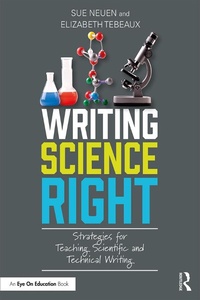
Writing Science Right
Strategies for Teaching Scientific and Technical Writing
Published on 18. September 2017
168 pages
978-1-351-71377-1 (ISBN)
Description

Help your students improve their science understanding and communicate their knowledge more effectively. Writing Science Right shows you the best ways to teach content-area writing so that students can share their learning and discoveries through informal and formal writing assignments and oral presentations.
You'll teach students how to...
identify their audience and an appropriate organizational structure for their writing;
achieve a readable style by knowing the reader's background knowledge;
build effective sentences and concise paragraphs;
prepare and deliver oral presentations that bring content to life;
use major science articles, abstracts, and summaries as mentor texts;
and more!
Throughout the book, you'll find a wide variety of sample articles and suggested assignments that you can use immediately. In addition, a list of additional teaching texts and resources is available on the Routledge website at www.routledge.com/9781138302679.
You'll teach students how to...
identify their audience and an appropriate organizational structure for their writing;
achieve a readable style by knowing the reader's background knowledge;
build effective sentences and concise paragraphs;
prepare and deliver oral presentations that bring content to life;
use major science articles, abstracts, and summaries as mentor texts;
and more!
Throughout the book, you'll find a wide variety of sample articles and suggested assignments that you can use immediately. In addition, a list of additional teaching texts and resources is available on the Routledge website at www.routledge.com/9781138302679.
Reviews / Votes
"Science education is quickly becoming fully interdisciplinary as we break down barriers between science, technology, engineering, and math (STEM) and expand students' opportunities to communicate ideas about complex issues that affect our nation and the world. With the emphasis on STEM and student research, excellent writing and presenting is of utmost importance for student success and advancing scientific findings. Writing Science Right contains practical examples for bringing science and writing together, from authors who are deeply committed to education." - Dr. Carol O'Donnell, Director, Smithsonian Science Education CenterMore details
Language
English
Place of publication
London
United Kingdom
Publishing group
Taylor & Francis Ltd
Target group
College/higher education
Professional and scholarly
Product notice
Reflowable
Illustrations
24 s/w Abbildungen
15 Line drawings, black and white; 6 Halftones, black and white; 21 Illustrations, black and white
File size
6,75 MB
ISBN-13
978-1-351-71377-1 (9781351713771)
Copyright in bibliographic data and cover images is held by Nielsen Book Services Limited or by the publishers or by their respective licensors: all rights reserved.
Schweitzer Classification
Other editions
Additional editions
Sue Neuen | Elizabeth Tebeaux
Writing Science Right
Strategies for Teaching Scientific and Technical Writing
Book
09/2017
1st Edition
Routledge
€133.69
Shipment within 10-20 days
Sue Neuen | Elizabeth Tebeaux
Writing Science Right
Strategies for Teaching Scientific and Technical Writing
Book
09/2017
1st Edition
Routledge
€40.10
Shipment within 10-20 days
Persons
Sue Neuen has had 16 years' experience as a school administrator and teacher. She received a Master of Science degree in Educational Administration with emphasis on School Restructuring from the University of Wisconsin-Madison, WI.
Elizabeth Tebeaux, Professor Emerita, taught English for 35 years at Texas A&M. She received her PhD from A&M, her MA in English from Sam Houston State University, a MEd from the University of Houston, and a BA from Baylor University in Math and English.
Elizabeth Tebeaux, Professor Emerita, taught English for 35 years at Texas A&M. She received her PhD from A&M, her MA in English from Sam Houston State University, a MEd from the University of Houston, and a BA from Baylor University in Math and English.
Content
Meet the Authors
Preface
Chapter 1: Writing for the Readers: Know Your Audience and Analyze Their Needs
Chapter 2: Achieving a Readable Style: Learn Techniques for Clear, Concise, Active Writing
Chapter 3: Reporting Research Findings: Explore the Use of Science Articles and Letters
Chapter 4: Planning and Presenting Oral Presentations: Discover Ways to Grab, Inform and Persuade an Audience
Chapter 5: Communicating a Complex Issue: Examine the Impact of Major Science Articles, Abstracts, and Editorials
Afterword
Preface
Chapter 1: Writing for the Readers: Know Your Audience and Analyze Their Needs
Chapter 2: Achieving a Readable Style: Learn Techniques for Clear, Concise, Active Writing
Chapter 3: Reporting Research Findings: Explore the Use of Science Articles and Letters
Chapter 4: Planning and Presenting Oral Presentations: Discover Ways to Grab, Inform and Persuade an Audience
Chapter 5: Communicating a Complex Issue: Examine the Impact of Major Science Articles, Abstracts, and Editorials
Afterword
