

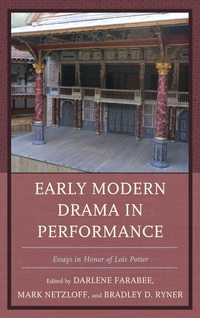
Early Modern Drama in Performance
Essays in Honor of Lois Potter
1st Edition
Published on 25. November 2014
202 pages
978-1-61149-756-4 (ISBN)
Description

Early Modern Drama in Performance is a collection of essays in honor of Lois Potter, the distinguished author of five monographs, including most recently The Life of William Shakespeare (2012), and numerous articles, edited collections, and editions. This collection's emphasis on Shakespearean and early modern drama reflects the area for which Potter is most widely known, as a performance critic, editor, and literary scholar. The essays by a diverse group of scholars who have been influenced by Potter address recurring themes in her work: Shakespeare and non-Shakespearean early modern drama, performance history and theatre practice, theatrical performance across cultures, play reviewing, and playreading. What unifies them most, though, is that they carry on the spirit of Potter's work: her ability to meet a text, a performance, or a historical period on its own terms, to give scrupulous attention to specific details and elegantly show how these details generate larger meaning, and to recover and preserve the fleeting and the ephemeral.
More details
Edition
1. Auflage
Language
English
Place of publication
United States
Publishing group
Bloomsbury Publishing Plc
Target group
Professional and scholarly
Illustrations
5 BW Illustrations
ISBN-13
978-1-61149-756-4 (9781611497564)
Copyright in bibliographic data and cover images is held by Nielsen Book Services Limited or by the publishers or by their respective licensors: all rights reserved.
Schweitzer Classification
Other editions
Additional editions
Mark Netzloff | Bradley D. Ryner | Darlene Farabee
Early Modern Drama in Performance
Essays in Honor of Lois Potter
Book
11/2014
University of Delaware Press
€109.50
Shipment within 3-4 weeks
Persons
Darlene Farabee is associate professor in the English Department at the University of South Dakota.
Mark Netzloff is associate professor of English at the University of Wisconsin-Milwaukee.
Bradley D. Ryner is associate professor of English at Arizona State University.
Mark Netzloff is associate professor of English at the University of Wisconsin-Milwaukee.
Bradley D. Ryner is associate professor of English at Arizona State University.
Content
Introduction by Darlene Farabee, Mark Netzloff, and Bradley D. Ryner
Chapter 1: Dramatic Verse and Early Modern Playgoers in Marlowe's Time by Roslyn L. Knutson
Chapter 2: The Usurer's Theatrical Body: Refiguring Profit in The Jew of Malta and The Blind Beggar of Alexandriaby Bradley D. Ryner
Chapter 3: Theater of Anatomy: The Tragedy of Hoffman by Peter Hyland
Chapter 4: 'Know you this ring?': Metonymic Functions of a Prop by Ann Thompson and John O. Thompson
Chapter 5: Editing and Staging The Revenger's Tragedy: Three Problems by Alan C. Dessen
Chapter 6: The 'most unsavoury similes' and Henry IV, Part Oneby Darlene Farabee
Chapter 7: Shakespeare's Cognitive Vision by Arthur Kinney
Chapter 8: Shakespeare's Conception of Tragedy: The Middle Tragedies by Jay L. Halio
Chapter 9: Shakespeare or not Shakespeare?: The propogation of the text in Europe through J. F. Ducis's 'Imitations' by Michèle Willems
Chapter 10:Un/natural Perspective: Viola on the late nineteenth-century stage by Virginia Mason Vaughan
Chapter 11: Reading, Recitation, and Entertainments: The Dunedin Shakespeare Club, 1877-1956
by Evelyn Tribble
Chapter 12: The power of Shakespeare's word in twentieth-century Prague by Zdenek Stríbrný Chapter 13: Showtime: Temporality and the Video Archive of Julius Caesar at the RSC
by Andrew Hartley
Chapter 1: Dramatic Verse and Early Modern Playgoers in Marlowe's Time by Roslyn L. Knutson
Chapter 2: The Usurer's Theatrical Body: Refiguring Profit in The Jew of Malta and The Blind Beggar of Alexandriaby Bradley D. Ryner
Chapter 3: Theater of Anatomy: The Tragedy of Hoffman by Peter Hyland
Chapter 4: 'Know you this ring?': Metonymic Functions of a Prop by Ann Thompson and John O. Thompson
Chapter 5: Editing and Staging The Revenger's Tragedy: Three Problems by Alan C. Dessen
Chapter 6: The 'most unsavoury similes' and Henry IV, Part Oneby Darlene Farabee
Chapter 7: Shakespeare's Cognitive Vision by Arthur Kinney
Chapter 8: Shakespeare's Conception of Tragedy: The Middle Tragedies by Jay L. Halio
Chapter 9: Shakespeare or not Shakespeare?: The propogation of the text in Europe through J. F. Ducis's 'Imitations' by Michèle Willems
Chapter 10:Un/natural Perspective: Viola on the late nineteenth-century stage by Virginia Mason Vaughan
Chapter 11: Reading, Recitation, and Entertainments: The Dunedin Shakespeare Club, 1877-1956
by Evelyn Tribble
Chapter 12: The power of Shakespeare's word in twentieth-century Prague by Zdenek Stríbrný Chapter 13: Showtime: Temporality and the Video Archive of Julius Caesar at the RSC
by Andrew Hartley
