

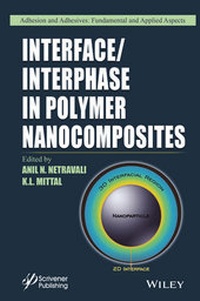
Interface / Interphase in Polymer Nanocomposites
Description

More details
Other editions
Additional editions
Persons
Anil Netravali is currently the Jean and Douglas McLean Professor in Fiber Science & Apparel Design, Cornell University. His main research is in the field of fiber reinforced composites and green materials and processes. In the past few years, his research group has developed green resins and adhesives from a variety of proteins and starches that have excellent mechanical properties. Dr. Netravali has written over 110 refereed papers and over 20 book chapters. He has also edited 2 books. He has presented his research at several conferences all over the world and several of them as Keynote addresses as well as plenary and invited lectures.
Kashmiri Lal Mittal was employed by the IBM Corporation from 1972 through 1993. Currently, he is teaching and consulting worldwide in the broad areas of adhesion as well as surface cleaning. He has received numerous awards and honors including the title of doctor honoris causa from Maria Curie-Skodowska University, Lublin, Poland. He is the editor of more than 120 books dealing with adhesion measurement, adhesion of polymeric coatings, polymer surfaces, adhesive joints, adhesion promoters, thin films, polyimides, surface modification,surface cleaning, and surfactants. Dr. Mittal is also the Founding Editor of the journal Reviews of Adhesion and Adhesives.
Content
Preface xiii
Part 1 Nanocomposite Interfaces/Interphases
1 Polymer Nanocomposite Interfaces: The Hidden Lever for Optimizing Performance in Spherical Nanofilled Polymers 3
Ying Li, Yanhui Huang, Timothy Krentz, Bharath Natarajan, Tony Neely and Linda S. Schadler
1.1 Introduction 4
1.1.1 Dispersion Control 5
1.1.2 Interface Structure 6
1.1.3 Interface Properties 6
1.1.4 Measuring and Modeling the Interface 7
1.2 Dispersion Control through Interfacial Modification 8
1.2.1 Introduction 8
1.2.2 Short Ligands 8
1.2.3 Polymer Brush 11
1.2.3.1 Polymer Brush Synthesis Methods 12
1.2.3.2 Enthalpic and Entropic Contributions of Polymer Brushes to Dispersion Control 13
1.3 Interface Structure 16
1.3.1 Introduction 16
1.3.2 Effects of Particle Size 17
1.3.3 Effects of Crystallinity and Crosslinking 18
1.3.4 Effects of Polymer Brush Penetration 19
1.3.4.1 The Athermal Case 19
1.3.4.2 The Enthalpic Case 21
1.3.5 Characterizing the Interface Structure 22
1.4 Interface Properties and Characterization Techniques 24
1.4.1 Introduction 24
1.4.2 Molecular Mobility in Nanocomposite Interfaces 25
1.4.3 Thermomechanical Properties and Measurements 28
1.4.3.1 Direct Measurement 30
1.4.3.2 Indirect Methods 32
1.4.4 Dielectric Properties and Measurements 40
1.4.4.1 Effects of Nanofillers 42
1.4.4.2 Measurement Techniques 43
1.4.4.3 Indirect Measurement 44
1.4.4.4 Finite Element Modeling 50
1.4.5 Remarks on Characterization Methods 52
1.5 Summary 53
Acknowledgements 54
References 55
2 Interphase Engineering with Nanofillers in Fiber-Reinforced Polymer Composites 71
József Karger-Kocsis, Sándor Kéki, Haroon Mahmood and Alessandro Pegoretti
2.1 Introduction 72
2.2 Interphase Tailoring for Stress Transfer 74
2.2.1 Coating with Nanofillers 74
2.2.2 Creation of Hierarchical Fibers 80
2.2.2.1 Chemical Grafting of Nanofillers 80
2.2.2.2 Chemical Vapor Deposition (CVD) 81
2.2.2.3 Other "Grafting" Techniques 83
2.2.3 Effects of Matrix Modification with Nanofillers 85
2.3 Interphase Tailoring for Functionality 87
2.3.1 Sensing/Damage Detection 87
2.3.2 Self-Healing/Repair 89
2.3.3 Damping 91
2.4 Outlook and Future Trends 91
2.5 Summary 93
2.6 Acknowledgements 93
2.7 Nomenclature 94
References 94
3 Formation and Functionality of Interphase in Polymer Nanocomposites 103
Peng-Cheng Ma, Bin Hao and Jang-Kyo Kim
3.1 Introduction 103
3.2 Formation of Interphase in Polymer Nanocomposites 105
3.3 Functionality of Interphase in Polymer Nanocomposites 111
3.3.1 Load Transfer in Nanocomposites 111
3.3.2 Reduction in Growth Rate of Fatigue Cracks in Nanocomposites 116
3.3.3 Controlling the Fracture Behavior of Nanocomposites 119
3.3.4 Enhancing the Damping Properties of Nanocomposites 121
3.3.5 Channels for the Transport of Ions and Moisture in Nanocomposites 123
3.3.6 Phonon Scattering in Nanocomposites 125
3.3.7 Electron Transfer in Nanocomposites 128
3.4 Summary and Prospects 130
Acknowledgements 133
References 133
4 Impact of Crystallization on the Interface in Polymer Nanocomposites 139
Nandika D'Souza Siddhi Pendse, Laxmi Sahu, Ajit Ranade and Shailesh Vidhate
4.1 Introduction 140
4.2 Thermodynamics of Crystallization 142
4.3 Nylon Nanocomposites 144
4.4 Dispersion of MLS in Nanocomposites 145
4.5 Effect of MLS on Thermal Transitions in Nylon 146
4.6 Permeability 149
4.7 PET Nanocomposites 151
4.8 Dispersion of MLS in Nanocomposites 151
4.9 Effect of MLS on Thermal Transitions in PET 151
4.10 PEN Nanocomposites 156
4.11 Dispersion of MLS in Nanocomposites 156
4.12 Effect of MLS on Thermal Transitions in PEN 157
4.13 Permeability 162
4.14 The Role of the Interface in Permeability: PET versus PEN 162
4.15 Summary 167
References 168
5 Improved Nanofiller-Matrix Bonding and Distribution in GnP-reinforced Polymer Nanocomposites by Surface Plasma Treatments of GnP 171
Rafael J. Zaldivar and Hyun I. Kim
5.1 Introduction 172
5.2 Experimental 173
5.2.1 Composite Fabrication 173
5.2.2 Image Analysis 174
5.2.3 Raman Spectroscopy 174
5.2.4 X-ray Photoelectron Spectroscopy (XPS) 174
5.2.5 Scanning Electron Microscopy (SEM) 175
5.2.6 Mechanical Testing 175
5.3 Results 175
5.4 Conclusions 187
Acknowledgement 187
References 187
6 Interfacial Effects in Polymer Nanocomposites Studied by Thermal and Dielectric Techniques 191
Panagiotis Klonos, Apostolos Kyritsis and Polycarpos Pissis
6.1 Introduction 192
6.2 Experimental Techniques 197
6.2.1 Differential Scanning Calorimetry (DSC) 197
6.2.2 Dielectric Techniques 202
6.2.2.1 Broadband Dielectric Spectroscopy (BDS) 203
6.2.2.2 Thermally Stimulated Depolarization Current (TSDC) Techniques 207
6.3 Evaluation in Terms of Interfacial Characteristics 209
6.3.1 Analysis of DSC Measurements 209
6.3.2 Analysis of Dielectric Measurements 211
6.3.3 Thickness of the Interfacial Layer 213
6.4 Examples 214
6.4.1 DSC Measurements 214
6.4.2 Dielectric Measurements 221
6.5 Prospects 235
6.6 Summary 236
Acknowledgements 237
References 237
Part 2 Techniques to Characterize/Control Nanoadhesion
7 Investigation of Interfacial Interactions between Nanofillers and Polymer Matrices Using a Variety of Techniques 251
Luqi Liu
7.1 Introduction 251
7.2 Observation of Interfacial Layer in Nanostructured Carbon Materials-based Nanocomposites 253
7.2.1 Characterization of Interface Layer Around CNTs 253
7.2.2 Characterization of Interface Layer Around Graphene Sheets 255
7.3 Interfacial Properties between Nanofiller and Polymer Matrix 256
7.3.1 Theoretical Simulations of CNT and/or Graphene-based Nanocomposites 256
7.3.1.1 Theoretical Simulation of CNT-based Nanocomposites 256
7.3.1.2 Theoretical Simulation of Graphene-based Nanocomposites 258
7.3.2 Experimental Studies to Characterize Interfacial Behavior in CNT and/or Graphene-based Nanocomposite Systems 260
7.3.2.1 Indirect Measurement 261
7.3.2.2 Direct Measurement 261
7.4 Summary 270
Acknowledgements 271
References 271
8 Chemical and Physical Techniques for Surface Modification of Nanocellulose Reinforcements 279
Viktoriya Pakharenko, Muhammad Pervaiz, Hitesh Pande and Mohini Sain
8.1 Introduction 279
8.2 Chemical Surface Modification 281
8.2.1 Acetylation 281
8.2.2 Silylation 284
8.2.3 Bacterial Treatment 285
8.2.4 Grafting 287
8.2.5 Surfactant Adsorption 289
8.2.6 TEMPO-mediated Oxidation 290
8.2.7 Click chemistry 292
8.3 Physical Surface Modification 292
8.3.1 Plasma 292
8.3.2 Corona 297
8.3.3 Laser 299
8.3.4 Flame 299
8.4 Use of Ions 300
8.5 Summary 300
Acknowledgments 301
References 301
9 Nondestructive Sensing of Interface/Interphase Damage in Fiber/Matrix Nanocomposites 307
Zuo-Jia Wang, Dong-Jun Kwon, Jin-Yeong Choi, Pyeong-Su Shin, K. Lawrence DeVries and Joung-Man Park
9.1 Introduction 308
9.2 Experimental Specimens and Methods 311
9.2.1 Gradient Specimen Test 311
9.2.2 Dual Matrix Fragmentation Test 314
9.3 Damage Sensing Using Electrical Resistance Measurements 317
9.3.1 Electrical Resistance Measurement for Strain Sensing Application 317
9.3.2 Electrical Resistance Measurement for Interface/Interphase Evaluation 321
9.4 Summary 327
References 327
10 Development of Polymeric Biocomposites: Particulate Incorporation, Interphase Generation and Evaluation by Nanoindentation 333
Oisik Das and Debes Bhattacharyya
10.1 Introduction 334
10.2 The Definitions of Composite and its Constituents 337
10.2.1 Composite 337
10.2.2 Biocomposite 337
10.2.3 The Reinforcement 337
10.2.4 The Matrix 338
10.3 Physical and Chemical Structures of Bio-based Reinforcements 339
10.3.1 Plant/Vegetable-based Reinforcements/Fibres 339
10.3.1.1 Physical Structure 339
10.3.1.2 Chemical Structure 339
10.3.2 Animal-based Reinforcements/Fibres 342
10.3.2.1 Physical Structure 342
10.3.2.2 Chemical Structure 343
10.4 Particulate and Short Fibre Composites 344
10.4.1 Biochar as Potential New Bio-based Particulate Reinforcement 345
10.4.2 Properties of Particulate-based Composites: Governing Factors 351
10.4.2.1 Particulate Properties 351
10.4.2.2 Particulate Structure 355
10.5 Nanoindentation Technique to Determine Interphase and Composite Properties 358
10.5.1 The Technique and Theory of Nanoindentation 358
10.5.1.1 Different Types of Indenter Tips 360
10.5.1.2 Nanoindentation Theory 362
10.5.1.3 Nanoindentation Instrument 364
10.5.2 Nanoindentation on Polymeric Composites and their Interphase 364
10.5 Concluding Remarks 369
References 370
11 Perspectives on the Use of Molecular Dynamics Simulations to Characterize Filler-Matrix Adhesion and Nanocomposite Mechanical Properties 375
Sanket A. Deshmukh, Benjamin J. Hanson, Qian Jiang and Melissa A. Pasquinelli
11.1 Introduction 376
11.2 Overview of Molecular Dynamics (MD) Simulations 377
11.3 Characterization of Interfacial Adhesion with MD Simulations 381
11.3.1 Quantifying Adhesion Strength 381
11.3.2 Effect of the Strength of Matrix-Filler Interactions 383
11.3.3 Effect of Filler Geometry 386
11.3.4 Effect of Ordering and Crosslinking within the Polymer Matrix 388
11.4 Characterization of Mechanical Properties with MD Simulations 391
11.4.1 Predicting Static Mechanical Properties 392
11.4.2 Predicting Dynamic Mechanical Properties 395
11.5 Prospects 399
11.6 Summary 400
Acknowledgements 400
References 400
Preface
Polymer composites are made of two components: polymer or matrix (continuous phase) and filler or reinforcement (discontinuous phase) to obtain properties that cannot be achieved by a single component alone. The specific tensile properties of fiber reinforced composites are excellent because of their low density and high mechanical properties. Over the past few decades such composites have replaced metals in many applications from aerospace to sports gears, from automobiles to wind turbines, and from circuit boards to civil structures such as bridges and buildings. With composites impacting every part of our lives they have become ubiquitous. Over the past 2-3 decades the fillers or reinforcing elements used in composites have become smaller and smaller to their current nanosize. Using nanoparticles or nanofibrils in polymers or resins provides significant advantages. Hundreds of studies have shown that only a small weight percent (loading) of nanoparticles can significantly alter the stiffness, strength and fracture strain as well as electrical, thermal or other functional properties of polymers because of their high surface-to-volume ratio. However, such benefits can be derived only if the particle dispersion is uniform and no clustering occurs. It is also universally accepted that the nanoparticle/resin interface and the interphase region in nanocomposites play a critical role in enhancing their properties. With better understanding of interface and interphase characteristics it should be possible to predict as well as design polymer nanocomposites with desired properties and performance. This book brings together several experts and leading researchers in this field to present their cutting edge research in understanding, modifying and controlling interfacial interactions between various nanofillers and a host of polymer matrices.
The book is divided into two parts; Part 1: Nanocomposite Interfaces/Interphases with 6 chapters and Part 2: Techniques to Characterize/Control Nanoadhesion with 5 chapters. In chapter 1 Schadler and coworkers define and discuss the two phases of polymer nanocomposites: polymeric matrix phase and inorganic nanofiller phase. Efforts have been made to improve the intrinsic properties of both the matrix and the nanofiller to enhance the overall performance of polymer nanocomposites. Accordingly, this chapter discusses the thermodynamic mechanisms governing nanofiller dispersion. The thermodynamic matrix/filler interactions also influence the structure and properties of the interfacial region, which can be significantly different from the bulk material. Examples of such structural modifications in semicrystalline and thermoset polymer nanocomposites are presented. In chapter 2 Pegoretti and colleagues discuss engineering of interphase with nanofillers in fiber-reinforced polymer composites. The first part of the chapter surveys recent advancements in the interphase engineering of fiber-reinforced polymer composites using different nanofillers. The second part of the chapter discusses strategies followed for stress transfer improvement or adding functionality to the interphase. The chapter also includes state-of-the-art knowledge on the characterization and modelling of the interphase. In the last 'Outlook' section some challenges and perspectives in the engineering of fiber/matrix interphase are summarized. The third chapter by Kim and colleagues discusses formation and functionality of interphase, a distinct region between the two phases in polymer nanocomposites. This chapter presents fundamental issues on the formation of interphase between carbon-based nanofillers, such as carbon nanotubes, graphene, carbon black, and polymer matrices. Special emphasis is placed on illustrating the role of interphase in governing the mechanical, electrical, thermal and other functional properties of nanocomposites. Based on the progress made so far, some suggestions are proposed for designing the interphase with specific structures for intended applications of nanocomposites. In chapter 4 D'Souza and colleagues examine the effects of crystallization on the interface in polymer nanocomposites. Crystallization in polymer nanocomposites is influenced by the nature of the polymer, the percentage of nanoparticles present and their dispersion and interparticle distance. This chapter presents the effect of montmorillonite nanoclay on the interfacial crystallization in three polymers: nylon, poly (ethylene terephthalate) and poly (ethylene naphthalate). The effect of crystallization on the permeability of all three systems is also examined. Chapter 5 by Zaldivar and Kim discusses a new class of Graphite Nanoplatelets (GnPs) based nanocomposites that have unique electrical and thermal properties. To obtain the highest possible properties, the nanoparticle/resin bonding needs to be improved. The chapter discusses how the nanoparticle surface can be optimally functionalized using Split Plasma Method. The sixth and the final chapter of Part 1 by Pissis and associates is devoted to the experimental investigation of interfacial effects in polymer nanocomposites using calorimetric studies for the glass transition and dielectric techniques for the segmental dynamics. After discussing the experimental techniques briefly, the authors focus on proper evaluation of the measurements to extract maximum information from the data. The authors also present methods and equations used to evaluate the results in terms of interfacial characteristics, in particular polymer fraction in the interfacial layer (the fraction of polymer with modified properties) and thickness of the interfacial layer. The chapter provides an overview of the state-of-the-art in the field from the materials point of view simply by using various methods to characterize several selected polymer nanocomposites.
Part 2 of the book spans chapter 7 to chapter 11. In chapter 7 Liu describes the recent progress in theoretical and experimental aspects of interfacial adhesion in nanostructured carbon materials based polymer nanocomposites and summarizes the common methods utilized to characterize the interfacial properties in nanocomposites. The next chapter by Sain and colleagues discusses chemical and physical techniques for surface modification of nanocellulose reinforcements. The polarity of cellulose fibers due to the abundance of hydroxyl groups is responsible for poor wetting of natural fibers by non-polar resins. Furthermore, a large difference in surface free energy levels between resins and natural fiber reinforcements is responsible for poor interfacial bonding. The chapter discusses the most recent surface treatment techniques being employed to develop high-performance nanocomposites. In chapter 9 Park and colleagues discuss a unique electro-micromechanical technique developed as an efficient nondestructive evaluation (NDE) method for sensing and determination of micro-damage at the filler/epoxy interface in nanocomposites. This 'self-sensing' method has also been used to evaluate interfacial damage in fiber reinforced polymer matrix nanocomposites. Among the advantages of this new NDE method, compared to other evaluation methods, include better stability, lower cost and its relative simplicity. Bhattacharyya and colleague discuss particulate incorporation, interphase generation and evaluation by nanoindentation in polymeric biocomposites in chapter 10. This chapter provides an overall perspective on the development of composites containing bio-based reinforcements, e.g., biochar. The properties and governing factors of the biochar composites are explained, which is followed by a discussion of the suitability of nanoindentation technique for determining nano-sized particle/resin interfacial properties. Finally, several studies involving nanoindentation on the nano-sized interfacial regions of composites are reviewed and critically discussed. In the 11th and the final chapter Pasquinelli and colleagues demonstrate the use of molecular dynamics (MD) simulations to quantify filler-matrix adhesion and nanocomposite mechanical properties. They also illustrate how MD simulations can predict the mechanical properties of polymer nanocomposites as a function of the chemical and structural composition of these materials. Other prospects for MD simulations include calculating other physical properties, improving the structure-property prediction through advancements in hardware architecture and software development, and connecting through multiscale modeling the nanoscale/microscale details from MD simulations to the macroscale characteristics.
The book should be of interest to researchers in academia, in government research labs and R&D personnel in a host of industries (e.g. aerospace, automotive, biomedical, composites, dentistry, fibers, medical, microelectronics, packaging, plastics, textiles) who are interested in designing and improving the properties of polymers and composites by the addition of nanoparticles. Industries such as aerospace and automotive where light-weighting of each component is critical and an ongoing effort, improved properties through scientific understanding of nanocomposites could be very advantageous. Anyone working in plastics/polymers and composites industries should find this book of great interest and very useful.
It is our great pleasure to thank those who made this book possible. First and foremost, we are profusely thankful to the contributing authors for their sustained interest, enthusiasm and cooperation and for investing their valuable time in sharing their knowledge and cutting edge research (in the form of chapters) with the interested community. This book would not have been possible without their hard work. The unwavering interest and...
