

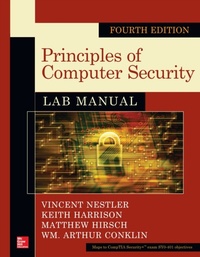
Principles of Computer Security Lab Manual, Fourth Edition
1st Edition
Published on 31. October 2014
385 pages
978-0-07-183656-2 (ISBN)
Available for download
Description

Practice the Computer Security Skills You Need to Succeed! 40+ lab exercises challenge you to solve problems based on realistic case studies Step-by-step scenarios require you to think critically Lab analysis tests measure your understanding of lab results Key term quizzes help build your vocabulary Labs can be performed on a Windows, Linux, or Mac platform with the use of virtual machines In this Lab Manual, you'll practice Configuring workstation network connectivity Analyzing network communication Establishing secure network application communication using TCP/IP protocols Penetration testing with Nmap, metasploit, password cracking, Cobalt Strike, and other tools Defending against network application attacks, including SQL injection, web browser exploits, and email attacks Combatting Trojans, man-in-the-middle attacks, and steganography Hardening a host computer, using antivirus applications, and configuring firewalls Securing network communications with encryption, secure shell (SSH), secure copy (SCP), certificates, SSL, and IPsec Preparing for and detecting attacks Backing up and restoring data Handling digital forensics and incident response Instructor resources available: This lab manual supplements the textbook Principles of Computer Security, Fourth Edition, which is available separately Virtual machine files Solutions to the labs are not included in the book and are only available to adopting instructors
More details
Other editions
Additional editions
Vincent Nestler | Keith Harrison | Matthew Hirsch
Principles of Computer Security Lab Manual, Fourth Edition
Book
12/2014
4th Edition
McGraw-Hill Professional
€58.50
Article not available at the moment
Content
- Cover
- Title Page
- Copyright Page
- Contents
- Foreword
- Acknowledgments
- Introduction
- Part I: Networking Basics: How Do Networks Work?
- Chapter 1 Workstation Network Configuration and Connectivity
- Lab 1.1: Network Workstation Client Configuration
- Lab 1.2: Computer Name Resolution
- Lab 1.3: IPv6 Basics
- Chapter 2 Network Transports
- Lab 2.1: Network Communication Analysis
- Lab 2.2: Port Connection Status
- Chapter 3 Network Applications
- Lab 3.1: FTP Communication (FTP-HTTP)
- Lab 3.2: E-mail Protocols: SMTP and POP3
- Part II: Vulnerabilities and Threats: How Can Systems Be Compromised?
- Chapter 4 Penetration Testing
- Lab 4.1: IP Address and Port Scanning, Service Identity Determination
- Lab 4.2: GUI-Based Vulnerability Scanners
- Lab 4.3: Researching System Vulnerabilities
- Lab 4.4: Using Metasploit
- Lab 4.5: Password Cracking
- Lab 4.6: Using Cobalt Strike
- Chapter 5 Attacks Against Applications
- Lab 5.1: Web SQL Injection
- Lab 5.2: Web Browser Exploits
- Lab 5.3: E-mail System Exploits
- Chapter 6 More Attacks: Trojan Attacks, MITM, Steganography
- Lab 6.1: Trojan Attacks
- Lab 6.2: Man-in-the-Middle Attack
- Lab 6.3: Steganography
- Part III: Prevention: How Do You Prevent Harm to Networks?
- Chapter 7 Hardening the Host Computer
- Lab 7.1: Hardening the Operating System
- Lab 7.2: Using Antivirus Applications
- Lab 7.3: Using Firewalls
- Chapter 8 Securing Network Communications
- Lab 8.1: Using GPG to Encrypt and Sign E-mail
- Lab 8.2: Using Secure Shell (SSH)
- Lab 8.3: Using Secure Copy (SCP)
- Lab 8.4: Using Certificates and SSL
- Lab 8.5: Using IPsec
- Part IV: Detection and Response: How Do You Detect and Respond to Attacks?
- Chapter 9 Preparing for and Detecting Attacks
- Lab 9.1: System Log Analysis
- Lab 9.2: Intrusion Detection Systems
- Lab 9.3: Backing Up and Restoring Data
- Lab 9.4: Using Honeypots
- Chapter 10 Digital Forensics
- Lab 10.1: Live Analysis: Incident Determination
- Lab 10.2: Acquiring the Data
- Lab 10.3: Forensic Analysis
- Lab 10.4: Remote Image Capture
- Appendix: Objectives Map: CompTIA Security+T
- Index
- A
- B
- C
- D
- E
- F
- G
- H
- I
- J
- K
- L
- M
- N
- O
- P
- R
- S
- T
- U
- V
- W
- X

