

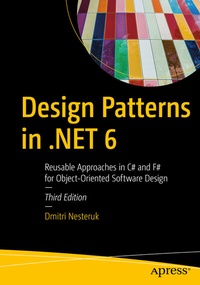
Design Patterns in .NET 6
Description

Using the C# and F# programming languages, Design Patterns in .NET 6 explores the classic design pattern implementations and discusses the applicability and relevance of specific language features for implementing patterns. You will learn by example, reviewing scenarios where patterns are applicable. Former C# MVP and patterns expert Dmitri Nesteruk demonstrates possible implementations of patterns,discusses alternatives and pattern relationships, and illustrates the way that a dedicated refactoring tool (JetBrains Rider) can be used to implement design patterns with ease.
What You Will Learn
-
Become familiar with the latest pattern implementations available in C# 10 and F# 6
-
Know how to better reason about software architecture
-
Understand the process of refactoring code to patterns
-
Refer to researched and proven variations of patterns
-
Study complete, self-contained examples, including many that cover advanced scenarios
-
Use the latest versions of C# and Visual Studio/Rider/ReSharper
Who This Book Is For
Developers who have some experience in the C# language and want to expand their comprehension of the art of programming by leveraging design approaches to solve modern problems
More details
Other editions
Additional editions
Person
Content
Part I: Introduction .- Chapter 1: The SOLID Design Principles.- Chapter 2: The Functional Perspective.- Part II: Creational Patterns. - Chapter 3: Builder.- Chapter 4: Factories.- Chapter 5: Prototype.- Chapter 6: Singleton.- Part III: Structural Patterns. - Chapter 7: Adapter.- Chapter 8: Bridge.- Chapter 9: Composite.- Chapter 10: Decorator.- Chapter 11: Façade.- Chapter 12: Flyweight.- Chapter 13: Proxy.- Chapter 14: Value Object.- Part IV: Behavioral Patterns. - Chapter 15: Chain of Responsibility.- Chapter 16: Command.- Chapter 17: Interpreter.- Chapter 18: Iterator.- Chapter 19: Mediator.- Chapter 20: Memento.- Chapter 21: Null Object.- Chapter 22: Observer.- Chapter 23: State.- Chapter 24: Strategy.- Chapter 25: Template Method.- Chapter 26: Visitor.
