


Polysemy
Flexible Patterns of Meaning in Mind and Language
1st Edition
Published on 12. May 2011
X, 422 pages
978-3-11-089569-8 (ISBN)
Description

About fifty years ago, Stephen Ullmann wrote that polysemy is 'the pivot of semantic analysis'. Fifty years on, polysemy has become one of the hottest topics in linguistics and in the cognitive sciences at large. The book deals with the topic from a wide variety of viewpoints. The cognitive approach is supplemented and supported by diachronic, psycholinguistic, developmental, comparative, and computational perspectives. The chapters, written by some of the most eminent specialists in the field, are all underpinned by detailed discussions of methodology and theory.
Reviews / Votes
"To end on a personal note, I hope that Polysemy: Flexible Patterns of Meaning in Mind and Language will provoke a number of discussions in related fields, leading to a number of interesting findings and the development of polysemy research in the future."Yoshikata Shibuya in: Cognitive Linguistics 4/2007More details
Other editions
Additional editions
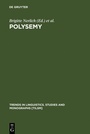
Brigitte Nerlich | Zazie Todd | Vimala Herman
Polysemy
Flexible Patterns of Meaning in Mind and Language
Book
08/2003
1st Edition
De Gruyter Mouton
€159.95
Shipment within 7-9 days
Brigitte Nerlich | Zazie Todd | Vimala Herman
Polysemy
Flexible Patterns of Meaning in Mind and Language
Book
01/2003
1st Edition
De Gruyter Mouton
€229.00
Article exhausted; check different version
Persons
Brigitte Nerlich is Senior Research Officer at the University of Nottingham, UK.
Zazie Todd is Lecturer at Leeds University, UK.
David D. Clarke is Professor at the University of Nottingham, UK.
Vimala Herman is Reader at the University of Nottingham, UK.
Content
Setting the scene
Polysemy and flexibility: introduction and overview
Brigitte Nerlich and David D. Clarke
Cognitive models of polysemy
John R. Taylor
Polysemy: past and present
Brigitte Nerlich
Cognitive approaches
Polysemy and conceptual blending
Gilles Fauconnier and Mark Turner
Reconsidering prepositional polysemy networks: the case of over
Andrea Tyler and Vyvyan Evans
Polysemy as flexible meaning: experiments with English get and Finnish pitaeae
Jarno Raukko
Metonymic polysemy and its place in meaning extension
Ken-ichi Seto
Synchrony/diachrony approaches
Polysemy in derivational affixes
Adrienne Lehrer
The role of links and/or qualia in modifier-head constructions
Beatrice Warren
Polysemy and bleaching
Jean Aitchison and Diana M. Lewis
Polysemy in the lexicon and in discourse
Andreas Blank
Psycholinguistic approaches
Irony in conversation: salience, role, and context effects
Rachel Giora and Inbal Gur
Young children's and adults' use of figurative language: how important are cultural and linguistic influences?
Ann Dowker
Emerging patterns and evolving polysemies: the acquisition of get between four and ten years
Brigitte Nerlich, Zazie Todd and David D. Clarke
Computational approaches
"I don't believe in word senses"
Adam Kilgarriff
Senses and texts
Yorick Wilks
Polysemy and flexibility: introduction and overview
Brigitte Nerlich and David D. Clarke
Cognitive models of polysemy
John R. Taylor
Polysemy: past and present
Brigitte Nerlich
Cognitive approaches
Polysemy and conceptual blending
Gilles Fauconnier and Mark Turner
Reconsidering prepositional polysemy networks: the case of over
Andrea Tyler and Vyvyan Evans
Polysemy as flexible meaning: experiments with English get and Finnish pitaeae
Jarno Raukko
Metonymic polysemy and its place in meaning extension
Ken-ichi Seto
Synchrony/diachrony approaches
Polysemy in derivational affixes
Adrienne Lehrer
The role of links and/or qualia in modifier-head constructions
Beatrice Warren
Polysemy and bleaching
Jean Aitchison and Diana M. Lewis
Polysemy in the lexicon and in discourse
Andreas Blank
Psycholinguistic approaches
Irony in conversation: salience, role, and context effects
Rachel Giora and Inbal Gur
Young children's and adults' use of figurative language: how important are cultural and linguistic influences?
Ann Dowker
Emerging patterns and evolving polysemies: the acquisition of get between four and ten years
Brigitte Nerlich, Zazie Todd and David D. Clarke
Computational approaches
"I don't believe in word senses"
Adam Kilgarriff
Senses and texts
Yorick Wilks
