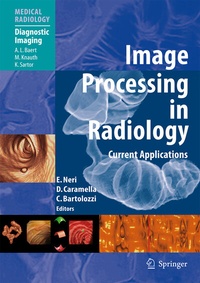
Image Processing in Radiology
Description

Few fields have witnessed such impressive advances as image processing in radiology. The progress achieved has revolutionized diagnosis and greatly facilitated treatment selection and accurate planning of procedures. This book, written by leading experts from many countries, provides a comprehensive and up-to-date description of how to use 2D and 3D processing tools in clinical radiology. The first section covers a wide range of technical aspects in an informative way. This is followed by the main section, in which the principal clinical applications are described and discussed in depth. To complete the picture, a third section focuses on various special topics. The book will be invaluable to radiologists of any subspecialty who work with CT and MRI and would like to exploit the advantages of image processing techniques. It also addresses the needs of radiographers who cooperate with clinical radiologists and should improve their ability to generate the appropriate 2D and 3D processing.
Reviews / Votes
From the reviews:
"This comprehensive overview of advanced image processing and post-processing in diagnostic imaging covers all modalities and explains the scan parameters, fundamentals of image processing, and clinical applications. . The book is intended primarily for practicing radiologists, although other clinicians, such as cardiologists and oncologic surgeons who use imaging extensively, may benefit as well. . This book is very useful in explaining workstations, display functions, and advanced image processing. . Many exam protocols are available for practicing radiologists to implement them into their routine practice." (Charles C. Matthews, Doody's Review Service, February, 2008)
"The purpose of this book is to provide extensive information on the fundamental technical aspects of present-day advanced image processing and its use in clinical applications. ... Each chapter is well written and flows well, the references are comprehensive, and the images are superb and printed on high-quality paper. ... This book belongs in the personal library and teaching libraries of radiologists, medical and surgical specialists, and any other professional dealing with advanced image processing and is an excellent book that is worth its price." (Aurelio Matamoros Jr., The Journal of Nuclear Medicine, Vol. 49, 2008)
"The book will be focused on both two-dimensional (2D) and three-dimensional (3D) aspects of the topic. . The most likely audience for this book is radiologists without a strong technical background who are responsible for the operation of 3D image processing labs." (Bradley Erickson, Radiology, Vol. 252 (2), August, 2009)
More details
Other editions
Additional editions