

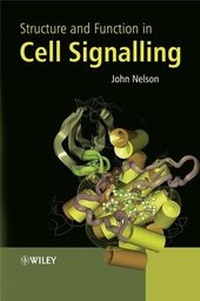
Structure and Function in Cell Signalling
Description

Reviews / Votes
"Richly illustrated with full-color molecular graphics (created byRasMol, a freeware molecular visualization program), Structureand Function in Cell Signaling provides a clear, engagingintroduction to signal transduction. Each of the book's 10 chaptersincludes tables and charts in color to illustrate signaltransduction pathways and genetic relationships between signaltransduction molecules. Nelson (Queens Univ. Belfast, UK) providesenough background information to make this complex subjectaccessible even to beginning students. Readers can easily re-createall of the molecular graphics for themselves in an interactiveformat by following simple instructions included in the appendix.Signal transduction has applications in all of the biologicalsciences. Thus, students in cell biology, biochemistry, immunology,molecular genetics, and other life sciences will all find muchvaluable information in this work. Summing Up: Highlyrecommended. Academic libraries, all levels."(Choice,February 2009) "From basics to details, this is an elegantly written andcarefully edited book. The chapters on cell cycle control andoncogenesis are particularly fascinating and valuable to biomedicalresearch. This is the book to have if you are interested inmolecular mechanisms of signal transduction. It is a greatintroduction to the literature that will be welcomed by studentsand experts alike." (Doody's, January 2009)More details
Other editions
Additional editions
Person
Content
Preface.
1 The components and foundations of signalling.
1.1 Definition of terms used.
1.2 Historical foundations.
1.3 Early milestones in signal transduction research.
1.4 The discovery of receptors and G proteins.
1.5 cAMP pathways.
1.6 cAMP: ancient hunger signal - primitive signalling in amoebazoans and prokaryotes.
References.
2 Enzymes and receptors - quantitative aspects.
2.1 Enzyme steady state assays - Michaelian enzymes.
2.2 Receptor equilibrium binding assays.
2.3 The receptor's environment.
2.4 Guanine nucleotides and the agonist 'affinity-shift' of 7-pass receptors.
References.
3 Modules and motifs in transduction.
3.1 Src homology domains.
3.2 PH superfold modules: PH-, PTB- and PDZ-domains.
3.3 Bcr-homology (BcrH) domains.
3.4 Dbl homology (DH) domains - partners of PH domains.
3.5 Bcl-2 homology (BH) domains.
3.6 Ras binding domains.
3.7 Phosphoserine/phosphothreonine-binding domains.
3.8 EF-hands - calcium-sensing modules.
3.9 C1 and C2 domains - a Ca2þ-activated, lipid-binding, module.
References.
4 Protein kinase enzymes - activation and auto-inhibition.
4.1 The protein kinase fold.
4.2 Protein kinases activated by A-loop phosphorylation.
4.3 The insulin receptor kinase (IRK) - a 'gated' kinase.
4.4 Cyclin dependent kinases.
4.5 Secondary inhibition mechanisms - PKA.
References.
5 7-pass receptors and the catabolic response.
5.1 7-pass receptor phylogeny.
5.2 Functional mechanisms of 7-pass receptors.
5.3 Amplification.
5.4 Adenylyl cyclase - signal limitation.
5.5 Adenylyl cyclase isoforms.
5.6 G proteins and the adenylyl cyclase effector isoforms.
5.7 Regulatory subunits of PKA and A-Kinase Anchoring Proteins.
5.8 Phosphorylase kinase.
5.9 Glycogen phosphorylase.
5.10 Glycogen synthase.
5.11 Remaining questions - scaffolds and alternate second messenger 'receptors'.
5.12 G protein coupled receptor kinases - downregulators, signal integrators.
References.
6 Single pass growth factor receptors.
6.1 Receptor tyrosine kinases - ligands and signal transduction.
6.2 The PDGFR family - signal transduction.
6.3 PDGFR family autoinhibition: juxtamembrane and A-loop tyrosines.
6.4 Crystal structure of kinase domain of PDGFR family-A member: Flt-3.
6.5 The ErbB family.
6.6 ErbB-type receptor signal transduction particles.
6.7 Autoinhibition of EGFR and activation.
References.
7 G proteins (I) - monomeric G proteins.
7.1 Classification.
7.2 ON and OFF states of Ras-like proteins.
7.3 Raf - a multi-domain serine/threonine kinase family of Ras effectors.
7.4 Ras protein structure and function.
7.5 The switch mechanism: hydrolysis-driven conformational change in Ras.
7.6 GTP hydrolysis.
References.
8 G proteins (II) - heterotrimeric G proteins.
8.1 Classification and structural relationship with Ras.
8.2 Ga-subunits: the Ras-like core, G-boxes and switch regions.
8.3 GTP exchange, hydrolysis and switch movements.
8.4 b/g- and receptor-binding surfaces of a-subunits.
8.5 Modulators of G protein activity - the 'RGS' protein family.
8.6 Signal transduction by b/c subunits.
References.
9 The insulin receptor and the anabolic response.
9.1 The insulin receptor - a pre-dimerised RTK with a unique substrate.
9.2 InsR and IGF-IR: differentiation leads differential tissue effects.
9.3 Features of metabolic control in key tissues.
9.4 InsR downstream signalling pathways.
9.5 The insulin receptor substrate - a surrogate signal transduction particle.
9.6 IRS-1/2 phosphorylation and PI-3-kinase activation.
9.7 Protein phosphatase-1 (PP-1).
9.8 Insulin reverses effects of adrenaline and/or glucagon.
9.9 PIP3 downstream effects - glycogen synthesis.
9.10 Many questions remain.
References.
10 Mitogens and cell cycle progression.
10.1 The mitogenic response and the cell division cycle.
10.2 G0, competency, and the point of no return in G1 - the 'R-point'.
10.3 Oncogene products derived from growth factor pathway components.
10.4 Transcription and cyclins.
10.5 Cyclin dependent kinases.
10.6 Deactivation by cyclin destruction.
10.7 Cyclin dependent kinases - activation through cyclin synthesis.
10.8 Mitogenic pathway downstream of single pass tyrosine kinase receptors.
10.9 CyclinD/Cdk-4/6 - only important substrate is RB.
10.10 Retinoblastoma-related 'pocket proteins' - negative modulators of E2F.
10.11 De-repression of the cyclin E gene by cyclin D/Cdk-4/6.
10.12 Cyclin A/Cdk-2 - S-phase progression and termination.
10.13 The controlled process of mammalian DNA replication.
10.14 Cyclin B translocations and M-phase.
10.15 Cdk inhibitors.
10.16 p53 cell cycle arrest and apoptosis.
10.17 7-pass receptors and mitosis.
10.18 Concluding remarks and caveats.
References.
Appendix 1: Worked examples.
A.1 Enzyme and receptor assays worked out from raw data examples.
A.1.1 An alkaline phosphatase assay.
Appendix 2: RasMol: installation and use.
Index.
