

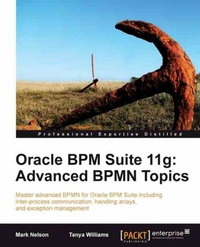
Oracle BPM Suite 11g: Advanced BPMN Topics
This tutorial reaches the parts that standard manuals don't, taking you deep into advanced BPMN topics for Oracle BPM Suite. With a practical approach and logical explanations, it will make you a maestro of BPMN.
1st Edition
Published on 13. January 2025
114 pages
978-1-84968-757-7 (ISBN)
Description

This tutorial reaches the parts that standard manuals don't, taking you deep into advanced BPMN topics for Oracle BPM Suite. With a practical approach and logical explanations, it will make you a maestro of BPMN.Key Features - Cover some of the most commonly misunderstood areas of BPMN
- Gain the knowledge to write professional BPMN processes
- A practical and concise tutorial packed with advanced topics which until now had received little or no documentation for BPM Suite developers and architects
Book DescriptionOracle BPM Suite is a popular and highly capable business process management system with extensive integration capabilities. BPMN, one of the most widely used process modeling notations, includes advanced capabilities for inter-process communication, working of arrays of data, and handling exceptions. However, these very same areas are often poorly understood. This book gives you the knowledge to create professional process models using these advanced features of BPMN."Oracle BPM Suite 11g: Advanced BPMN Topics" is the only book available that provides coverage of advanced BPMN topics for Oracle BPM Suite, helping to fill in the gaps left by the product documentation, and giving you the information that you need to know to use BPMN to its full potential.This book covers the important theory behind inter-process communication, working with arrays and handling exceptions in BPMN, along with detailed, step-by-step practical exercises that demonstrate and consolidate this theoretical knowledge.Throughout the book we'll cover topics including different types of sub-processes, initializing and manipulating arrays, using the multi-instance embedded sub-process, fault propagation and more.With "Oracle BPM Suite 11g: Advanced BPMN Topics" in hand, you'll gain detailed and practical experience in using the advanced features of BPMN to create professional BPMN processes with Oracle BPM.What you will learn - Understand different ways to communicate between processes
- Grasp which mechanisms are available for handling exceptions in BPM
- Understand when to use different approaches to exception handling
- Recognize how the Fault Management Framework can be used with BPM
- Create, manipulate and iterate over arrays in BPMN
- Capture exceptions in a BPMN process
- Get to grips with using correlation, including inside loops
- Understand how BPM exceptions affect the SCA composite
- Ensure that communications are delivered to the correct instance of a process
- Tackle each advanced concept through both theoretical and practical learning
Who this book is forIf you are a developer or architect working with Oracle BPM Suite 11g, this book is for you. Basic knowledge of BPM Suite and business process management in general is assumed.
- Gain the knowledge to write professional BPMN processes
- A practical and concise tutorial packed with advanced topics which until now had received little or no documentation for BPM Suite developers and architects
Book DescriptionOracle BPM Suite is a popular and highly capable business process management system with extensive integration capabilities. BPMN, one of the most widely used process modeling notations, includes advanced capabilities for inter-process communication, working of arrays of data, and handling exceptions. However, these very same areas are often poorly understood. This book gives you the knowledge to create professional process models using these advanced features of BPMN."Oracle BPM Suite 11g: Advanced BPMN Topics" is the only book available that provides coverage of advanced BPMN topics for Oracle BPM Suite, helping to fill in the gaps left by the product documentation, and giving you the information that you need to know to use BPMN to its full potential.This book covers the important theory behind inter-process communication, working with arrays and handling exceptions in BPMN, along with detailed, step-by-step practical exercises that demonstrate and consolidate this theoretical knowledge.Throughout the book we'll cover topics including different types of sub-processes, initializing and manipulating arrays, using the multi-instance embedded sub-process, fault propagation and more.With "Oracle BPM Suite 11g: Advanced BPMN Topics" in hand, you'll gain detailed and practical experience in using the advanced features of BPMN to create professional BPMN processes with Oracle BPM.What you will learn - Understand different ways to communicate between processes
- Grasp which mechanisms are available for handling exceptions in BPM
- Understand when to use different approaches to exception handling
- Recognize how the Fault Management Framework can be used with BPM
- Create, manipulate and iterate over arrays in BPMN
- Capture exceptions in a BPMN process
- Get to grips with using correlation, including inside loops
- Understand how BPM exceptions affect the SCA composite
- Ensure that communications are delivered to the correct instance of a process
- Tackle each advanced concept through both theoretical and practical learning
Who this book is forIf you are a developer or architect working with Oracle BPM Suite 11g, this book is for you. Basic knowledge of BPM Suite and business process management in general is assumed.
All prices
More details
Other editions
Additional editions
Book
09/2012
Packt Publishing
€31.70
Shipment within 3-4 weeks
Content
- Intro
- Oracle BPM Suite 11g: Advanced BPMN Topics
- Table of Contents
- Oracle BPM Suite 11g: Advanced BPMN Topics
- Credits
- About the Authors
- About the Reviewers
- www.PacktPub.com
- Support files, eBooks, discount offers and more
- Why Subscribe?
- Free Access for Packt account holders
- Instant Updates on New Packt Books
- Preface
- What this book covers
- What you need for this book
- Where to download the software from
- Conventions
- Reader feedback
- Customer support
- Errata
- Piracy
- Questions
- 1. Inter-process Communication
- Conversations
- The default conversation
- Correlation
- Correlation sets
- Correlation when there are multiple calls
- Throw and catch events
- Send and receive tasks
- When to use throw/catch events and send/receive tasks
- Messages, signals, and errors
- Messages
- Signals
- Errors
- Invoking sub-processes
- Embedded sub-processes
- Multi-instance embedded sub-processes
- Reusable sub-processes
- Recommended sub-process style to use
- Summary
- 2. Inter-process Communication in Practice
- Communicating between processes using messages and correlation
- Communication between processes inside a loop
- Communicating between processes using signals
- Using reusable sub-processes
- Summary
- 3. Working with Arrays
- Data Associations
- Creating an empty array
- Creating an array with some empty elements
- Creating an initialized array
- Getting elements from arrays
- Setting elements in arrays
- Appending elements to arrays
- Joining two arrays
- Removing elements from arrays
- Iterating over arrays with a multi-instance embedded sub-process
- Cardinality or collection
- Sequential or parallel
- Using a completion condition
- Scope
- Practice: Iterating over an array using an embedded sub-process
- Summary
- 4. Handling Exceptions
- Mechanisms for catching exceptions in BPMN
- Boundary events
- Event sub-processes
- Exception propagation with sub-processes and peer processes
- Exception propagation with embedded sub-processes
- Exception propagation with sub-processes invoked with a call activity
- Exception propagation with peer processes invoked with a throw event
- Exception propagation with peer processes invoked with a send task
- How BPM exceptions affect the SCA composite
- Summary
- 5. Handling Exceptions in Practice
- Using boundary events to implement timeouts
- Using boundary events to implement the cancel message use case
- Using event sub-processes
- Propagating exceptions using peer processes
- Summary
- Index

