

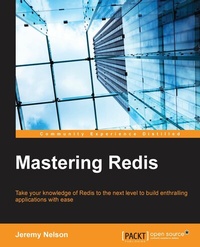
Mastering Redis
Take your knowledge of Redis to the next level to build enthralling applications with ease
Published on 8. July 2025
366 pages
978-1-78398-819-8 (ISBN)
Description

Take your knowledge of Redis to the next level to build enthralling applications with ease
Key Features
[*]Detailed explanation on Data structure server with powerful strings, lists, sets, sorted-sets, and hashes
[*]Learn to Scale your data with Redis Cluster's distributed setup
[*] This is a fast paced practical guide full of screenshots and real work examples to help you get to grips with Redis in no time.
Book DescriptionRedis is the most popular, open-source, key value data structure server that provides a wide range of capabilities on which multiple platforms can be be built. Its fast and flexible data structures give your existing applications an edge in the development environment. This book is a practical guide which aims to help you deep dive into the world of Redis data structure to exploit its excellent features. We start our journey by understanding the need of Redis in brief, followed by an explanation of Advanced key management. Next, you will learn about design patterns, best practices for using Redis in DevOps environment and Docker containerization paradigm in detail. After this, you will understand the concept of scaling with Redis cluster and Redis Sentinel , followed by a through explanation of incorporating Redis with NoSQL technologies such as Elasticsearch and MongoDB. At the end of this section, you will be able to develop competent applications using these technologies. You will then explore the message queuing and task management features of Redis and will be able to implement them in your applications. Finally, you will learn how Redis can be used to build real-time data analytic dashboards, for different disparate data streams. What you will learn
[*]Choose the right Redis data structure for your problem
[*]Understand Redis event-loop and implement your own custom C commands
[*]Solve complex workflows with Redis server-side scripting with Lua
[*]Configure your Redis instance for optimal memory management
[*]Scale your data in a distributed manner with Redis Cluster
[*]Improve the stability of your Redis solution using Redis Sentinel
[*]Complement your existing database and NoSQL environment with Redis
[*]Exploit a wide range of features provided by Redis to become a DevOps expert.
Who this book is forIf you are a software developer with some experience with Redis and would now like to elevate your Redis knowledge and skills even further, then this book is for you.
Key Features
[*]Detailed explanation on Data structure server with powerful strings, lists, sets, sorted-sets, and hashes
[*]Learn to Scale your data with Redis Cluster's distributed setup
[*] This is a fast paced practical guide full of screenshots and real work examples to help you get to grips with Redis in no time.
Book DescriptionRedis is the most popular, open-source, key value data structure server that provides a wide range of capabilities on which multiple platforms can be be built. Its fast and flexible data structures give your existing applications an edge in the development environment. This book is a practical guide which aims to help you deep dive into the world of Redis data structure to exploit its excellent features. We start our journey by understanding the need of Redis in brief, followed by an explanation of Advanced key management. Next, you will learn about design patterns, best practices for using Redis in DevOps environment and Docker containerization paradigm in detail. After this, you will understand the concept of scaling with Redis cluster and Redis Sentinel , followed by a through explanation of incorporating Redis with NoSQL technologies such as Elasticsearch and MongoDB. At the end of this section, you will be able to develop competent applications using these technologies. You will then explore the message queuing and task management features of Redis and will be able to implement them in your applications. Finally, you will learn how Redis can be used to build real-time data analytic dashboards, for different disparate data streams. What you will learn
[*]Choose the right Redis data structure for your problem
[*]Understand Redis event-loop and implement your own custom C commands
[*]Solve complex workflows with Redis server-side scripting with Lua
[*]Configure your Redis instance for optimal memory management
[*]Scale your data in a distributed manner with Redis Cluster
[*]Improve the stability of your Redis solution using Redis Sentinel
[*]Complement your existing database and NoSQL environment with Redis
[*]Exploit a wide range of features provided by Redis to become a DevOps expert.
Who this book is forIf you are a software developer with some experience with Redis and would now like to elevate your Redis knowledge and skills even further, then this book is for you.
All prices
More details
Edition
Digital original
Language
English
Place of publication
Birmingham
United Kingdom
Target group
Professional and scholarly
US School Grade: College Graduate Student
Edition type
Digital original
File size
10,40 MB
ISBN-13
978-1-78398-819-8 (9781783988198)
Copyright in bibliographic data and cover images is held by Nielsen Book Services Limited or by the publishers or by their respective licensors: all rights reserved.
Schweitzer Classification
Other editions
Additional editions
Jeremy Nelson
Mastering Redis
Take your knowledge of Redis to the next level to build enthralling applications with ease
Book
05/2016
Packt Publishing
€69.60
Shipment within 3-4 weeks
Person
Nelson Jeremy :
Jeremy Nelson is the metadata and systems librarian at Colorado College, a 4-year private liberal arts college in Colorado Springs. In addition to working 8 hours a week on the library's research helpdesk, providing information literacy instructions to undergraduates, and supervising the library's systems and cataloguing departments, Nelson is actively researching and developing various components and open source tools in the Catalog Pull Platform for use by Colorado College, the Colorado Alliance of Research Libraries Consortium, and the Library of Congress. He is also co-founder and CTO of KnowledgeLinks.io, a semantic web startup. His previous library experience includes jobs at Western State Colorado University and the University of Utah. Prior to becoming a librarian, he worked as programmer and project manager at various software companies and financial services institutions. His first book, Becoming a Lean Library, published in 2015, applies lean startup and lean manufacturing ideas to libraries and library operations. Nelson's undergraduate degree is from Knox College and his master's of science in library and information science is from the University of Illinois Urbana-Champaign.
Jeremy Nelson is the metadata and systems librarian at Colorado College, a 4-year private liberal arts college in Colorado Springs. In addition to working 8 hours a week on the library's research helpdesk, providing information literacy instructions to undergraduates, and supervising the library's systems and cataloguing departments, Nelson is actively researching and developing various components and open source tools in the Catalog Pull Platform for use by Colorado College, the Colorado Alliance of Research Libraries Consortium, and the Library of Congress. He is also co-founder and CTO of KnowledgeLinks.io, a semantic web startup. His previous library experience includes jobs at Western State Colorado University and the University of Utah. Prior to becoming a librarian, he worked as programmer and project manager at various software companies and financial services institutions. His first book, Becoming a Lean Library, published in 2015, applies lean startup and lean manufacturing ideas to libraries and library operations. Nelson's undergraduate degree is from Knox College and his master's of science in library and information science is from the University of Illinois Urbana-Champaign.
Content
Table of Contents
Why Redis?
Advanced Key Management and Data Structures
Managing RAM - Tips and Techniques for Redis Memory Management
Programming Redis Part 1 - Core, Clients, and Languages
Programming Redis Part 2 - Lua Scripting, Design Patterns, and DevOps
Scaling with Redis Cluster and Sentinel
Redis and Complementary NoSQL Technologies
Docker Containers and Cloud Deployments
Task Management and Message Queuing
Measuring and Managing Information Streams
Why Redis?
Advanced Key Management and Data Structures
Managing RAM - Tips and Techniques for Redis Memory Management
Programming Redis Part 1 - Core, Clients, and Languages
Programming Redis Part 2 - Lua Scripting, Design Patterns, and DevOps
Scaling with Redis Cluster and Sentinel
Redis and Complementary NoSQL Technologies
Docker Containers and Cloud Deployments
Task Management and Message Queuing
Measuring and Managing Information Streams

