

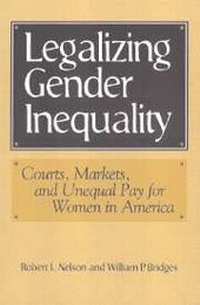
Legalizing Gender Inequality
Courts, Markets and Unequal Pay for Women in America
1st Edition
Published on 28. January 2005
978-0-511-03517-3 (ISBN)
Description

Legalizing Gender Inequality challenges existing theories of gender inequality within economic, sociological, and legal organizations. The book argues that male-female earnings differentials cannot be explained adequately by market forces, principles of efficiency, or society-wide sexism. Rather it suggests that employing organizations tend to disadvantage holders of predominantly female jobs by denying them power in organizational politics and by reproducing male cultural advantages. These findings contradict major legal precedents which have argued that labor markets and not employers are the source of inequality. The authors further argue that comparable worth is an inappropriate remedy, as such an approach misdiagnoses the causes of gender inequality and often falls prey to the same organizational processes that initially generated this differential. The book argues that the courts have, by uncritically accepting the market explanation for male-female wage disparity, tended to legitimate and to legalize a crucial dimension of gender inequality in American society.
Reviews / Votes
"Legalizing Gender Inequality presents a new organization-centered paradigm for understanding gender-differentials in pay, which promises to turn on its head standard thinking about the relationship between law, markets, and organizations. By offering important new insights into pay equity, gender relations in the workplace, and organization-market relations, Nelson and Bridges make significant contributions to the sociological literatures on gender, law, and organizations." Lauren Edelman, University of California, Berkeley "Legalizing Gender Inequality provides a truly pathbreaking analysis of how organizations produce pay disparities between the sexes and how the courts legitimate them. Nelson and Bridges' superb scholarship, cogent logic, and accessible style make this book a winner." Barbara Reskin, Harvard University "Equal Pay for equal work' is a central tenet of our civil rights law, but the principle of 'comparable pay for comparable work' is recognized neither by law nor in the public consciousness. This means on the ground that between-job gender inequality is currently unregulated, because employers have convinced courts that 'the market made us' pay female-dominated jobs less than male-dominated jobs. Legalizing Gender Inequality persuasively refutes this strong-form market-based defense. In penetrating and clear-eyed fashion, the authors re-analyze the four crucial cases that flirted with the possiblity of comparable worth." Ian Ayres, Yale University "But instead of merely trashing the market, this book concludes that inequality can be produced under pay systems based on either comparable worth or market principles. Rather than using comparable pay as the sole remedy for gender inequality, the authors suggest procedural reforms to improve organizational politics and even consider harnessing the transformative energies of the market. In short, this book eschews the reifying choice between market and non-market forces as causes of inequality and instead develops a more comprehensive organizational theory which better fits the facts which the authors have so painstakingly unearthed." Ian Ayres, Yale University "...a well-written book about an important topic that is well-argued and empirically grounded." Sara C. Benesh, The Law and Politics Book Review "The authors raise new questions for theory and research about pay equity." Patti A. Giuffre, Social Forces "...an unusual and creative approach." Law & Social Inquiry "The authors are otherwise will qualified to tackle the issue of pay equity. Their findings constitute significant contributions to the field. Graduate students and faculty who focus on complex organizations and pay discrimination issues and plaintiff lawyers will appreciate this book." Gender & Society "Legalizing Gender Inequality is one of the best recent efforts I have seen to address and analyze policies aimed at achieving gender equailty in paid work." Qualitative Sociology "Legalizing Gender Equality is essential reading for scholars of social inequality, gender, and sociology of law. The books breaks new ground in a highly polarized debate over pay equity. The results of this compelling study testify to the importantce of mapping variations in gender inequality across different market and organizational contexts." American Journal of SociologyMore details
Series
Language
English
Place of publication
Cambridge
United Kingdom
Publishing group
Cambridge University Press
Target group
College/higher education
Professional and scholarly
Illustrations
35 Tables, unspecified; 10 Line drawings, unspecified
File size
2,68 MB
ISBN-13
978-0-511-03517-3 (9780511035173)
Copyright in bibliographic data and cover images is held by Nielsen Book Services Limited or by the publishers or by their respective licensors: all rights reserved.
Schweitzer Classification
Other editions
Additional editions
Robert L. Nelson | William P. Bridges
Legalizing Gender Inequality
Courts, Markets and Unequal Pay for Women in America
Book
05/1999
Cambridge University Press
€52.71
Article exhausted; check for reprint
Robert L. Nelson | William P. Bridges
Legalizing Gender Inequality
Courts, Markets and Unequal Pay for Women in America
Book
05/1999
Cambridge University Press
€51.80
Shipment within 15-20 days
Persons
Content
List of figures and tables; Acknowledgements; 1. Law, markets, and the institutional construction of gender inequality in pay; Part I. Theory and Method: 2. Legal theories of sex-based pay discrimination; 3. Toward an organizational theory of gender inequality in pay; 4. Methodological approach: law cases, case studies, and critical empiricism; Part II. The Case Studies. Section A. Public Sector Organizations: 5. Paternalism and politics in a university pay system: Christensen v. State of Iowa; 6. Bureaucratic politics and gender inequality in a state pay system: AFSCME v. State of Washington; Section B. Private Sector Organizations: 7. Corporate politics, rationalization, and managerial discretion: EEOC v. Sears, Roebuck & Co.; 8. The financial institution as a male, profit-making club: Glass v. Coastal Bank; Part III. Conclusion: Legalizing Gender Inequality: 9. Rethinking the relationship between law, markets, and gender inequality in organizations; Appendix: court documents and case materials used in case studies; References; Index.
