

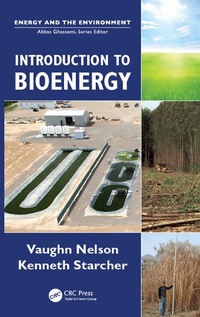
Introduction to Bioenergy
Published on 19. December 2017
277 pages
978-1-4987-1699-4 (ISBN)
Description

Explore a Major Component of Renewable Energy
Introduction to Bioenergy
takes a look at energy from biomass (thermal energy, power, liquid fuels, and biogas) and envisions a sustainable future fueled by renewable energy. From production to conversion to heat, power, and biofuel, this book breaks down the science of bioenergy and explains the major processes for its production, conversion, and use.
Covers Solar Energy, Bioenergy, and Biomass Resources
The book begins with an introduction to solar energy (the source of bioenergy) and then moves on to describe bioenergy, biomass, chemical conversion, and the renewable energy processes involved. The authors cover measurement energy parameters, analysis of data, and the prediction of energy production for different bio products. They also consider the institutional, environmental, and economic concerns surrounding bioenergy.
An all-inclusive resource covering a rapidly-advancing field, this book:
Explores the impact of climate change and global warming on the production of biomass
Describes the positive and negative effects of biomass production on ecosystems and biodiversity
Illustrates the use of biomass for the production of electricity
Considers the replacement of fossil fuels with biofuels, biofuel production, and emerging technologies
Addresses institutional and environmental issues relevant to bioenergy
Discusses factors impacting the economic feasibility of renewable energy systems
Introduction to Bioenergy
defines major processes for the production, conversion, and use of bioenergy. A book suitable for coursework or self-study, this essential work serves students and practicing professionals in the renewable energy, environmental science, agriculture engineering, and biology fields.
Introduction to Bioenergy
takes a look at energy from biomass (thermal energy, power, liquid fuels, and biogas) and envisions a sustainable future fueled by renewable energy. From production to conversion to heat, power, and biofuel, this book breaks down the science of bioenergy and explains the major processes for its production, conversion, and use.
Covers Solar Energy, Bioenergy, and Biomass Resources
The book begins with an introduction to solar energy (the source of bioenergy) and then moves on to describe bioenergy, biomass, chemical conversion, and the renewable energy processes involved. The authors cover measurement energy parameters, analysis of data, and the prediction of energy production for different bio products. They also consider the institutional, environmental, and economic concerns surrounding bioenergy.
An all-inclusive resource covering a rapidly-advancing field, this book:
Explores the impact of climate change and global warming on the production of biomass
Describes the positive and negative effects of biomass production on ecosystems and biodiversity
Illustrates the use of biomass for the production of electricity
Considers the replacement of fossil fuels with biofuels, biofuel production, and emerging technologies
Addresses institutional and environmental issues relevant to bioenergy
Discusses factors impacting the economic feasibility of renewable energy systems
Introduction to Bioenergy
defines major processes for the production, conversion, and use of bioenergy. A book suitable for coursework or self-study, this essential work serves students and practicing professionals in the renewable energy, environmental science, agriculture engineering, and biology fields.
Reviews / Votes
"This book provides an excellent overview of the basic science that describes the source (solar energy) and how this energy is collected and converted to what we call bioenergy. ... The latter chapters describe how bioenergy can be utilized by society and meet the growing need for additional energy as the supply of fossil fuels declines in the future."-R. Nolan Clark, Retired, Director, ARS, USDA, Bushland, Texas, USA
More details
Series
Language
English
Place of publication
London
United Kingdom
Publishing group
Taylor & Francis Ltd
Target group
College/higher education
Illustrations
89 s/w Abbildungen, 42 s/w Tabellen
42 Tables, black and white; 89 Illustrations, black and white
File size
33,37 MB
ISBN-13
978-1-4987-1699-4 (9781498716994)
Copyright in bibliographic data and cover images is held by Nielsen Book Services Limited or by the publishers or by their respective licensors: all rights reserved.
Schweitzer Classification
Other editions
Additional editions
Vaughn C. Nelson | Kenneth L. Starcher
Introduction to Bioenergy
Book
06/2016
1st Edition
CRC Press
€202.50
Shipment within 15-20 days
Persons
Vaughn Nelson has been involved with renewable energy, primarily wind energy, since the early 1970s. Currently, he is retired from West Texas A&M University (WTAMU). He has earned the following degrees: PhD in physics, University of Kansas, EdM, Harvard University, and BSE, Kansas State Teachers College, Emporia. He is the author of three books and four CDs, and has published over 50 articles and reports. In the series Energy and the Environment, Dr. Nelson is the author of Wind Energy (2009, 2nd ed. 2013) and Introduction to Renewable Energy (2011) as well as the 2nd ed. (2015) from CRC Press.
Kenneth Starcher began his college career and involvement with renewables in the same semester at West Texas State University in 1976. It led to a BS in physics/computer science in 1980. He received an MS in engineering technology at West Texas A&M University (WTAMU) in 1995. Ken has been the educational funnel for on-site training and public information for students and public workshops for AEI and has been a field worker for projects at the company since 1980. He has served as a consultant for wind companies in the United States and produced wind resources maps for various areas worldwide.
Kenneth Starcher began his college career and involvement with renewables in the same semester at West Texas State University in 1976. It led to a BS in physics/computer science in 1980. He received an MS in engineering technology at West Texas A&M University (WTAMU) in 1995. Ken has been the educational funnel for on-site training and public information for students and public workshops for AEI and has been a field worker for projects at the company since 1980. He has served as a consultant for wind companies in the United States and produced wind resources maps for various areas worldwide.
Content
INTRODUCTION. ENERGY. SUN. CLIMATE CHANGE. PLANTS. SOIL. CONSTRAINTS. HEAT AND POWER. BIOFUELS. SECONDARY USES. INSTITUTIONAL ISSUES. ECONOMICS. OBSERVATIONS. APPENDIX.
