

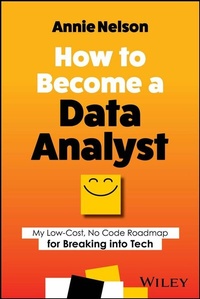
How to Become a Data Analyst
Description

In How to Become a Data Analyst: My Low-Cost, No Code Roadmap for Breaking into Tech, data analyst and analytics consultant Annie Nelson walks you through how she took the reins and made a dramatic career change to unlock new levels of career fulfilment and enjoyment. In the book, she talks about the adaptability, curiosity, and persistence you'll need to break free from the 9-5 grind and how data analytics--with its wide variety of skills, roles, and options--is the perfect field for people looking to refresh their careers.
Annie offers practical and approachable data portfolio-building advice to help you create one that's manageable for an entry-level professional but will still catch the eye of employers and clients. You'll also find:
* Deep dives into the learning journey required to step into a data analytics role
* Ways to avoid getting lost in the maze of online courses and certifications you can find online--while still obtaining the skills you need to be competitive
* Explorations of the highs and lows of Annie's career-change journey and job search--including what was hard, what was easy, what worked well, and what didn't
* Strategies for using ChatGPT to help you in your job search
A must-read roadmap to a brand-new and exciting career in data analytics, How to Become a Data Analyst is the hands-on tutorial that shows you exactly how to succeed.
More details
Other editions
Additional editions
Person
Content
Preface
I've never seen myself as particularly "techy" or "good at math." To be honest, I never enjoyed math, and if you'd asked me even a few years ago if I had any interest in learning how to code, I would've laughed at you. So how in the world did I go from that to writing this book about becoming a data analyst? Perhaps I should start with some context, because I find that the more I connect with others in the data community, the more I see my story reflected in theirs.
In the United States the phrase "What do you want to be when you grow up?" is usually synonymous with both "What do you want your identity to be?" and "What career do you want to have?" I grew up thinking that what I did for work had to be my entire personality. I was never quite sure what I wanted to "be." I was a natural caretaker and wanted to be seen as empathetic, and I've always loved spending time with kids. I also knew that I love spending time outdoors and going on adventures regularly.
This led to the natural conclusion that I should become a teacher or maybe a wilderness therapist. Well, after some time dabbling in teaching I realized that it was not the path for me. So after discovering the joys of nature-based occupational therapy with children, I decided I knew what I wanted to "be," and I signed up for my master's degree a few months later.
Fast-forward a couple of years (and many thousands of dollars later), and I was more burnt out than I'd ever been. Unfortunately, a perfect storm of circumstances had rocked my (our) world(s) in the last few years. In my first year of graduate school (1) we entered a global pandemic (hello, 2020!), (2) I developed a mysterious autoimmune disorder in my brain, and (3) I was juggling full-time graduate school and being elected president of the student government of my program.
Unfortunately, I didn't have the best graduate school experience. I felt that I was often being asked to ingest and regurgitate information seemingly at the instructor's discretion. I'm someone who genuinely enjoys learning, and being forced to perform under high stakes without the joy of being allowed to truly learn was a hard pill to swallow. I poured hours of time (and many tears) into trying to advocate for myself and my peers, only to get chastised for being "unprofessional."
After two years of poor physical health (migraines, brain fog, and overwhelming fatigue) and poor mental health (due to graduate school), I knew that something in my life needed to change. The year 2021 in particular felt like it was grinding me down so hard that all that was left was an emotionless pile of dust. So, in the last semester of school I quit my job and moved out of my apartment to go live with my parents, to try to recover some of the spark I used to have for life.
Why am I telling you all this? None of the individual brush strokes of my story are likely to be relevant to you. But, if we back up a bit and look at the whole picture I've painted, I know it suddenly becomes a familiar picture for many people out there. What's the number one thing people tell me when I ask why they decided to take the leap and switch careers into data? "I was burnt out, unhappy, and wondering if there could be more than the life I was living before."
As I started to recover from burnout, the first thing that returned was my interest in learning. The next thing to come was the acute awareness that I still needed to make it through another nine months before I could get a job as an occupational therapist and start paying off my tens of thousands of dollars in student loans. At first, besides the time I was spending on internships as a part of the end of my Master's Degree, I was reading five books a week and delivering for Instacart. At around the same time, I started to see all these TikToks from people who worked in tech talking about their remote jobs, how flexible they were, and how well they paid.
The idea of working remotely, having autonomy over your schedule, and being paid well enough to be comfortable was fascinating to me, but it felt far out of reach. I wrote it off initially, thinking I wasn't smart enough. "I'm just not a math person" and "I could never enjoy coding" and even "I like having a job where I'm on my feet often" were all mental statements I made to myself.
Sometime about mid-January, I decided to look up "tech jobs you can do without learning to code." To my surprise, it appeared there were many paths into the tech industry, not all of them requiring a computer science degree or any coding. I spent a few hours going down the rabbit hole of different options and finally landed on data analytics. What I gathered about data analytics is that it involves working with data in programs like Microsoft Excel. It can be done remotely or in person. And, crucially, it seemed like it had a pretty low barrier to entry.
I put all those pieces together and decided, "Maybe I could learn data analytics well enough that people would pay me to organize and analyze their spreadsheets as a side hustle." It had all the markings of a perfect plan-I could do it on my own time, make more than minimum wage, and do it without having to drive anywhere. I'd found this Google Certificates course in Data Analytics that seemed to have the roadmap laid out for me to prepare for a job or side gig.
I was lucky enough at that point to have already prepared for the time I would be in various occupational therapy clinics full-time to complete the requirements for my degree (kind of like student teaching), unable to have a steady source of income. I had some free time to spend learning, as long as it was cheap. Looking back, what was most exciting to me about signing up for and beginning that Google Certificates course was the ability to finally get to learn again.
I'll continue sharing the story of what happened next in the chapters to come, but the short version is that the random decision to try analyzing spreadsheets as a side hustle became not only the catalyst for eventually deciding to switch careers, but also one of the single most influential and pivotal moments in my life so far. As you can imagine, you don't get to the point of writing a book about how to become a data analyst without it being a life-changing event.
I'm so glad that I put a very small amount of thought into the idea of trying out data analytics. If I'd thought about it and tried picturing myself as a data analyst among other data analysts, I never would've started.
If you'd asked me a year and a half ago what your average "data analyst" looks like, I would've answered something like this:
- Male
- Good at math/statistics
- Into computers
- Has a computer science or math degree
This is far beyond the scope of this book and I am not qualified to talk about it, but as I've discussed this topic with others in the industry, something that often comes up is that most people perceive tech to be dominated by cis straight white men. If I had to choose from a multiple-choice list who would be the best fit for "data analyst" and "cis white male" was one of the options, I would've chosen that.
The point I'm making here is this: I definitely did not see myself represented in the tech world. I can't imagine that I would've decided to seek a new career that I knew nothing about, where I wouldn't fit in with anyone, while not having any idea if I would ever be good at it-even if it promised good pay and remote work.
That's part of the reason I'm writing this book: I hope readers can see themselves represented in my story. I am neurodivergent, I have an autoimmune disorder. I am a (white) woman. When I was writing this preface and explaining how I hated calculus in high school, I realized two days later that it was algebra. I never even took calculus in high school (I did take pre-calc). I love spending my time with children. Three years ago was the first time I ever had a full-time job during the summer, because prior to that I would take my summers off so I could spend afternoons swimming, camping, rock climbing, and generally not working or sitting in front of a computer.
I'm not what someone would consider the "ideal candidate" for a data analyst role on paper. But you know what? In just six months I taught myself data analytics for less than $100 and landed a great job. I have loved being a data analyst, and I don't get the "Sunday Scaries" anymore, where I spend most of my Sunday dreading going back to work on Monday. I have also never gotten a less-than-glowing performance review from my manager(s) since I changed careers, and others around me tell me that I am learning fast and doing exceptionally well for someone so new to the industry.
So far I've talked about data analytics from the perspective of what it looks like to be an entry-level data analyst. But how about what comes next? If you launch a data career, what can you expect your roadmap to look like in the future?
The beautiful thing about working in tech in general, and analytics is no exception, is that it is always growing and evolving. Earlier I mentioned how curiosity and a love of learning are a valuable part of the data analyst mindset. There are so many...
