

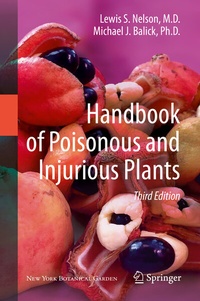
Handbook of Poisonous and Injurious Plants
Description

This third edition of the Handbook of Poisonous and Injurious Plants is designed to assist the clinician in the initial response to the needs of a child or adult exposed to a poisonous or injurious plant. It highlights common and important plants that lead to the adverse effects upon exposure, and it describes the mechanisms of action of the implicated toxin, clinical manifestations, and specific therapeutics, as available, for each. This truly comprehensive resource is botanically rigorous with insights from both the pharmacognosy and medical literature. At the same time, it is also for those who are interested in growing and enjoying the plants in their environment, filling in a not-often-discussed botanical and horticultural niche that goes beyond their beautiful physical appearance. Plants contain many useful chemicals that humans have used for millennia as botanical curatives. This book will help the reader understand the fine balance between a medication and a poison, why plants contain these natural substances, and their impact on the human body.
With its thorough references and full-color photos of hundreds of potentially toxic and injurious plants inside and outside the home, this book is useful for identifying and addressing concerns about cultivated species and those found in the wild.
This book will be of interest to botanists, horticulturists, clinicians, and naturalists as well as hikers, gardeners, and all those who simply enjoy the wonders of nature and the great outdoors.
More details
Other editions
Additional editions
Previous edition
Persons
Lewis S. Nelson, MD is Professor and Chair of the Department of Emergency Medicine and Director of the Division of Medical Toxicology at Rutgers New Jersey Medical School in Newark, NJ. He is a member of the Board of Directors of the American Board of Emergency Medicine and a Past-President of the American College of Medical Toxicology. In addition to his clinical work in the Emergency Department at University Hospital in Newark, he is a senior consultant to the New Jersey Poison Information & Education System on human poisoning. He is the senior editor of Goldfrank's Toxicologic Emergencies, currently in its 11 th edition. The focus of his research in on the adverse consequences of opioids used either for pain relief or for abuse, with an emphasis on system development for prevention and treatment.
Michael J. Balick, Ph.D . is Vice President for Botanical Science, Director of the Institute of Economic Botany and Senior Philecology Curator at The New YorkBotanical Garden. For more than four decades, he has studied the relationship between plants, people and culture, the field known as ethnobotany, and floristics, the study of botanical diversity within a specific region. His research has included studies in the Amazon Valley, Central and South America, The Middle East, Southeast Asia and Pacific Islands in Micronesia and Melanesia. He currently holds adjunct teaching or research appointments at City University of New York, Columbia University, Fordham University, Harvard University, the Institute of Ethnomedicine and the National Tropical Botanical Garden. He is a member of the Board of Trustees of the American Botanical Council and Past-President of the Society for Economic Botany.