

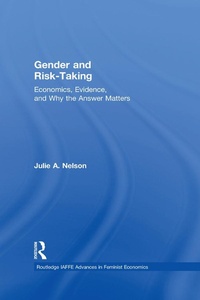
Gender and Risk-Taking
Economics, Evidence, and Why the Answer Matters
Published on 14. July 2017
156 pages
978-1-351-98040-1 (ISBN)
Description

The belief that men and women have fundamentally distinct natures, resulting in divergent preferences and behaviours, is widespread. Recently, economists have also engaged in the search for gender differences, with a number claiming to find fundamental gender differences regarding risk-taking, altruism, and competition. In particular, the idea that "women are more risk-averse than men" has become accepted as a truism. But is it true? And what are its causes and consequences?
Gender and Risk Taking makes three contributions. First, it asks whether the belief that men and women have distinct risk preferences is backed up by high quality empirical evidence. The answer turns out to be "no." This leads to a second question: Why, then, does so much of the literature claim to find evidence of "difference"? This, it will be shown, can be attributed to biases arising from too-easy categorical thinking, widespread stereotyping, and a tendency to prefer results that are publishable and that fit one's prior beliefs. Third, the book explores the economic implications of the conventional association of risk-taking with masculinity and risk-aversion with femininity. Not only fairness in employment, but also the health of the financial sector and national responses to climate change, this book argues, are being compromised.
This volume will be eye-opening for anyone interested in gender, decision-making, cognition, and/or risk, especially in areas relating to employment, finance, management, or public policy.
Gender and Risk Taking makes three contributions. First, it asks whether the belief that men and women have distinct risk preferences is backed up by high quality empirical evidence. The answer turns out to be "no." This leads to a second question: Why, then, does so much of the literature claim to find evidence of "difference"? This, it will be shown, can be attributed to biases arising from too-easy categorical thinking, widespread stereotyping, and a tendency to prefer results that are publishable and that fit one's prior beliefs. Third, the book explores the economic implications of the conventional association of risk-taking with masculinity and risk-aversion with femininity. Not only fairness in employment, but also the health of the financial sector and national responses to climate change, this book argues, are being compromised.
This volume will be eye-opening for anyone interested in gender, decision-making, cognition, and/or risk, especially in areas relating to employment, finance, management, or public policy.
Reviews / Votes
'Julie Nelson's new book is a rigorously academic bombshell, exploding the social science purportedly demonstrating that attitudes to risk meaningfully differ by gender. In clear and engaging prose, Professor Nelson authoritatively demonstrates how confirmation bias has tainted academic research on this topic, and in the process clarifies both the methodologies capable of revealing how stereotypes undermine the practice of science and the pernicious, real-world consequences.' - Mary C. King, Professor Emerita of Economics, Portland State University, USA'A rigorous and important debunking of the notion of fundamental sex differences in financial risk-taking, and a fascinating exploration of the gendering of economic thinking.' - Cordelia Fine, Professor of History & Philosophy of Science, University of Melbourne, Australia
'Gender and Risk-Taking offers a model for how to discipline the cumulation of scientific knowledge. In this careful re-examination, Julie Nelson shows how tentative and modest in scope and statistical strength, the evidence on gender differences in risk-taking actually is.' - Colin F. Camerer, Robert Kirby Prof. of Behavioral Economics, Caltech, USA
"Nelson provides an extremely clear explanation of the methods for comparing groups' characteristics, written at an undergraduate level and thus accessible to anyone with some understanding of statistics. The book is available in paperback and e-book formats, and the short chapters make it ideal for teaching. Part I should be assigned to students in every statistics course." -Cordelia W. Reimers, Hunter College and the Graduate School of the City University of New York.
More details
Series
Language
English
Place of publication
London
United Kingdom
Publishing group
Taylor & Francis Ltd
Target group
College/higher education
Product notice
Reflowable
Illustrations
20 s/w Abbildungen, 8 s/w Tabellen, 20 s/w Zeichnungen
8 Tables, black and white; 20 Line drawings, black and white; 20 Illustrations, black and white
File size
1,37 MB
ISBN-13
978-1-351-98040-1 (9781351980401)
Copyright in bibliographic data and cover images is held by Nielsen Book Services Limited or by the publishers or by their respective licensors: all rights reserved.
Schweitzer Classification
Other editions
Additional editions
Book
06/2017
1st Edition
Routledge
€62.70
Shipment within 10-20 days

Book
06/2017
1st Edition
Routledge
€205.80
Shipment within 10-20 days
Person
Julie A. Nelson is Professor of Economics at the University of Massachusetts Boston and Senior Research Fellow at the Global Development and Environment Institute at Tufts University, USA.
Content
Dedication
List of Figures and Tables
Acknowledgements
Introduction
Part I. To Understand the Answer, You First Have to Have a Clear Question
Chapter 1. The Better Question: How Much Different and How Much Similar
Chapter 2. Why We Get Stuck on the Bad Question
Chapter 3. Statistical Tools for Analyzing Similarity and Difference
Chapter 4. Statistical Tools for Inference and the Detection of Bias
Part II. Evidence about Risk Behavior: Little Difference, Much Similarity
Chapter 5. Difference and Similarity in 35 Scholarly Works
Chapter 6. Difference and Similarity in 37 Investment Game Studies
Part III. Evidence about Stereotyping and Confirmation Bias: Rampant
Chapter 7. Stereotyping and Research Participants
Chapter 8. Confirmation Bias Among Researchers in 35 Scholarly Works
Chapter 9. Confirmation Bias and the Review of 37 Investment Game Studies
Part IV. Why It Matters
Chapter 10. Presumed Timidity: Consequences for Women
Chapter 11. Recklessness: The (Masculine) Gendering of Commerce and Finance
Chapter 12. Fearing Fear: The (Masculine) Gendering of Economics and Policy
Conclusion
Index
List of Figures and Tables
Acknowledgements
Introduction
Part I. To Understand the Answer, You First Have to Have a Clear Question
Chapter 1. The Better Question: How Much Different and How Much Similar
Chapter 2. Why We Get Stuck on the Bad Question
Chapter 3. Statistical Tools for Analyzing Similarity and Difference
Chapter 4. Statistical Tools for Inference and the Detection of Bias
Part II. Evidence about Risk Behavior: Little Difference, Much Similarity
Chapter 5. Difference and Similarity in 35 Scholarly Works
Chapter 6. Difference and Similarity in 37 Investment Game Studies
Part III. Evidence about Stereotyping and Confirmation Bias: Rampant
Chapter 7. Stereotyping and Research Participants
Chapter 8. Confirmation Bias Among Researchers in 35 Scholarly Works
Chapter 9. Confirmation Bias and the Review of 37 Investment Game Studies
Part IV. Why It Matters
Chapter 10. Presumed Timidity: Consequences for Women
Chapter 11. Recklessness: The (Masculine) Gendering of Commerce and Finance
Chapter 12. Fearing Fear: The (Masculine) Gendering of Economics and Policy
Conclusion
Index
