

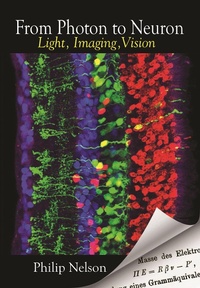
From Photon to Neuron
Description

A richly illustrated undergraduate textbook on the physics and biology of light
Students in the physical and life sciences, and in engineering, need to know about the physics and biology of light. Recently, it has become increasingly clear that an understanding of the quantum nature of light is essential, both for the latest imaging technologies and to advance our knowledge of fundamental life processes, such as photosynthesis and human vision. From Photon to Neuron provides undergraduates with an accessible introduction to the physics of light and offers a unified view of a broad range of optical and biological phenomena. Along the way, this richly illustrated textbook builds the necessary background in neuroscience, photochemistry, and other disciplines, with applications to optogenetics, superresolution microscopy, the single-photon response of individual photoreceptor cells, and more.
With its integrated approach, From Photon to Neuron can be used as the basis for interdisciplinary courses in physics, biophysics, sensory neuroscience, biophotonics, bioengineering, or nanotechnology. The goal is always for students to gain the fluency needed to derive every result for themselves, so the book includes a wealth of exercises, including many that guide students to create computer-based solutions. Supplementary online materials include real experimental data to use with the exercises.
- Assumes familiarity with first-year undergraduate physics and the corresponding math
- Overlaps the goals of the MCAT, which now includes data-based and statistical reasoning
- Advanced chapters and sections also make the book suitable for graduate courses
- An Instructor's Guide and illustration package is available to professors
More details
Other editions
Additional editions
Person
Content
- Cover
- Title Page
- Copyright
- Table of Contents
- Web resources
- To the student
- Features of this book
- Skills and habits
- About you
- To the instructor
- Prologue: Preliminaries
- 0.1 Signpost: Uncertainty
- 0.2 Discrete Probability Distributions
- 0.2.1 A probability distribution summarizes our knowledge about an uncertain situation
- 0.2.2 Conditional probability quantifies the degree to which events are correlated
- 0.2.3 A random variable can be partially described by its expectation and variance
- 0.2.4 Joint distributions
- 0.2.5 Some explicit discrete distributions
- Uniform discrete distribution
- Bernoulli trial
- Geometric distribution
- Binomial and Poisson distributions
- 0.3 Dimensional Analysis
- 0.4 Continuous Probability Distributions
- 0.4.1 Probability density functions
- 0.4.2 Some explicit continuous distributions
- Uniform
- Gaussian
- Cauchy
- Exponential
- Power-law
- 0.5 More Properties of, and Operations on, Probability Distributions
- 0.5.1 Transformation of a probability density function
- 0.5.2 The sample mean of many independent, identically distributed random variables has lower variance than any one of its constituents
- 0.5.3 Count data are typically Poisson distributed
- 0.5.4 The difference of two noisy quantities can have greater relative standard deviation than either by itself
- 0.5.5 The convolution of two distributions describes the sum of their random variables
- Convolution property of Poisson distributions
- 0.6 Thermal Randomness
- Big Picture
- Key Formulas
- Problems
- Part I Doorways of Light
- 1 What Is Light?
- 1.1 Signpost: Photons
- Why do you need natural sunlight, not indoor artificial lighting, to generate vitamin D?
- 1.2 Light Before 1905
- 1.2.1 Basic light phenomena
- 1.2.2 Light displays wavelike behavior in many situations
- 1.3 Light Is Lumpy
- 1.3.1 The discrete aspect of light and its interactions is most apparent at extremely low intensity
- 1.3.2 The photoelectric effect
- 1.3.3 Einstein's proposal
- 1.3.4 Light-induced phenomena in biology qualitatively support the Einstein relation
- 1.4 Background: Poisson Processes
- 1.4.1 A Poisson process can be defined as a continuous-time limit of repeated Bernoulli trials
- 1.4.2 Blip counts in a fixed interval are Poisson distributed
- 1.4.3 Waiting times are Exponentially distributed
- 1.5 A New Physical Model of Light
- 1.5.1 The Light Hypothesis, part 1
- 1.5.2 The spectrum of light can be regarded as a probability density times an overall rate
- 1.5.3 Light can eject electrons from individual molecules, inducing photochemical reactions
- 1.6 Fluorescence and Photoisomerization Can Occur after Photon Absorption
- 1.6.1 The Electron State Hypothesis
- 1.6.2 Atoms have sharp spectral lines
- 1.6.3 Molecules: fluorescence
- 1.6.4 Molecules: photoisomerization
- 1.7 Transparent Media Are Unchanged by the Passage of Light, but Slow It Down
- Big Picture
- Key Formulas
- Track 2
- 1.3.1' Quantum randomness is distinct from classical chaos
- 1.3.3'a The reality of photons
- 1.3.3'b Light also carries momentum
- 1.3.3'c The thermal radiation spectrum
- 1.3.3'd The role of frequency
- 1.4' Corrections to Poisson emission and detection
- 1.5.1'a Gamma rays
- 1.5.1'b More about the Light Hypothesis
- 1.5.3' Mechanism of DNA photodamage
- 1.6.1' Dense media
- 1.6.2'a More about atoms and light
- 1.6.2'b A Cauchy distribution in physics
- 1.6.3'a Born-Oppenheimer approximation
- 1.6.3'b Classical approximation for nuclear motion
- 1.6.3'c Debye relaxation
- 1.6.4' Fast conformational changes
- Problems
- 2 Photons and Life
- 2.1 Signpost: Seeing and Touching
- How can you see tiny intramolecular motions using ordinary light?
- 2.2 Light-Induced DNA Damage
- 2.3 Fluorescence as a Window into Cells
- 2.3.1 Fluorescence can discriminate healthy from diseased tissue during surgery
- Autofluorescence
- Induced fluorescence
- 2.3.2 Fluorescence microscopy can reduce background and specifically show only objects of interest
- 2.4 Background: Membrane Potential
- 2.4.1 Electric currents involve ion motion
- 2.4.2 An ion imbalance across the cell membrane can create a membrane potential
- 2.4.3 Ion pumps maintain a resting electric potential drop across the cell membrane
- 2.4.4 Ion channels modulate the membrane potential to implement neural signaling
- 2.4.5 Action potentials can transmit information over long distances
- 2.4.6 Creation and utilization of action potentials
- Input
- Output
- Networking
- Alternative inputs and outputs
- 2.4.7 More about synaptic transmission
- Discrete release of vesicles
- 2.5 Optogenetics
- 2.5.1 Brains are hard to study
- 2.5.2 Channelrhodopsin can depolarize selected neurons in response to light
- 2.5.3 Halorhodopsin can hyperpolarize selected neurons in response to light
- 2.5.4 Other methods
- 2.6 Fluorescent Reporters Can Give Real-Time Readout of Cellular Conditions
- 2.6.1 Voltage-sensitive fluorescent reporters
- 2.6.2 Split fluorescent proteins and genetically encoded calcium indicators
- Split fluorescent proteins
- Genetically encoded calcium indicators
- 2.7 Two-Photon Excitation Permits Imaging Deep within Living Tissue
- 2.7.1 The problem of imaging thick samples
- 2.7.2 Two-photon excitation depends sensitively on light intensity
- 2.7.3 Multiphoton microscopy can excite a specific volume element of a specimen
- 2.8 Fluorescence Resonance Energy Transfer
- 2.8.1 How to tell when two molecules are close to each other
- 2.8.2 A physical model for FRET
- 2.8.3 Some forms of bioluminescence also involve FRET
- 2.8.4 FRET can be used to create a spectroscopic ``ruler''
- 2.8.5 Application of FRET to DNA bending flexibility
- 2.8.6 FRET-based indicators
- 2.9 A Glimpse of Photosynthesis
- 2.9.1 It's big
- 2.9.2 Two quantitative puzzles advanced our understanding of photosynthesis
- The puzzle of low oxygen yield per chlorophyll
- The puzzle of the action spectrum of photosynthesis
- 2.9.3 Resonance energy transfer resolves both puzzles
- Other pigments can transfer excitation to chlorophyll, resolving the spectral puzzle
- Oxygen yield and the light-harvesting complex
- Big Picture
- Key Formulas
- Track 2
- 2.4.3' More about membrane potentials
- 2.4.5' Other uses for the resting potential
- 2.7.2' The -squared rule
- 2.7.3' More about two-photon imaging
- 2.8.1' About FRET and its efficiency
- 2.8.4' Other experimental tests of FRET
- 2.8.5' Why reported FRET efficiencies sometimes exceed 100%
- 2.9.3' More details about the photosynthesis apparatus in plants
- Problems
- 3 Color Vision
- 3.1 Signpost: A Fifth Dimension
- How can a mixture of red and green light appear yellow?
- 3.2 Color Vision Confers a Fitness Payoff
- 3.3 Newton's Experiments on Color
- 3.4 Background: More Properties of Poisson Processes
- 3.4.1 Thinning property
- 3.4.2 Merging property
- 3.4.3 Significance for light
- 3.5 Combining Two Beams Corresponds to Summing Their Spectra
- 3.6 Psychophysical Aspects of Color
- 3.6.1 R+G looks like Y
- 3.6.2 Color discrimination is many-to-one
- 3.6.3 Perceptual matching follows quantitative, reproducible, and context-independent rules
- 3.7 Color from selective absorption
- 3.7.1 Reflectance and transmittance spectra
- 3.7.2 Subtractive color scheme
- 3.8 A Physical Model of Color Vision
- 3.8.1 The color-matching function challenge
- 3.8.2 Available wetware in the eye
- Anatomical
- Functional
- 3.8.3 The trichromatic model
- 3.8.4 The trichromatic model explains why R+G~Y
- 3.8.5 Our eyes project light spectra to a 3D vector space
- Interpretation of spectral sensitivity functions
- 3.8.6 A mechanical analogy for color matching
- 3.8.7 Connection between the mechanical analogy and color vision
- 3.8.8 Quantitative comparison to experimentally observed color-matching functions
- 3.9 Why the Sky Is Not Violet
- 3.10 Direct Imaging of the Cone Mosaic
- Big Picture
- Key Formulas
- Track 2
- 3.5'a Flux, irradiance, and spectral flux irradiance
- 3.5'b Combining spectra is a linear operation
- 3.6.3'a Variation of color matching
- 3.6.3'b Colorblindness
- 3.6.3'c Tetrachromacy
- 3.7' Perceptual color
- 3.8.3'a Determination of sensitivity functions
- 3.8.3'b Contrast to audition
- 3.8.4'a Enhancement of color contrast in autofluorescence endoscopy
- 3.8.4'b Spectral analysis can discriminate many fluorophores and their combinations
- 3.8.5'a Photoisomerization rate regarded as an inner product
- 3.8.5'b Correction to predicted color matching due to absorption
- 3.8.8'a Relative versus absolute sensitivity
- 3.8.8'b Simplified color space
- Problems
- 4 How Photons Know Where to Go
- 4.1 Signpost: Probability Amplitudes
- If light really consists of particles, then how can our eye lens focus it?
- 4.2 Summary of Key Phenomena
- 4.3 The Probability Amplitude
- 4.3.1 Reconciling the particle and wave aspects of light requires the introduction of a new kind of physical quantity
- 4.4 Background: Complex Numbers Simplify Many Calculations
- 4.5 Light Hypothesis, part 2
- 4.6 Basic Interference Phenomena
- 4.6.1 Two-slit interference explained via the Light Hypothesis
- 4.6.2 Newton's rings illustrate interference in a three-dimensional setting
- 4.6.3 An objection to the Light Hypothesis
- 4.7 The Stationary-Phase Principle
- 4.7.1 The Fresnel integral illustrates the stationary-phase principle
- 4.7.2 The probability amplitude is computed as a sum over all possible photon paths
- 4.7.3 Diffraction through a single, wide aperture
- Other aperture shapes
- 4.7.4 Reconciliation of particle and wave aspects
- Big Picture
- Key Formulas
- Track 2
- 4.2' On philosophically repugnant theories
- 4.5'a More about the Light Hypothesis
- 4.5'b More about uniform media
- 4.6.1' Which slit?
- 4.6.2' More about reflection
- 4.6.3' More objections
- 4.7.2'a The neighborhood of the stationary-phase path
- 4.7.2'b Nonuniform media
- Problems
- 5 Optical Phenomena and Life
- 5.1 Signpost: Sorting and Directing
- Why do some butterfly wings lose their brilliant color when saturated with an appropriate liquid, then regain color when the liquid evaporates?
- 5.2 Structural Color in Insects, Birds, and Marine Organisms
- 5.2.1 Some animals create color by using nanostructures made from transparent materials
- 5.2.2 An extension of the Light Hypothesis describes reflection and transmission at an interface
- 5.2.3 A single thin, transparent layer reflects with weak wavelength dependence
- 5.2.4 A stack of many thin, transparent layers can generate an optical bandgap
- 5.2.5 Structural color in marine organisms
- 5.3 Ray-optics Phenomena
- 5.3.1 The reflection law is a consequence of the stationary-phase principle
- 5.3.2 Transmission and reflection gratings generate non-ray-optics behavior by editing the set of allowed photon paths
- 5.3.3 Refraction arises from the stationary-phase principle applied to a piecewise-uniform medium
- 5.3.4 Total internal reflection provides another tool to enhance signal relative to noise in fluorescence microscopy
- Medical applications
- Total internal reflection fluorescence microscopy
- 5.3.5 Refraction is generally wavelength dependent
- Big Picture
- Key Formulas
- Track 2
- 5.2.2' Transmission and reflection in classical electromagnetism
- 5.3.1' Fine points about reflection and refraction
- 5.2.4' More complicated layers
- Problems
- Part II Human and Superhuman Vision
- 6 Direct Image Formation
- 6.1 Signpost: Bright Yet Sharp
- How do swim goggles help you to see underwater?
- 6.2 Image Formation Without Lenses
- 6.2.1 Shadow imaging
- 6.2.2 Pinhole imaging suffices for some animals
- Snake sensory organ
- nautilus eye
- 6.3 Addition of a Lens Allows Formation of Bright, Yet Sharp, Images
- 6.3.1 The focusing criterion relates object and image distances to lens shape
- 6.3.2 A more general approach
- 6.3.3 Formation of a complete image
- 6.3.4 Aberration degrades image formation outside the paraxial limit
- 6.4 The Vertebrate Eye
- 6.4.1 Image formation with an air-water interface
- 6.4.2 Focusing powers add in a compound lens system
- Some numbers
- 6.4.3 A deformable lens implements focal accommodation
- Failures of accommodation
- 6.5 Light Microscopes and Related Instruments
- 6.5.1 ``Rays of light'' are a useful idealization in the ray-optics regime
- 6.5.2 Real and virtual images
- 6.5.3 Spherical aberration
- Gradient-index lenses partially compensate for aberration in animal eyes
- 6.5.4 Dispersion gives rise to chromatic aberration
- 6.5.5 Confocal microscopy suppresses out-of-focus background light
- 6.6 Darwin's Difficulty
- 6.7 Background: Angles and Angular Area
- 6.7.1 Angles
- 6.7.2 Angular area
- 6.8 Diffraction Limit
- 6.8.1 Even a perfect lens will not focus light perfectly
- 6.8.2 Three dimensions: The Rayleigh criterion
- 6.8.3 Animal eyes match their photoreceptor size to the diffraction limit
- Human
- Eagle
- Big Picture
- Key Formulas
- Track 2
- 6.4' The retinal pigment epithelium
- 6.8.2' The Abbe criterion
- Problems
- 7 Imaging as Inference
- 7.1 Signpost: Information
- If light is a wave, then how can you see objects smaller than its wavelength?
- 7.2 Background: On Inference
- 7.2.1 The Bayes formula tells how to update a probability estimate
- Discrete versus continuous
- 7.2.2 Inference with a Uniform prior reduces to likelihood maximization
- 7.2.3 Inferring the center of a distribution
- 7.2.4 Parameter estimation and credible intervals
- 7.2.5 Binning data reduces its information content
- 7.3 Localization of a Single Fluorophore
- 7.3.1 Localization is an inference problem
- 7.3.2 Formulation of a probabilistic model
- Two dimensions
- Realistic point spread function
- Stray light
- Pixelation
- 7.3.3 Maximum-likelihood analysis of image data
- 7.3.4 Results for molecular motor stepping
- 7.4 Localization Microscopy
- 7.5 Defocused Orientation Imaging
- Big Picture
- Key Formulas
- Track 2
- 7.3.2'a Airy pattern
- 7.3.2'b Anisotropic point spread function
- 7.3.2'c Other tacit assumptions
- 7.3.3' Advantages of the maximum likelihood method
- 7.3.4'a Background estimation
- 7.3.4'b Region of interest
- 7.4' Interferometric PALM imaging
- 7.5' More about anisotropy
- Problems
- 8 Imaging by X-Ray Diffraction
- 8.1 Signpost: Inversion
- How can we find the details of macromolecule architecture? That substructure is too small to resolve!
- 8.2 It's Hard to See Atoms
- 8.3 Diffraction Patterns
- 8.3.1 A periodic array of narrow slits creates a diffraction pattern of sharp lines
- 8.3.2 Generalizations to the setup needed to handle x-ray crystallography
- 8.3.3 An array of slits with substructure gives a diffraction pattern modulated by a form factor
- 8.3.4 A 2D ``crystal'' yields a 2D diffraction pattern
- 8.3.5 Real crystals can be analyzed by similar methods
- 8.4 The Diffraction Pattern of DNA Encodes Its Double-Helical Character
- 8.4.1 The helical pitch, base pair rise, helix offset, and diameter of DNA can be obtained from its diffraction pattern
- 8.4.2 Accurate determination of size parameters led to a breakthrough on the puzzle of DNA structure and function
- Big Picture
- Key Formulas
- Track 2
- 8.3.3' Factorization of amplitudes
- 8.4.1'a How to treat fiber samples of DNA
- 8.4.1'b The phase problem
- Problems
- 9 Vision in Dim Light
- 9.1 Signpost: Construction
- What sets the absolute limit to night vision?
- 9.2 The Edge of Vision
- 9.2.1 Many ecological niches are dimly lit
- 9.2.2 The single-photon challenge
- 9.2.3 Measures of detector performance
- 9.3 Psychophysical Measurements of Human Vision
- 9.3.1 The probabilistic character of vision is most evident under dim-light conditions
- Optimal conditions: Dark adaptation
- Optimal conditions: Location on the retina
- Optimal conditions: Wavelength
- Optimal conditions: Flash duration and spot size
- Probability of seeing
- 9.3.2 Rod cells must be able to respond to individual photon absorptions
- 9.3.3 The eigengrau hypothesis states that true photon signals are merged with a background of spontaneous events
- 9.3.4 Forced-choice experiments characterize the dim-light response
- 9.3.5 Questions raised by psychophysical experiments
- 9.4 Single-Cell Measurements
- 9.4.1 Vertebrate photoreceptors can be monitored via the suction pipette method
- 9.4.2 Determination of threshold, quantum catch, and spontaneous signaling rate
- 9.4.3 Direct confirmation that the rod cell imposes no threshold
- 9.4.4 Additional single-cell results
- Multiple photon absorptions
- Univariance
- 9.4.5 Questions raised by the single-cell measurements
- Big Picture
- Key Formulas
- Track 2
- 9.4.2'a The fraction of absorbed light depends exponentially on thickness
- 9.4.2'b The quantum yield for rod signaling
- 9.4.2'c Quantum catch for a single human rod cell under axial illumination
- 9.4.2'd The whole-retina quantum catch is the product of several factors
- Problems
- 10 The Mechanism of Visual Transduction
- 10.1 Signpost: Dynamic Range
- What mechanism can monitor one hundred million chromophores and reliably report when any one of them absorbs a photon?
- 10.2 Photoreceptors
- 10.2.1 Photoreceptors are a specialized class of neurons
- 10.2.2 Each rod cell simultaneously monitors one hundred million rhodopsin molecules
- Cat eye
- 10.3 Background: Cellular Control and Transduction Networks
- 10.3.1 Cells can control enzyme activities via allosteric modulation
- 10.3.2 Single-cell organisms can alter their behavior in response to environmental cues, including light
- 10.3.3 The two-component signaling pathway motif
- 10.3.4 Network diagrams summarize complex reaction networks
- 10.3.5 Cooperativity can increase the sensitivity of a network element
- 10.4 Photon Response Events Localized to One Disk
- 10.4.1 Step 1: photoisomerization of rhodopsin in the disk membrane
- 10.4.2 Step 2: activation of transducin in the disk membrane
- 10.4.3 Steps 3-4: activation of phosphodiesterase in the disk membrane, and hydrolysis of cyclic GMP in the cytosol
- 10.5 Events Elsewhere in the Rod Outer Segment
- 10.5.1 Ion pumps in the rod cell plasma membrane maintain nonequilibrium ion concentrations
- 10.5.2 Step 5: ion channel closing in the plasma membrane
- 10.6 Events at the Synaptic Terminal
- 10.6.1 Step 6: hyperpolarization of the plasma membrane
- 10.6.2 Step 7: modulation of neurotransmitter release into the synaptic cleft
- Voltage-gated channels
- Neurotransmitter release
- 10.7 Summary of the Visual Cascade
- Big Picture
- Key Formulas
- Track 2
- 10.2.2' Higher light intensities
- 10.3.3'a More about two-component signaling pathways
- 10.3.3'b Phototaxis
- 10.3.4' More about adaptation in chemotaxis
- 10.4.1' Cone and cone bipolar cells
- 10.4.3' Recently discovered vertebrate photoreceptors
- 10.6' Glutamate removal
- 10.7'a Termination of the photoreceptor response
- 10.7'b Negative feedback implements adaptation and standardizes rod signals
- 10.7'c Recycling of retinal
- Problems
- 11 The First Synapse and Beyond
- 11.1 Signpost: False Positives
- If each rod cell can signal upon absorbing a single photon, then why do our brains impose a lower limit of several such signals before alerting the conscious mind?
- 11.2 Transmission at the First Synapse
- 11.2.1 The synapse from rod to rod bipolar cells inverts its signal via another G protein cascade
- 11.2.2 The first synapse also rejects rod signals below a transmission breakpoint
- 11.3 Synthesis of Psychophysics and Single-Cell Physiology
- 11.3.1 Why does vision require several captured photons?
- 11.3.2 Review of the eigengrau hypothesis
- 11.3.3 Single-rod measurements constrain the fit parameters in the eigengrau model
- 11.3.4 Processing beyond the first synapse is highly efficient
- 11.4 A Multistep Relay Sends Signals on to the Brain
- 11.4.1 The classical rod pathway implements the single-photon response
- 11.4.2 Other signaling pathways
- 11.4.3 Optogenetic retinal prostheses
- 11.5 Evolution and Vision
- 11.5.1 Darwin's difficulty, revisited
- 11.5.2 Parallels between vision, olfaction, and hormone reception
- Big Picture
- Key Formulas
- Track 2
- 11.2.2'a Instrumental noise
- 11.2.2'b Quantal release noise
- 11.2.2'c Mechanism of discrimination at the first synapse
- 11.2.2'd Why discrimination at the first synapse is advantageous
- 11.2.2'e Thresholding at later stages of processing
- 11.3.4' Psychophysics with single photon stimuli
- 11.4.1'a ON and OFF pathways
- 11.4.1'b Image processing in the retina
- 11.5.1' Rhabdomeric photoreceptors
- Problems
- Part III Advanced Topics
- 12 Electrons, Photons, and the Feynman Principle
- 12.1 Signpost: Universality
- 12.2 Electrons
- 12.2.1 From paths to trajectories
- 12.2.2 The action functional singles out classical trajectories as its stationary points
- 12.2.3 The Feynman principle expresses probability amplitudes as sums over trajectories
- 12.2.4 States and operators arise from partial summation over trajectories
- 12.2.5 Time-invariant states
- 12.2.6 A confined-electron problem
- 12.2.7 Light absorption by ring-shaped molecules
- 12.2.8 The Schrodinger equation emerges in the limit of an infinitesimal time step
- 12.3 Photons
- 12.3.1 The action functional for photon trajectories
- 12.3.2 The special case of a monochromatic light source reduces to our earlier formulation
- 12.3.3 Vista: reflection, transmission, and the index of refraction
- Reflection
- Transmission
- Big Picture
- 13 Field Quantization, Polarization, and the Orientation of a Single Molecule
- 13.1 Signpost: Fields
- How can insects and crustaceans see the polarization state of light? Why can't we do this?
- 13.2 A Single Molecule Emits Photons in a Dipole Distribution
- 13.3 Classical Field Theory of Light
- 13.4 Quantization Replaces Field Variables by Operators
- Step 1: Quantize
- Step 2: Diagonalize energy
- Step 3: Diagonalize momentum
- Step 4: Relabel
- 13.5 Photon States
- 13.5.1 Basis states can be formed by applying creation operators to the vacuum state
- 13.5.2 Coherent states mimic classical states in the limit of large occupation numbers
- 13.6 Interaction with Electrons
- 13.6.1 Classical interactions involve adding source terms to the field equations
- 13.6.2 Electromagnetic interactions can be treated perturbatively
- 13.6.3 The dipole emission pattern
- 13.6.4 Electrons and positrons can also be created and destroyed
- 13.7 Vistas
- 13.7.1 Connection to the approach used in earlier chapters
- 13.7.2 Some invertebrates can detect the polarization of light
- 13.7.3 Invertebrate photoreceptors have a different morphology from vertebrates'
- 13.7.4 Polarized light must be used for single photoreceptor measurements
- 13.7.5 Some transitions are far more probable than others
- 13.7.6 Lasers exploit a preference for emission into an already occupied state
- 13.7.7 Fluorescence polarization anisotropy
- Big Picture
- 14 Quantum-Mechanical Theory of FRET
- 14.1 Signpost: Decoherence
- Why do FRET, and related energy transfers like the ones in photosynthesis, obey first-order kinetics? (Other radiationless two-state transitions, such as the ammonia molecule's inversions, obey a different rule.)
- 14.2 Two-state Systems
- 14.2.1 FRET displays both classical and quantum aspects
- 14.2.2 An isolated two-state system oscillates in time
- 14.2.3 Environmental effects modify the behavior of a two-state system in solution
- 14.2.4 The density operator summarizes the effect of the environment
- 14.2.5 Time development of the density operator
- 14.3 FRET
- 14.3.1 The weakly coupled, strongly incoherent limit displays first-order kinetics
- 14.3.2 Förster's formula arises in the electric dipole approximation
- 14.3.3 More realistic treatment of the role of FRET in photosynthesis
- Big Picture
- Epilogue
- The shortest summary
- Follow the rabbit
- Models
- Wonder
- Beauty
- Last
- Acknowledgments
- Last
- A Global List of Symbols
- A.1 Mathematical Notation
- Abbreviated words
- Operations
- Other modifiers
- Vectors
- Matrices
- Quantum operators
- Relations
- Miscellaneous
- A.2 Network Diagrams
- A.3 Named Quantities
- Latin alphabet
- Greek alphabet
- B Units and Dimensional Analysis
- B.1 Base Units
- B.2 Dimensions Versus Units
- Functions applied to dimensional quantities
- Additional SI units
- Traditional but non-SI units
- Temperature
- B.3 About Graphs
- B.3.1 Arbitrary units
- B.3.2 Angles
- B.4 Payoff
- C Numerical Values
- C.1 Fundamental Constants
- C.2 Optics
- C.2.1 Index of refraction for visible light
- C.2.2 Miscellaneous
- C.3 Eyes
- C.3.1 Geometric
- C.3.2 Rod cells
- C.3.3 Cone cells
- C.3.4 Beyond photoreceptors
- C.4 B-Form DNA
- D Complex Numbers
- Bibliography
- Credits
- Index
- Blank Page
