

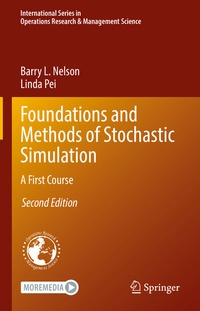
Foundations and Methods of Stochastic Simulation
Description

This graduate-level textbook covers modelling, programming and analysis of stochastic computer simulation experiments, including the mathematical and statistical foundations of simulation and why it works. The book is rigorous and complete, but concise and accessible, providing all necessary background material. Object-oriented programming of simulations is illustrated in Python, while the majority of the book is programming language independent. In addition to covering the foundations of simulation and simulation programming for applications, the text prepares readers to use simulation in their research. A solutions manual for end-of-chapter exercises is available for instructors.
More details
Other editions
Additional editions
Persons
Barry L. Nelson is the Walter P. Murphy Professor in the Department of Industrial Engineering and Management Sciences at Northwestern University, US. His research expertise is in the design and analysis of computer simulation experiments on models of stochastic systems, focusing particularly on statistical efficiency and simulation optimization. His application domains include computer-performance modelling, manufacturing systems, financial engineering and transportation. He is a Fellow of INFORMS and IISE.
Linda Pei is a senior Ph.D. student in the Department of Industrial Engineering and Management Sciences at Northwestern University, US. Her research interests are simulation optimization and data science. She designed and developed Python programs for large-scale parallel simulation optimization and was named the Outstanding Teaching Assistant in the department.
Content
Chapter 1: Why Do We Simulate.- Chapter 2: Simulation Programming: Quick Start.- Chapter 3: Examples.- Chapter 4: Simulation Programming with PythonSim.- Chapter 5: Three Views of Simulation.- Chapter 6: Simulation Input.- Chapter 7: Simulation Output.- Chapter 8: Experiment Design and Analysis.- Chapter 9: Simulation Optimization and Sensitivity.- Chapter 10: Simulation for Research.- References.- Index.
