

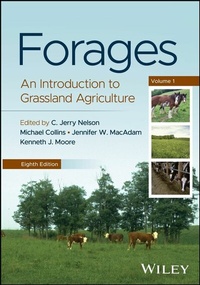
Forages, Volume 1
Description

Comprehensive introduction to forages enabling readers to understand the complexity of grassland ecosystems and their relationships to the wider environment
Forages delivers a balance of scientific principles to aid in reader integration of the concepts as well as practical information on forage identification, plant characteristics, management, and utilization. The coverage of the science behind the plant characteristics and responses make this book applicable to many parts of the world.
This edition has been updated to reflect recent changes in precision planting, fertilization, pest management technologies, new control chemicals, and increasing use of biologicals. The editors have also added a new chapter on forages for conservation and ecological services to discuss the many ways in which forages can be used to mitigate environmental impacts and increase the resilience of agricultural systems. This aspect of forage use has also been highlighted in other chapters throughout the book.
Part I covers the characteristics of forage species. Part II covers establishment, fertilization, and pest management of forages. Part III covers all aspects of forage utilization, grazing systems, and animal management, including the use of GPS collars and drones to control movement of animals.
Sample topics discussed in Forages include:
- Forages' ability to reduce soil erosion, filter nutrients from water, and increase the water- and nutrient-holding capacity of the soil while also providing tons of feed per acre
- The state of forages and grasslands in a changing world and the structure and morphology of grasses, legumes, and other forbs
- Forage crops for bioenergy and industrial products
- Forage-related animal disorders, grazing management services guidelines, and management of grassland ecosystems
Forages is an essential textbook for undergraduates studying forages and an excellent reference for all individuals working in industry, government, and organizations involved with the use of forages.
More details
Other editions
Additional editions
Persons
C. Jerry Nelson, Emeritus Curators' Professor of Plant Sciences at the University of Missouri, USA. His research focuses on growth of grasses and persistence of legumes and he is active in agriculture-related international programs.
Michael Collins, Emeritus Professor and former Director of the Division of Plant Sciences at the University of Missouri, USA.
Kenneth J. Moore, Charles F. Curtiss Distinguished Professor in Agricultural and Life Sciences and Professor of Agronomy at Iowa State University, USA.
Content
List of Contributors vii
Foreword and Dedication xi
Preface xiii
The Metric System xv
In Praise of Bluegrass xvii
Part I Characteristics of Forage Species 1
1 Forages and Grasslands in a Changing World 3
C. Jerry Nelson Michael Collins Jennifer W. MacAdam and Kenneth J. Moore
2 Structure and Morphology of Grasses 19
Shelby M. Gruss and Kenneth J. Moore
3 Structure and Morphology of Legumes and Other Forbs 37
Robert B. Mitchell and C. Jerry Nelson
4 Physiology of Forage Plants 53
Jennifer W. MacAdam and C. Jerry Nelson
5 Environmental Aspects of Forage Management 71
Jeffrey J. Volenec and C. Jerry Nelson
6 Grasses for Northern Areas 89
Michael Collins C. Jerry Nelson and Vern S. Baron
7 Grasses for Southern Areas 105
Daren D. Redfearn and C. Jerry Nelson
8 Legumes for Northern Areas 119
Jacob M. Jungers Craig C. Sheaffer and C. Jerry Nelson
9 Legumes for Southern Areas 135
Lynn E. Sollenberger and Michael Collins Copyrighted Material
10 Forage Crops for Bioenergy Industrial Products and Human Foods 151
Jacob M. Jungers and Kenneth J. Moore
11 Forages for Soil Conservation and Other Ecosystem Services 165
S. Carolina Córdova and Kenneth J. Moore
Compendium of Common Forages 177
Kenneth J. Moore and Shelby M. Gruss
Part II Forage Management 233
12 Forage Establishment 235
Rocky W. Lemus and Jennifer W. MacAdam
13 Forage Fertilization and Nutrient Management 249
David J. Barker Marilia B. Chiavegato and Michael Collins
14 Integrated Pest Management in Forages 269
E. Scott Flynn Lisa L. Baxter and Kenneth J. Moore
Part III Forage Utilization 283
15 Forage Quality 285
Yoana C. Newman and Michael Collins
16 Forage Utilization 303
Michael Collins and Kenneth J. Moore
17 Forage- Related Animal Disorders 317
Ali M. Missaoui Nikolay M. Filipov and Michael Collins
18 Preservation of Forage as Hay and Silage 337
Glenn E. Shewmaker Jennifer W. MacAdam and Michael Collins
19 Grazing Management Systems 359
Robert L. Kallenbach and Michael Collins
20 Managing Grassland Ecosystems 377
John A. Guretzky and C. Jerry Nelson
Appendix: Common and Botanical Names of Forages 395
Glossary 407
Index 423
