

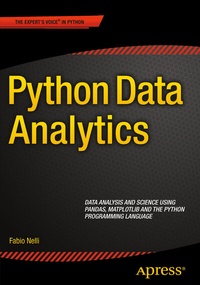
Python Data Analytics
Description

Author Fabio Nelli expertly shows the strength of the Python programming language when applied to processing, managing and retrieving information. Inside, you will see how intuitive and flexible it is to discover and communicate meaningful patterns of data using Python scripts, reporting systems, and data export. This book examines how to go about obtaining, processing, storing, managing and analyzing data using the Python programming language.
You will use Python and other open source tools to wrangle data and tease out interesting and important trends in that data that will allowyou to predict future patterns. Whether you are dealing with sales data, investment data (stocks, bonds, etc.), medical data, web page usage, or any other type of data set, Python can be used to interpret, analyze, and glean information from a pile of numbers and statistics.
This book is an invaluable reference with its examples of storing and accessing data in a database; it walks you through the process of report generation; it provides three real world case studies or examples that you can take with you for your everyday analysis needs.
Reviews / Votes
"The book is named 'Python Data Analytics' and it provides exactly what it says. It shows you how to use Python step-by-step for Data Analytics. The important libraries in Python - NumPy, Pandas, MatPlotLib are presented in literally step-by-step introduction - from their installation to about 70-80 % of their properties and functions. . if you need Python for data analysis this book is quite ok. With step by step approach, you will become fluent in what you write . ." (Vitosh Academy, vitoshacademy.com, September, 2015)
More details
Other editions
New editions
Additional editions
Person
Content
1. Setup Your Environment
2. Automation Scripts
PART II
3. Where and How to Get Data
4. Introduction to pandas
5. pandas In-Depth
6. Python Data Visualizations with matplotlib
7. Designing Beautiful Graphs
8. Analyze Text Data with Natural Language Processing
PART III9. Full Example project 1
10. Full Example project 2
11. Full Example project 3
Appendix A
Appendix B
