

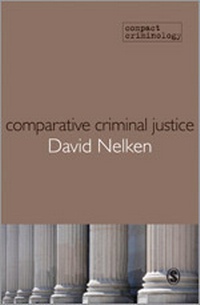
Comparative Criminal Justice
Making Sense of Difference
1st Edition
Published on 22. April 2010
136 pages
978-1-4462-4833-1 (ISBN)
Description

David Nelken is the 2013 laureate of the Association for Law and Society International Prize
The increasingly important topic of comparative criminal justice is examined from an original and insightful perspective by David Nelken, one of the top scholars in the field. The author looks at why we should study crime and criminal justice in a comparative and international context, and the difficulties we encounter when we do.
Drawing on experience of teaching and research in a variety of countries, the author offers multiple illustrations of striking differences in the roles of criminal justice actors and ways of handling crime problems. The book includes in-depth discussions of such key issues as how we can learn from other jurisdictions, compare 'like with like', and balance explanation with understanding - for example, in making sense of national differences in prison rates. Careful attention is given to the question of how far globalisation challenges traditional ways of comparing units. The book also offers a number of helpful tips on methodology, showing why method and substance cannot and should not be separated when it comes to understanding other people's systems of justice.
Students and academics in criminology and criminal justice will find this book an invaluable resource.
Compact Criminology is an exciting series that invigorates and challenges the international field of criminology.
Books in the series are short, authoritative, innovative assessments of emerging issues in criminology and criminal justice - offering critical, accessible introductions to important topics. They take a global rather than a narrowly national approach. Eminently readable and first-rate in quality, each book is written by a leading specialist.
Compact Criminology provides a new type of tool for teaching, learning and research, one that is flexible and light on its feet. The series addresses fundamental needs in the growing and increasingly differentiated field of criminology.
The increasingly important topic of comparative criminal justice is examined from an original and insightful perspective by David Nelken, one of the top scholars in the field. The author looks at why we should study crime and criminal justice in a comparative and international context, and the difficulties we encounter when we do.
Drawing on experience of teaching and research in a variety of countries, the author offers multiple illustrations of striking differences in the roles of criminal justice actors and ways of handling crime problems. The book includes in-depth discussions of such key issues as how we can learn from other jurisdictions, compare 'like with like', and balance explanation with understanding - for example, in making sense of national differences in prison rates. Careful attention is given to the question of how far globalisation challenges traditional ways of comparing units. The book also offers a number of helpful tips on methodology, showing why method and substance cannot and should not be separated when it comes to understanding other people's systems of justice.
Students and academics in criminology and criminal justice will find this book an invaluable resource.
Compact Criminology is an exciting series that invigorates and challenges the international field of criminology.
Books in the series are short, authoritative, innovative assessments of emerging issues in criminology and criminal justice - offering critical, accessible introductions to important topics. They take a global rather than a narrowly national approach. Eminently readable and first-rate in quality, each book is written by a leading specialist.
Compact Criminology provides a new type of tool for teaching, learning and research, one that is flexible and light on its feet. The series addresses fundamental needs in the growing and increasingly differentiated field of criminology.
Reviews / Votes
An accessible, engaging and sophisticated introduction to the challenges of truly comparative research on crime, criminal justice and penal policy-making. This is a gem of a book, that should help to place comparative studies where they belong, at the heart of the criminological enterprisePaul Roberts
University of Nottingham
Comparative scholarship is riven with carelessness, and this primer shows us how to do it right. Both beginning students and advanced scholars alike have much to gain by a patiently working through this book. The book is not just for criminologists; it can be read with profit by anthropologists, political scientists, sociologists, legal scholars--indeed anyone who engages in comparative analysis on any topic. In short, all of us
Malcolm M. Feeley
University of California at Berkeley ,
This succinct yet sophisticated, learned and challenging tour de force highlights the pitfalls and problems of comparative research, but the even greater perils of ignoring the diversity of cultural approaches to crime and criminal justice. A definitive analysis by the leading scholar in the field
Robert Reiner,
Professor of Criminology, Law Department, London School of Economics
Comparative Criminal Justice provides a challenging perspective on comparative criminological enquiry. It is thought provoking throughout, particularly for the comparative researcher but also for criminologists looking to find broader underpinnings of their work. [Nelken] carefully sets comparative research as not a fringe endeavour but as part and parcel of criminology... The invitation to engage in comparative research that I perceive in Nelken's book is therefore extended well beyond those who think of themselves as comparatists but to criminology as a whole
International Journal of Law, Crime and Justice
...the book is not just a stimulating commentary on comparative research but also an introduction to the now impressive oeuvre of a productive and innovative thinker
Tom Daems
University of Leuven in Panopticon
The book is an extremely learned discussion of the goals, the assumptions, the implications and the methods of comparing criminal justice systems. The arguments are enriched by a number of examples drawn from the literature, with a particular attention to recent studies...Overall, the book is extremely enriching and inspiring. The author poses a number of extremely relevant questions and provides the reader with clues and suggestions for finding the most appropriate answers
European Journal on Criminal Policy and Research
David Nelken... presents a basic programme for a reflexive approach to research on criminal justice that is sensitive to the differing cultural backgrounds and framings of national-state criminal justice systems....Being able to question ones-self and becoming aware of one's own culturally shaped starting points - which at first glance appears self-evident - has not yet succeeded in gaining the status of a common practice in a comparative criminology dominated by Anglo- Saxon scholars. Probably Nelken owes his critical awareness to his many years of experience working as a British criminologist in Italy. The more readers can benefit from this, the more optimistic we may allow ourselves to be about the prospects of the discipline itself
Criminal Law Forum
David Nelken asks important questions of, and offers helpful insights into, the enterprise of comparative legal studies. ..will serve as a useful text, at both the graduate and undergraduate levels, for courses in criminology, law and society, legal studies, sociology, and comparative law
James NolanLaw and Society Review -- UK Reviewsall
All prices
More details
Series
Language
English
Place of publication
London
United Kingdom
Target group
College/higher education
ISBN-13
978-1-4462-4833-1 (9781446248331)
Copyright in bibliographic data and cover images is held by Nielsen Book Services Limited or by the publishers or by their respective licensors: all rights reserved.
Schweitzer Classification
Other editions
Additional editions
Book
04/2010
1st Edition
SAGE Publications Ltd
€163.68
Article exhausted; check different version
Book
04/2010
1st Edition
SAGE Publications Ltd
€68.30
Shipment within 15-20 days
Person
David Nelken is Professor of Sociology and Director of the Institute of Sociology at the University of Macerata in Italy. He is also visiting Professor of Law (Criminology) at University College London where he was previously Reader in Law. His book The Limits of the Legal Process (Academic Press, 1983) gained an American Sociological Association Distinguished Scholar Award. He is general editor of the International Library of Criminology and Criminal Justice (Dartmouth) for whom he is editing a volume on White-Collar Crime. He will also shortly be publishing a book with N Passas on Controlling EC Fraud and for Pluto Press a book entitled Law's Truth.
CONTRIBUTORS OUTSIDE WESTERN HEMISPHERE
Nelken: Futures of Criminology
Stanley Cohen Hebrew University Jerusalem
Wayne Morrison Queen Mary and Westfield College, London
Massimo Pavarini University of BolognaPeter Rush University of Lancaster
Alison Young University of Lancaster
CONTRIBUTORS OUTSIDE WESTERN HEMISPHERE
Nelken: Futures of Criminology
Stanley Cohen Hebrew University Jerusalem
Wayne Morrison Queen Mary and Westfield College, London
Massimo Pavarini University of BolognaPeter Rush University of Lancaster
Alison Young University of Lancaster
Content
Changing Paradigms
Why Compare?
Just Comparison
Ways of Making Sense
Explaining too Much?
The Challenge of the Global
Whose Sense?
Why Compare?
Just Comparison
Ways of Making Sense
Explaining too Much?
The Challenge of the Global
Whose Sense?
