

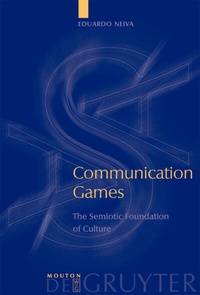
Communication Games
Description

Communication Games is a new and radical interpretation of the relationship between culture and communication. It explores the idea that culture and communication studies should be seen predominantly in relation to struggles and conflicts within the social arena.
It criticizes the conventional heritage of the social sciences and humanities. Culture and communication are conceived not merely as means of integrating social actors, but as semiotic ways of providing fitness indicators that allow for the resolution of competition between individuals.
From the perspective of Peircean semiotics and the Darwinian understanding of life processes, Communication Games redefines culture in terms of Darwin's notion of sexual selection. Moving on from the realization that sexual selection creates individual organisms with conflicting interests, Communication Games emphasizes the contribution of game theory to semiotics and communication studies.
The book demonstrates how cooperation and shared conventions eventually emerge, and how conflicts are resolved through the display of costly and inflated signs. It is from these inflated signs and the escalation of excessive messages that cultures gain a certain degree of stability.
Communication Games
proposes a new way of understanding culture, communication, and semiotic exchange in terms of game theory.
Reviews / Votes
Over the past twenty years the insights of semiotics have inspired and guided research across the whole spectrum of the humanities - from anthropology to queer theory, from literary history to film studies, from philosophy to art history. Yet with time the imbalances and fault lines within the original core of semiotic theory have also emerged, or half emerged. Neiva names and defines a set of problems that semiotics must finally resolve - before the whole engine runs out of steam. A daring, inventive, passionately original book, this is essential reading for everyone concerned with culture, signs, meanings, subjects. Norman Bryson Blending social history with evolutionary biology, Eduardo Neiva shows how sexual selection impacts cultural practice through complex communicative exchange. Debunking conventional explanations of cultural development, the author employs a massive body of evidence ranging from the bloody battlegrounds of ancient conflict to the technologically-driven terrain of contemporary life to fashion an intriguing argument. James Lull, San Jose State UniversityMore details
Other editions
Additional editions
Person
Content
- Intro
- Acknowledgements
- Foreword
- About time
- The historical persistence of total ideologies
- A misleading alternative to total ideologies
- Games, the alternative
- Sex, selection, and culture
- The long road to the canonical conception of culture
- The common descent of nature and culture
- Strategies and Players
- Part 1 Canonical games
- 1. Conflict
- 1.1History, the speeches, and the funeral oration
- 1.2 Pericles' problems
- 1.3 What to praise
- 1.4 In praise of Athenian culture
- 1.5 The city in crisis
- 1.6 The answer before dying
- 2. Coordination
- 2.1 Democracy, warfare, and the political system
- 2.2 The contrast of nature and conventions
- 2.3 To have a civic morality
- 2.4 Starting with signs
- 2.5 Exchanging signs
- 2.6 From signs to values
- 2.7 The political sign
- 3. Contract
- 3.1 Thorns in Augustine
- 3.2 The insufficiency of rhetoric
- 3.3 The importance of wisdom and happiness
- 3.4 The demise of the classical tradition
- 3.5 Undoing a labyrinth of doubts
- 3.6 Among digns
- 3.7 Which meaning?
- 3.8 Signs and things
- 3.9 Knowledge and semiosis
- 3.10 How and where to find the norms
- 3.11 The light within the heart
- Part 2 Ancestral games
- 4. Origin
- 4.1 The anthropological ideology
- 4.2 Cultural cohesion
- 4.3 Nature approximately
- 4.4 Predators and prey in interaction
- 4.5 Cooperation and conflict within species
- 4.6 Signs displayed
- 4.7 A natural typology of human societies
- 4.8 Toward sex
- 5. Sex, signals
- 5.1 The case for individuality
- 5.2 The case for sex
- 5.3 Live sex
- 5.4 The maintenance of sex
- The fall of the virgin lesbians
- 5.5 Winning without winning
- 5.6 Choosing a mate, selecting signs
- 5.7 Signs in a continuously drifting world
- 5.8 Deceptive and honest signalling
- 5.9 Why not deception everywhere?
- 5.10 Truth without conventions
- Part 3 Individual games
- 6. Strategies
- 6.1 Anatomy of the game
- 6.2 Complex utility
- 6.3 Adding up to zero
- 6.4 Pennies for your thoughts
- 6.5 Ruling the game
- 6.6 In equilibrium
- 6.7 Cutting and choosing the slices of a magical pizza
- 7. Players
- 7.1 The storm blast came
- 7.2 A ghastly crew of uncooperative players
- 7.3 Serving time
- 7.4 Unto others
- 7.5 The tit-for-tat blues
- 7.6 Someone's gotta give
- 7.7 It is not yellow
- it is Chicken
- 7.8 Signs of asymmetry and asymmetric players
- 7.9 Types, tokens, and inflated signs
- Afterword
- The cause of conflict between cultures
- Sexualized culture
- The traditional fallacies of cultural semiotics
- The future of cultural semiotics
- Notes
- References
- Index
