

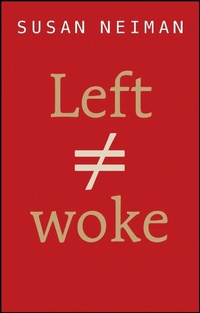
Left Is Not Woke
Description

The confusion arises because woke is fuelled by traditionally leftwing emotions: the wish to stand with the oppressed and marginalized, to address historic crimes. But those emotions are undermined by widespread philosophical assumptions with reactionary sources. As a result, wokeism conflicts with ideas that have guided the left for more than 200 years: a commitment to universalism, a firm distinction between justice and power, and a belief in the possibility of progress. Without these ideas, the woke will continue to undermine their own goals and drift, inexorably and unintentionally, towards the right.
One of the world's leading philosophical voices, Neiman calls with passion and power for the left to return to the ideals that built the best of the modern world.
More details
Other editions
Additional editions
Person
Content
1 Universalism and Tribalism
2 Justice and Power
3 Progress and Doom
4 What's Left?
Acknowledgments
Notes
2
Universalism and Tribalism
Let's begin with the idea of universalism, which once defined the left; international solidarity was its watchword. This was just what distinguished it from the right, which recognized no deep connections, and few real obligations, to anyone outside its own circle. The left demanded that the circle encompass the globe. That was what standing left meant: to care about striking coal miners in Wales, or Republican volunteers in Spain, or freedom fighters in South Africa, whether you came from their tribes or not. What united was not blood but conviction - first and foremost the conviction that behind all the differences of time and space that separate us, human beings are deeply connected in a wealth of ways. To say that histories and geographies affect us is trivial. To say that they determine us is false.
It's certain that shared experiences and histories create particular bonds. We all tend to trust those whose codes we needn't work to crack, whose jokes we get in an instant, whose allusions we recognize immediately. It takes an act of abstraction to become a universalist. Learning languages, and immersing yourself in other cultures, will make that abstraction concrete, but not everyone is as gifted as the great artist and activist Paul Robeson. Yet even without his talents, there are plenty of ways to share, if not to fully enter, other peoples' cultures. You'll never have the same relationship to a culture as do those who fell asleep to its lullabies. But good literature, film, and art can work wonders.
The opposite of universalism is often called 'identitarianism,' but the word is misleading, for it suggests that our identities can be reduced to two dimensions, at most. In fact, all of us have many, whose importance will vary in space and in time throughout our lives. As the philosopher Kwame Anthony Appiah reminds us:
Until the middle of the twentieth century, no one who was asked about a person's identity would have mentioned race, sex, class, nationality, region or religion.1
We are all someone's children, a fact that recedes in importance if we are busy raising our own, but you need only step into your parents' home to shift back to the moment when your primary identity was 'child.' It shifts again when you leave your lover in the morning to take up a professional role at work. Is one of these identities more essential to you than the other? Always? Those shifts of identity are fairly universal, but there are many more. A politically engaged person cannot think of herself as indifferent to politics; a passionate soccer fan cannot envision her identity without loyalty to her home team. Not everyone identifies with whatever they do to make a living, but for those of us who do, imagining ourselves as ourselves with an entirely different profession is to imagine a rudderless void.
Depending on the person, those components of identity are at least as important as the two that identity politics insists we consider: ethnic and gender identity. A moment's reflection shows even those to be less determinate than supposed. The life of a black person is dramatically different in America and Nigeria, as Chimamanda Adichie so brilliantly showed in Americanah. And being Nigerian is only an identifying description outside the country; in a land whose citizens are divided by fraught histories and more than five hundred languages, saying you're Nigerian means nothing at all. Being a Jew in Berlin and a Jew in Brooklyn are experienced so differently that I can assure you they amount to different identities. A Jew in Tel Aviv has another identity again; but a Jew who was born in Tel Aviv has a fundamentally different stance in the world than a Jew who moves there later in life. Is there an Indian identity that holds equally for Hindus and Muslims, Brahmins and Dalits? Can you identify someone as gay without mentioning whether he lives in Tehran or Toledo? The historian Benjamin Zachariah comments:
Once upon a time, essentializing people was considered offensive, somewhat stupid, anti-liberal, anti-progressive, but now this is only so when it is done by other people. Self-essentializing and self-stereotyping are not only allowed but considered empowering.2
Those who condemned essentializing not two decades past are now content to whittle all the elements of our identity down to two. Recent efforts to increase diversity often appeal to the importance of having people in positions of authority who "look like me." It's a remarkably childlike expression, but what do children actually see? People whose heritage is (at least partly) African can have the widest variety of skin tones and hair textures; nor are skin tone or hair texture the only visual qualities we perceive. A child told of someone who "looks like her" might just as well ask: is she taller or shorter? Fatter or thinner? Older or younger? And what about gender?
No one will deny that visual identities are important. When I was a child, people considered attractive in America were not only white but blond. For those of us who weren't, it was a relief when Barbra Streisand entered the limelight, even more when attention turned to Angela Davis. Different as they were, both were beautiful, and neither looked like Marilyn Monroe. The woke movement has made us aware that white was not considered to be an identity at all but something between norm and neutrality, as crayons labelled flesh-colored suggested that all flesh was pasty pink. Diversity is a good. It just isn't the only one. I'm not the first to point out that diversifying power structures without asking what the power is used for can simply lead to stronger systems of oppression. Nor does it stop with conservative governments appointing the formerly marginalized. At Ian Malcolm's suggestion, Canadian comedian Ryan Long interviewed a variety of bystanders on the question of whether offshore interrogators, which is CIA-speak for torturers, should become more diverse. The fact that he was taken seriously is not funny at all.3
The reduction of the multiple identities we all possess to race and gender only appears to be a question of looks. The focus on two dimensions of human experience is a focus on those dimensions that experienced the most trauma. Identity politics embodies a major shift that began in the mid twentieth century: the subject of history was no longer the hero but the victim.4 Two world wars had undermined the urge to valorize traditional forms of heroism. The impulse to shift our focus to the victims of history began as an act of justice. History had been the story of the victors, while the victims' voices went unheard. This condemned the victims to a double death: once in the flesh, once again in memory. To turn the tables and insist that the victims' stories enter the narrative was just a part of righting old wrongs. If victims' stories have claims on our attention, they have claims on our sympathies and systems of justice. When slaves began to write their memoirs, they took steps toward subjectivity and won recognition - and slowly but certainly, recognition's rewards.
So the movement to recognize the victims of slaughter and slavery began with the best of intentions. It recognized that might and right often fail to coincide, that very bad things happen to all sorts of people, and that even when we cannot change that we are bound to record it. As an alternative to preceding millennia, when the survivor of a massacre by Roman legions or Mongol invaders could expect no more than a laconic "shit happens," this was a step toward progress. Yet something went wrong when we rewrote the place of the victim; the impulse that began in generosity turned downright perverse. The limiting case of this trend is the story of Benjamin Wilkomirski, the Swiss man whose claims to have spent his childhood in a concentration camp turned out to be invented. Earlier rogues sought to hide troubled origins, inventing aristocratic genealogies as a way to climb. Anyone, after all, might be the son of an errant knight or a wayward pope. Now that cachet has given way to another: claiming a more miserable birth than your true one guarantees new forms of status.
Wilkomirski was hardly alone. To escape racist discrimination, light-skinned African Americans once passed as white, leaving families behind to live freer if sadder lives in the dominant class. Recently, however, several white Americans have lost jobs they gained by falsely passing as black. An African American actor was jailed for staging a racist attack on himself.5 A Jewish German pop star provoked attention and outrage by inventing an antisemitic incident hundreds of hours of police investigations could not confirm.6 Orchestrated victimhood is perfidious because it mocks the victims of real racist attacks, but I'm less interested now in the consequences than in the fact that they're possible at all. What was recently a stigma has become a source of standing. Where painful origins and persecution were once acknowledged, as in Frederick Douglass's narratives, the pain was a prelude to overcoming it. Prevailing over victimhood, as Douglass did, could be a source of pride; victimhood itself was not. The rash of contemporaries inventing worse histories than they experienced is something new.
Fraudulent claims to status are nothing special; just think how many embellish war experiences to center themselves in heroic...
