

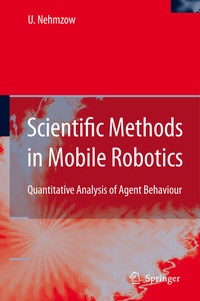
Scientific Methods in Mobile Robotics
Description

Mobile robotics has until now focused on issues like design of controllers and robot hardware. It is now ready to embrace theoretical methods from dynamical systems theory, statistics and system identification to produce a formalized approach based on quantitative analyses and computer models of the interaction between robot, task and environment.
This book is a step towards a theoretical understanding of the operation of autonomous mobile robots. It presents cutting-edge research on the application of chaos theory, parametric and non-parametric statistics and dynamical systems theory in this field. Practical examples and case studies show how robot behaviour can be logged, analysed, interpreted and modelled, aiding design of controllers, analysis of agent behaviour and verification of results.
As the first book to apply advanced scientific methods to mobile robots it will interest researchers, lecturers and post-graduate students in robotics, artificial intelligence and cognitive science.
Reviews / Votes
This is the first book to apply advanced scientific methods to the growing field of mobile robots. It will be bought by researchers lecturers in robotics, artificial intelligence and cognitive science and post-graduates in this subject.
More details
Other editions
Additional editions
Person
Dr Ulrich Nehmzow is a Senior Lecturer at the Department of Computer Science at the University of Essex, UK. The Robotics group in this department is the largest in the UK and considered to be one of the world's leading in this subject.
Dr Nehmzow is the publisher of the SV London textbook, Mobile Robotics: A Practical Introduction , now in its second edition (1-85233-726-5, 2003). He has over ten years' experience in mobile robotics and is considered to be an authoritative researcher in the experimental end of the subject. The author has recently commenced a one-year research sabbatical at the University of Wollongong, Australia. He aims to use some of this year writing his book.
