

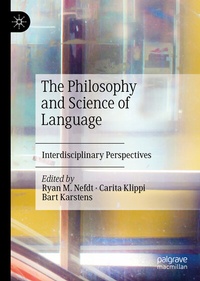
The Philosophy and Science of Language
Description

This volume brings together a diverse range of scholars to address important philosophical and interdisciplinary questions in the study of language. Linguistics throughout history has been a conduit to the study of the mind, brain, societal structure, literature and history itself. The epistemic and methodological transfer between the sciences and humanities in regards to linguistics has often been documented, but the underlying philosophical issues have not always been adequately addressed.
With 15 original and interdisciplinary chapters, this volume therefore tackles vital questions relating to the philosophy, history, and theoretical interplay between the study of language and fields as varied as logic, physics, biology, classical philology and neuroscience.
With a four part structure, questions of the mathematical foundations of linguistics, links to the natural sciences, cognitive implications and historical connections, take centre stage throughout thevolume. The final chapters present research related to the linguistic connections between history, philosophy and the humanities more broadly. Advancing new avenues of research, this volume is exemplary in its treatment of diachronic and cross-disciplinary interaction, and will be of interest to all scholars interested in the study of language.
More details
Other editions
Additional editions
Persons
Ryan M. Nefdt
, Lecturer in Philosophy, University of Cape Town, South Africa. He is a visiting fellow at the Pittsburgh Center for the Philosophy of Science and has published numerous works in the philosophy of linguistics and language.
Bart Karstens , Research Fellow at the Rathenau Institute, The Hague, and member of the Vossius Center for the History of Humanities and Sciences at the University of Amsterdam, The Netherlands.
